
My First Six Months in PR or: How I Learned to Stop Worrying and Love the Job by Heather Sliwinski

About one week into my job, I wondered if I oversold myself during my interviews. I’m not saying I lied—no one should ever lie in an interview—but I had to question if I made it clear that I had zero PR experience when I landed my first position at a PR agency in August.

I took the advertising and PR classes in college, toiled at the obligatory unpaid internships in marketing and promotions and gained more than two years of marketing experience after graduation. With that said, I still didn’t know what a media list or subject matter expert was.

I had a lot to learn, not only about our clients’ businesses, but also the business of PR; I was terrified.

I had more than a few sleepless nights in the beginning, worrying about how I was going to tackle my projects. But in the past six months, I’ve embraced agency life and realized that, when it came to my early fears, there was more than met the eye:

Phone pitching is daunting.

I’ve never been a big phone talker. Calling up complete strangers (reporters) and telling them to cover a story idea made me feel like a telemarketer. I couldn’t believe that this was a common practice in PR. Why would a reporter care about me, someone they’ve never met, and my client, a company they’ve never heard of? Little did I know, with a good story idea, a knowledgeable expert and some flexibility, reporters do care.

Phone pitching is part trial and error and part knowing your stuff. I still get intimidated by phone pitching, but when we have a great idea, know our client’s expertise and go into the call with the intent of having a conversation, the results are always positive.

Plus, reporters are just people, too.

Media lists are crucial.

If you start with the wrong reporter, your pitching will get you nowhere. My first media lists were terrible. I relied on Cision to tell me who to pitch, rather than going to the source and figuring out who would want to cover our story. Having reporter history and past articles is great ammo for pitching and makes having an intelligent conversation with a reporter much easier.

My colleagues had me work and rework the early media lists, partly because I didn’t know Cision could be wrong (I would say it’s 50/50 on being right/wrong about a reporter’s beat). I feel that I am getting better at gauging who would cover a story, and I still edit, add and delete as I get on the phone with folks.

Seeing red doesn’t make you a bad writer.

My roots are in journalism: up until sophomore year of college, I thought I was going to be a reporter. I have adequate knowledge of AP style and proper grammar. I’ve been published in a few outlets. I thought I was a decent writer. When I started writing for PR, I lost most of my confidence.

My press releases, emails, media alerts, pitches—anything I wrote, really—came back with red ink all over the page. Seeing all the edits was definitely a blow to my ego. In time, I’ve seen that seeing red actually makes you a better writer. Considering I came from marketing, I wasn’t expected to know how to write a pitch. My writing style was much more focused on sales for marketing purposes, where PR is more about featuring news. My writing evolved. I learned to dig deep into a pitch and figure out where the story is, and I see less and less red as a result.

Social media isn’t the devil.

After coming from a few corporate cultures where using social media at work is frowned upon, I was excited to see that not only was I allowed to use social media at work, it was encouraged! The transition was difficult in the beginning. I felt a little naughty, checking Twitter for updates, retweeting during the workday and actually responding to messages between 9 a.m. and 5 p.m.

Social media is part of my job, and I’m expected to stay on top of the news, retweet important content and interact with journalists during the day. I’ve had a handful of pitches that have sprouted from a breaking news tweet or friendly correspondence with a reporter. You never know what future opportunity can come out of social media.

You always have something to bring to the table.

When I joined my agency, I didn’t know what a ProfNet was. I didn’t know how to use Cision. I didn’t know how to write an expert available pitch. I knew nothing about my clients. Having every task in your job be completely new can weigh heavily on you.

However, not knowing the PR ropes didn’t mean that I didn’t have unique skills to contribute. Being a relative news junkie, I was able to spot breaking news stories and find angles where our clients could comment. My background in marketing has lent to assisting one of our clients with a website revamp. Having knowledge of graphic design programs allows us to offer additional design services to our clients, if needed.

And, we all have ideas. I was reserved in meetings, reluctant to share my thoughts. What do I know? I’m the new kid—my colleagues are the experts. But, we all read different publications and have different skills, experiences and approaches to thinking. I try to share my opinion more now, since there is no ‘wrong’ in brainstorming. No matter your level of PR knowledge, the next big idea could be yours.

My first six months in PR were definitely a roller coaster. I’m still adjusting and always learning, which I don’t think will ever go away. If we’re lucky, we’ll keep adding new clients, changing the game all over again. PR is never dull, and much like snowflakes, no two days in PR are ever the same.

While the unknown of each day used to stress me out, I try not to waste my energy worrying about what I don’t know and instead revel in the small victories that make it all worthwhile: being ahead of breaking news to land our client in the New York Times, securing an interview with a Reuters reporter, watching our client on live TV at 7 in the morning.

Don’t you just love PR?

What were some of your biggest challenges when you started your first PR job? Did you recently transition to PR from another field? Share your experiences below!

Heather SliwinskiHeather Sliwinski is an account executive at KemperLesnik, a Chicago-based public relations agency, providing media relations and social media services to a variety of B2B clients. She has held positions in marketing and event planning for corporations, nonprofits and higher education. She earned a bachelor’s degree in journalism and mass communications with an emphasis in strategic communications from the University of Wisconsin-Madison. Sliwinski is the blog co-chair for the PRSA New Professionals Section. Feel free to connect with her on LinkedIn or Twitter.
Never Stop Learning: Why Having a Mentor is Crucial as a Young Professional by Brandi Boatner and Kate Enos

Albert Einstein once said, “”Intellectual growth should commence at birth and cease only at death.”

Yes, we’ve checked the boxes: graduated from high school, received a diploma in college and got our first, second or third job. But that doesn’t mean learning should ever stop, especially in the workplace.

In public relations, all the classes in the world can’t teach you what you learn while on the job. The art of managing tight deadlines, heavy demands and expecting the unexpected isn’t on any syllabus. But there is one resource that remains untapped and full of knowledge – those who have blazed the trails before us in the world of public relations, otherwise known as mentors.

January marked National Mentoring Month, a celebration of those who choose to dedicate valuable time and energy into the next generation of professionals. No matter your age and title, everyone can use a mentor.

The trick is finding a mentor.

According the New York Times, it won’t happen overnight. Here a few tips and tricks to finding the right match for you:

  • Time: It takes time to cultivate relationships and to see if the chemistry fits to make a match.
  • Industry: Find someone in communications and public relations if that’s the career path you see yourself in.
  • Commitment: Make sure your potential mentor is willing to put time into meeting regularly and making you a priority.
  • Goals: Set goals, and know your strengths and weaknesses before you meet with a mentor.

Mentoring is not only for those who are seasoned practitioners in the field. New professionals in the industry can also be mentors through “reverse mentoring”.

Recently, the Wall Street Journal found “many businesses are pairing upper management with younger employees in a practice known as reverse mentoring. The trend is taking off at a range of companies, from tech to advertising.”   

With the advent of social media, new technologies and innovative marketing techniques, businesses across a variety of industries recognize the skills, knowledge and expertise young professionals bring to an organization, thereby benefiting all employees.

Your mentor is out there – all you have to do is ask. So, what are you waiting for?


Brandi Boatner and Kate Enos are the PRSA New Professionals Section mentorship co-chairs.

PRSA New Pros Tweetchat – Promoting YOU: PR Tips for Networking, Landing a Job and Moving Up Recap

PRSA New Professionals Section hosted its first Tweetchat last week. Two experts shared advice on the art of self-promotion.

On Tuesday, October 25, PRSA New Professionals Section held it first tweetchat with Meryl Weinsaft Cooper and Jessica Kleiman, the authors of our July Summer Book Club selection, “Be Your Own Best Publicist: How to Use PR Techniques to Get Noticed, Get Hired and Get Rewarded at Work”. #NPchat participants gathered to hear Cooper and Kleiman shared great advice for networking and getting ahead in your PR career.

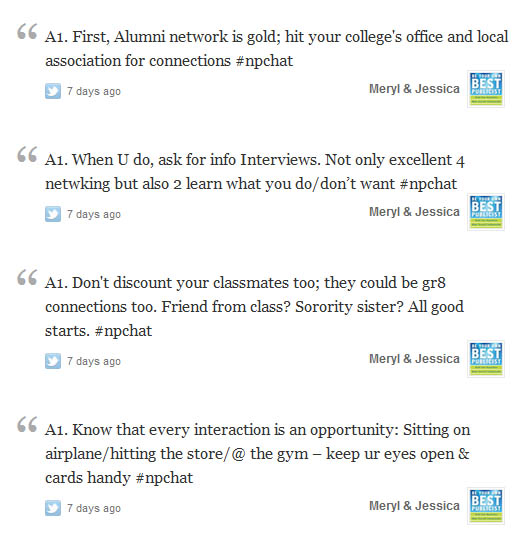
Boy were the tweets moving fast and furiously across our timeline. From the first question to the last, the chat provided valuable advice for recent graduates looking to kick start their career and new pros striving to get to the next level. We kicked the discussion off with best way to network as a new graduate. Here are a few tweets of advice from our authors:

If you weren’t able to stop by our #NPchat or want to access the transcript of the event, click here. The response to this event was positive, and we thank everyone who attended.


If you have topics you’d like to read about on our blog or discuss on a future Tweetchat, comment below, Tweet @PRSANewPros or share on our Facebook and LinkedIn pages. If you really want to get involved, fill out our volunteer interest form and be a part of our 2012 Executive Committee!

New Professionals Section Tweetchat—Promoting YOU: PR Tips for Networking, Landing a Job and Moving Up

Working in the public relations field, promoting our clients or organizations is the root of what we do. We leverage Twitter, blogs, networking and traditional media to garner the highest praise for our client. When it comes to promoting ourselves for a better position, a higher salary or maybe even our first job, new PR professionals may come up short since we’re used to working behind the scenes.

The PRSA New Professionals Section wants to answer those burning questions you have about how to network effectively, how to stand out in a saturated job candidate pool and how to continue progressing in your PR career. This Tuesday, October 25, the New Professionals Section will be hosting its first Tweetchat with the authors of our July Summer Book Club book, “Be Your Own Best Publicist: How to Use PR Techniques to Get Noticed, Get Hired and Get Rewarded at Work”. Jessica Kleiman and Meryl Weinsaft Cooper will be live Tweeting at 7:15 p.m. EST with the PRSA New Professionals Section.

How to Join the Conversation

We will be posing questions from the PRSA New Professionals Section handle, with Kleiman and Weinsaft Cooper providing insight from their handle. You can follow both @PRSANewPros and @BestPublicist on Twitter, or simply monitor the #npchat hashtag to see what the whole Twitterverse is saying.

Didn’t get a chance to read the book? No worries. Read Blog Co-Chair Diahnn Henderson’s discussion of the book to get a preview of the advice you’ll gain during the chat.

Don’t miss this opportunity to hear from two experts in PR, publicity and personal branding and make yourself indispensable to your current or future employer! Follow #npchat with the New Pros on Tuesday night!

Our featured participants:

Jessica Kleiman is currently VP-public relations for Hearst Magazines, one of the world’s largest publishers of monthly magazines. A graduate of University of Michigan with a BA in Communication, she started her career at a magazine publicity firm and then served as director of PR at The Knot, a wedding media company. In 2011, Kleiman was nominated as “Publicist of the Year” by PR News.  She lives in Brooklyn, NY with her husband and daughter and enjoys posting words she finds funny on Twitter, Facebook and her blog, Funny Word of the Day.

Meryl Weinsaft Cooper is a co-founder and principal of Allen/Cooper Enterprises, a marketing, exhibitions and events company with a focus on art and lifestyle brands.  Previously, as managing director  of the DeVries Public Relations‘ Home & Lifestyle division and as SVP-Partner at LaForce+Stevens, she led programs for a variety of hospitality and consumer brands including Veuve Clicquot, Belvedere Vodka, Pepperidge Farm, Samuel Adams Beer, New Amsterdam Gin and Ecco Domani Wines.  A graduate of Ithaca College’s Park School of Communications, her PR experience includes stints in art, music and entertainment, including time at the Screen Actors Guild’s New York office.  She lives in Brooklyn, NY with her husband and dog, and spends her spare time writing and producing films as well as seeking out the best culinary, travel and art experiences, which she documents in her blog, Searching for Jake Ryan.

Both authors are contributing bloggers on Forbes.com’s Work in Progress section.

Getting the Most Out of PRSA International Conference: 4 Tips for New Pros

So, you’ve registered for the PRSA 2011 International Conference. Now what? All you need to do is pack and relax, right? Well, maybe. This year’s conference is going to rock! Most likely, you’ll leave with a few business cards in hand and, most importantly, the tools and knowledge necessary to take your career to the next level. But, there is much work to be done.

Here are a few tips for new PR pros to help get the most out of conference:

  • Plan your schedule– the International Conference is jam packed with sessions, and it may be hard to choose which ones to attend. By planning ahead, you’ll be able to enjoy the conference more. Look for sessions that relate to your everyday job and ones that might challenge you. As a new PR pro, you may want to consider sessions like “How to Pitch to Overworked Journalists and Harried Bloggers and Come Out Unscathed” or “The Personal Branding Project – Crafting Your Identity.” Sessions like these will help hone your craft and position you to the right audiences, especially if you are looking for a job.
  • Network, network, network – so much of what we do is about creating and retaining relationships with key media and stakeholders. It’s only fitting that in order to excel in this field, we need to make connections with other professionals. You never know where your next job offer will come from, and you never know who might become your mentor. So, don’t be shy–introduce yourself to someone new at each session you attend! A must-attend networking event is the opening-night reception hosted by PRSA Orlando (shameless plug). The reception will be a great way to kick off the conference with other industry professionals from across the country. Other must-attend events include the PRSA Connections Networking Luncheon and the PRSA and Inside PR Tweetup by the lazy river. (Yes. You read that right. There is a lazy river at the hotel. Let’s do this!) 
  • Enjoy Orlando – conference isn’t all work and no play. There will be plenty of time to soak up some sun or venture off property to explore the other side to Orlando.
  • Follow up with your connections – be sure to send personal notes to all the connections you make at conference. You’ll want to keep in touch. In fact, when you get a business card from someone, write a note on the back of the card about what you talked about or where you met them to help jog your memory later.

So, pack your bags and trek on down to Orlando. The awesomeness that is the PRSA International Conference starts in a few short days. Who’s ready for some PR fun in the sun? 

Christina Morton is on the PRSA Orlando Regional Chapter Host Committee. She is an account executive specializing in social media for CBR Public Relations in Maitland, Fla.