Intro to Education PR by Kirsten Khire, APR

Are you ready for a PR career in higher education?

By Kirsten M. Khire, APR

This year marks my 10th anniversary working in higher education public relations, following seven years in journalism. When people ask me what I do, I can predict some of the reactions. “It must be so nice to have the summer off.” Or “What a fun laid-back job!” Oh yes, I’ve come to identify the stereotypes and misconceptions about higher ed PR. For those new PR professionals considering hoping to break into the field, I have more information about working in higher education public relations and communications.

  1. Truth: It’s a very rewarding career. I often tell new interns during orientation that we are promoting one of the best products in existence – education. It’s a universal need and it’s very fulfilling to watch students complete their degrees and succeed. It’s also a thrill to be around faculty members who are researching and teaching new ideas in the field. That energy is genuinely contagious.
  2. False: Higher ed PR pros have the summers off. In my experience, the summer season is definitely quieter in the physical sense because the students and faculty members are mostly on hiatus. But for me, it has traditionally been a heavy production period (particularly in terms of publications and web projects) and a time to plan and strategize.
  3. True and False: It’s a fun, laid-back job. Fun it is, laid back it is not. If you are working for a public university, you are dealing with a non-profit budget, probably budget cuts, and a very small staff. You learn to be creative with your time and your talents. This morning, I created a PowerPoint for the dean, ghostwrote a dean communiqué and gathered photos for 3 fundraising videos – all before noon.
  4. True: Higher education public relations provides a solid public relations foundation. Recently I successfully completed the PRSA Accreditation process. The work I was doing met all of the major PR campaign processes – research, planning, implementation and evaluation. I may not have the budget that a major soft drink company might, but the strategy involved in PR campaigns remains the same.
  5. False: Higher ed PR doesn’t have clear goals. Like any business, higher education has very tangible business metrics. These include student recruitment (tuition dollars), external research funding (grants and contracts from government, foundations and industry) and individual support (donations from alumni and “friends.”) These are extremely real financial goals, and the sooner PR pros plug into them, the better. Public relations can proactively boost the brand and lead to measurable results of objectives.
  6. False: You need specific training for a higher ed PR career. My path is a case in point. As a former journalist, I’m comfortable conducting interviews with faculty members on topics that are unfamiliar or need layperson translation. As with most humans (we are only that!), PR professionals have strengths and areas of growth. Some are wonderful at media relations; others have a background in marketing. The goods news is that universities need a good variety of communications professionals.

All of this is a long-winded introduction to say, if you are still interested in this career, read on. Breaking into higher education PR is not impossible, but you need to be strategic. Having experience in non-profit settings, writing about research and of course being an alum/alumna all help. Pursuing your master’s degree or Accreditation also can help. Above all, networking with and talking to current PR pros in higher education can provide you with insight into the field and valuable connections during the job hunt.

Kirsten Khire is an accredited communications professional with more than 17 years of experience in public relations and journalism, with a focus on strategic, digital, web and social media communications.


My First Six Months in PR or: How I Learned to Stop Worrying and Love the Job by Heather Sliwinski

About one week into my job, I wondered if I oversold myself during my interviews. I’m not saying I lied—no one should ever lie in an interview—but I had to question if I made it clear that I had zero PR experience when I landed my first position at a PR agency in August.

I took the advertising and PR classes in college, toiled at the obligatory unpaid internships in marketing and promotions and gained more than two years of marketing experience after graduation. With that said, I still didn’t know what a media list or subject matter expert was.

I had a lot to learn, not only about our clients’ businesses, but also the business of PR; I was terrified.

I had more than a few sleepless nights in the beginning, worrying about how I was going to tackle my projects. But in the past six months, I’ve embraced agency life and realized that, when it came to my early fears, there was more than met the eye:

Phone pitching is daunting.

I’ve never been a big phone talker. Calling up complete strangers (reporters) and telling them to cover a story idea made me feel like a telemarketer. I couldn’t believe that this was a common practice in PR. Why would a reporter care about me, someone they’ve never met, and my client, a company they’ve never heard of? Little did I know, with a good story idea, a knowledgeable expert and some flexibility, reporters do care.

Phone pitching is part trial and error and part knowing your stuff. I still get intimidated by phone pitching, but when we have a great idea, know our client’s expertise and go into the call with the intent of having a conversation, the results are always positive.

Plus, reporters are just people, too.

Media lists are crucial.

If you start with the wrong reporter, your pitching will get you nowhere. My first media lists were terrible. I relied on Cision to tell me who to pitch, rather than going to the source and figuring out who would want to cover our story. Having reporter history and past articles is great ammo for pitching and makes having an intelligent conversation with a reporter much easier.

My colleagues had me work and rework the early media lists, partly because I didn’t know Cision could be wrong (I would say it’s 50/50 on being right/wrong about a reporter’s beat). I feel that I am getting better at gauging who would cover a story, and I still edit, add and delete as I get on the phone with folks.

Seeing red doesn’t make you a bad writer.

My roots are in journalism: up until sophomore year of college, I thought I was going to be a reporter. I have adequate knowledge of AP style and proper grammar. I’ve been published in a few outlets. I thought I was a decent writer. When I started writing for PR, I lost most of my confidence.

My press releases, emails, media alerts, pitches—anything I wrote, really—came back with red ink all over the page. Seeing all the edits was definitely a blow to my ego. In time, I’ve seen that seeing red actually makes you a better writer. Considering I came from marketing, I wasn’t expected to know how to write a pitch. My writing style was much more focused on sales for marketing purposes, where PR is more about featuring news. My writing evolved. I learned to dig deep into a pitch and figure out where the story is, and I see less and less red as a result.

Social media isn’t the devil.

After coming from a few corporate cultures where using social media at work is frowned upon, I was excited to see that not only was I allowed to use social media at work, it was encouraged! The transition was difficult in the beginning. I felt a little naughty, checking Twitter for updates, retweeting during the workday and actually responding to messages between 9 a.m. and 5 p.m.

Social media is part of my job, and I’m expected to stay on top of the news, retweet important content and interact with journalists during the day. I’ve had a handful of pitches that have sprouted from a breaking news tweet or friendly correspondence with a reporter. You never know what future opportunity can come out of social media.

You always have something to bring to the table.

When I joined my agency, I didn’t know what a ProfNet was. I didn’t know how to use Cision. I didn’t know how to write an expert available pitch. I knew nothing about my clients. Having every task in your job be completely new can weigh heavily on you.

However, not knowing the PR ropes didn’t mean that I didn’t have unique skills to contribute. Being a relative news junkie, I was able to spot breaking news stories and find angles where our clients could comment. My background in marketing has lent to assisting one of our clients with a website revamp. Having knowledge of graphic design programs allows us to offer additional design services to our clients, if needed.

And, we all have ideas. I was reserved in meetings, reluctant to share my thoughts. What do I know? I’m the new kid—my colleagues are the experts. But, we all read different publications and have different skills, experiences and approaches to thinking. I try to share my opinion more now, since there is no ‘wrong’ in brainstorming. No matter your level of PR knowledge, the next big idea could be yours.

My first six months in PR were definitely a roller coaster. I’m still adjusting and always learning, which I don’t think will ever go away. If we’re lucky, we’ll keep adding new clients, changing the game all over again. PR is never dull, and much like snowflakes, no two days in PR are ever the same.

While the unknown of each day used to stress me out, I try not to waste my energy worrying about what I don’t know and instead revel in the small victories that make it all worthwhile: being ahead of breaking news to land our client in the New York Times, securing an interview with a Reuters reporter, watching our client on live TV at 7 in the morning.

Don’t you just love PR?

What were some of your biggest challenges when you started your first PR job? Did you recently transition to PR from another field? Share your experiences below!

Heather SliwinskiHeather Sliwinski is an account executive at KemperLesnik, a Chicago-based public relations agency, providing media relations and social media services to a variety of B2B clients. She has held positions in marketing and event planning for corporations, nonprofits and higher education. She earned a bachelor’s degree in journalism and mass communications with an emphasis in strategic communications from the University of Wisconsin-Madison. Sliwinski is the blog co-chair for the PRSA New Professionals Section. Feel free to connect with her on LinkedIn or Twitter.

Cross-Trained: The Intersection of Marketing and PR

Public relations practitioners new and old have been challenged to adapt to the new PR landscape that includes the understanding of the concept of integrated marketing communications or IMC, as we continue in the digital age.

Imagine a job in a manufacturing factory where every person only knows their individual function. Each one of those factory workers are limited in their understanding of how the products are made. With today’s PR landscape, every factory worker (PR practitioner) must be cross-trained in marketing to truly understand how the PR machine must function.

As a new PR pro, learning how public relations is not an independent study, but encapsulates all of the sciences under the marketing umbrella, including advertising and communications is critical. In this day, the traditional PR department or agency employs various marketing techniques that contribute to a greater PR influence.

The biggest challenge that new professionals face is within the changing PR landscape is learning more about marketing and how marketing directly relates to public relations. Below are four things every new PR pro can do to be cross-trained and propel their PR understanding to new heights:

  1. Read PR and Marketing News – New sites like Forbes, Fortune, Mashable and PR Daily are great resources on up-to-the-minute PR news and trends. Subscribe to their RSS feeds on your personal blog site, or follow their respective Twitter pages to receive news as it breaks. What are some of your favorite industry news outlets?
  2. Seek an experienced mentor – Last week we posted about the importance of PR mentoring for new and experienced professionals as January was National Mentoring Month. Exchanging best practices and experiences with a mentor is a great way to learn and grow.
  3. Practice, practice, practice – Knowledge is useless without application. Anything that you are learning, take time to study it further and put it into action right away. Remember all of those concepts that you learned in college that you never used? Implement all of the knowledge that you find and make yourself sharp.
  4. Engage with your PRSA section – This may seem like a dead giveaway, however PRSA New Professionals host a plethora of events and resources from a quarterly newsletter, blog, Twitter page, teleconferences and more. Get involved and make the most out of your membership!

What are some other things new professionals can do to sharpen their PR skills?

Zaneta Chuniq InpowerZaneta Chuniq Inpower is owner and president of Chuniq PR, an independent media and marketing management firm. Additionally, she is the digital communications coordinator for Douglas J Aveda Institutes and Salons, editor  for Supreme Design Publishing and social media manager for COIN Handlers Management. Her personal interests include reading, international travel and culture and community revitalization. Inpower received her B.A. in advertising from Michigan State University.

Never Stop Learning: Why Having a Mentor is Crucial as a Young Professional by Brandi Boatner and Kate Enos

Albert Einstein once said, “”Intellectual growth should commence at birth and cease only at death.”

Yes, we’ve checked the boxes: graduated from high school, received a diploma in college and got our first, second or third job. But that doesn’t mean learning should ever stop, especially in the workplace.

In public relations, all the classes in the world can’t teach you what you learn while on the job. The art of managing tight deadlines, heavy demands and expecting the unexpected isn’t on any syllabus. But there is one resource that remains untapped and full of knowledge – those who have blazed the trails before us in the world of public relations, otherwise known as mentors.

January marked National Mentoring Month, a celebration of those who choose to dedicate valuable time and energy into the next generation of professionals. No matter your age and title, everyone can use a mentor.

The trick is finding a mentor.

According the New York Times, it won’t happen overnight. Here a few tips and tricks to finding the right match for you:

  • Time: It takes time to cultivate relationships and to see if the chemistry fits to make a match.
  • Industry: Find someone in communications and public relations if that’s the career path you see yourself in.
  • Commitment: Make sure your potential mentor is willing to put time into meeting regularly and making you a priority.
  • Goals: Set goals, and know your strengths and weaknesses before you meet with a mentor.

Mentoring is not only for those who are seasoned practitioners in the field. New professionals in the industry can also be mentors through “reverse mentoring”.

Recently, the Wall Street Journal found “many businesses are pairing upper management with younger employees in a practice known as reverse mentoring. The trend is taking off at a range of companies, from tech to advertising.”   

With the advent of social media, new technologies and innovative marketing techniques, businesses across a variety of industries recognize the skills, knowledge and expertise young professionals bring to an organization, thereby benefiting all employees.

Your mentor is out there – all you have to do is ask. So, what are you waiting for?


Brandi Boatner and Kate Enos are the PRSA New Professionals Section mentorship co-chairs.

PRSA New Pros Tweetchat – Promoting YOU: PR Tips for Networking, Landing a Job and Moving Up Recap

PRSA New Professionals Section hosted its first Tweetchat last week. Two experts shared advice on the art of self-promotion.

On Tuesday, October 25, PRSA New Professionals Section held it first tweetchat with Meryl Weinsaft Cooper and Jessica Kleiman, the authors of our July Summer Book Club selection, “Be Your Own Best Publicist: How to Use PR Techniques to Get Noticed, Get Hired and Get Rewarded at Work”. #NPchat participants gathered to hear Cooper and Kleiman shared great advice for networking and getting ahead in your PR career.

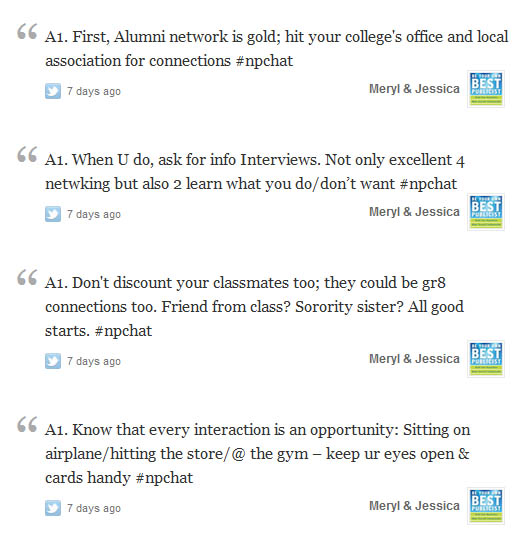
Boy were the tweets moving fast and furiously across our timeline. From the first question to the last, the chat provided valuable advice for recent graduates looking to kick start their career and new pros striving to get to the next level. We kicked the discussion off with best way to network as a new graduate. Here are a few tweets of advice from our authors:

If you weren’t able to stop by our #NPchat or want to access the transcript of the event, click here. The response to this event was positive, and we thank everyone who attended.


If you have topics you’d like to read about on our blog or discuss on a future Tweetchat, comment below, Tweet @PRSANewPros or share on our Facebook and LinkedIn pages. If you really want to get involved, fill out our volunteer interest form and be a part of our 2012 Executive Committee!