Intro to International PR: Why Going Global Can (and Should) Be Your Next Career Move by Stephanie Takach

For new public relations professionals looking to get ahead and obtain a unique skill set, getting international career experience is more than a viable option—it’s one that’s becoming a necessity—as organizations increasingly expand outside of the United States. To find out more about what it takes for PR professionals to get experience overseas, I sat down and interviewed Stacie Berdan, an international careers consultant and author of the new eBook GO GLOBAL! Launching an International Career Here or Abroad. Stacie has more than a decade of experience at Burson-Marstellar and later joined Unilever before publishing her first book Get Ahead By Going Abroad.

Stephanie Takach: Why do you think it’s important for PR professionals to experience part (or all) of their career abroad?

Stacie Berdan: Globalization is here and its pervasiveness is destined to expand. There has been a shift in many companies as to where their revenue is being generated–for many it’s in the emerging markets and at increasing percentages. As a consultant or a support function in-house, PR professionals who have a combination of industry skills and international experience can better support their client’s or organization’s global growth.

ST: Are there any unique skill sets that PR young professionals need or should pick up before looking to jump-start their international career?

SB: Acquire as much international experience as possible. Before you graduate, study or intern, join international clubs, practice foreign languages, volunteer or work abroad. Once you’re in the workforce, work on global teams or with global clients to demonstrate that you can work cross-culturally and on virtual teams. If you have foreign language skills, practice. If you have knowledge of or experience with another culture or country, try to get involved in a relevant assignment.

It’s important that young PR professionals build up what I like to call their “toolbox of talents”–working with top-notch professionals at the start of their career. This could be anywhere in the world but requires some thought. Once you have three to four years of experience, you can start branching out and looking for opportunities most anywhere because you will then have multiple offerings: solid PR skills, international mobility and the global skills you’ve acquired.

ST: And what about languages? For PR pros who only speak English fluently, how much of a barrier can that be?

SB: Being bilingual or trilingual is a definite benefit to working in the global marketplace, but it doesn’t have to be a deal breaker. Consider what other skills you have that an organization would benefit from and market them. Exceptional English language skills can prove beneficial in many markets where English is the second or third language to ensure accuracy, but you’ll want to be careful you don’t simply become the editor as opposed to the strategist behind the PR.

ST: What advantages does international PR bring to the table for young professionals? Are there any disadvantages?

SB: International PR provides the opportunity to work at the forefront of the globalization wave, which shows no sign of slowing down. Most internationalists agree that the personal and professional growth is explosive–working abroad for one year usually feels like the equivalent of three in experience. However, the downsides can be the incredibly challenging circumstances you face every day. It’s difficult to live in another country and work cross-culturally every day, in a second language or through interpreters; learning new ways of doing things as well as new regulations, currencies and politics can be draining.

ST: When is the right time in one’s career to go global?

SB: The right time is when you spot the opportunity because there are benefits to going at any stage in a PR professional’s career. If you go early on, you probably have fewer restrictions, yet the flexibility to go anywhere, which many companies appreciate and want, so the opportunities are probably the broadest. If you go mid-career, you’ll have significant talents in your toolbox and can probably step up your game in a smaller or emerging market that needs your professional expertise. This could then transfer to greater responsibility faster to be leveraged in another market or your home market after a few years. If you go as a senior person, you have a great deal of practical knowledge and experience to offer a new market, yet you’ll still need to learn about your new home. It all depends on what you’re looking for, your expectations and your flexibility, which are key in seeking, landing and thriving in an international role.

Is now the right time in your career for you to go global? What challenges or roadblocks have you encountered on your journey to gain international PR experience?

Stephanie Takach is a senior at Drexel University, majoring in communication with a minor in marketing. Takach is also president of Drexel’s Public Relations Student Society of America Chapter and an aspiring PR and marketing professional. Feel free to contact Stephanie on Twitter.

PRSA New Pros Tweetchat – Promoting YOU: PR Tips for Networking, Landing a Job and Moving Up Recap

PRSA New Professionals Section hosted its first Tweetchat last week. Two experts shared advice on the art of self-promotion.

On Tuesday, October 25, PRSA New Professionals Section held it first tweetchat with Meryl Weinsaft Cooper and Jessica Kleiman, the authors of our July Summer Book Club selection, “Be Your Own Best Publicist: How to Use PR Techniques to Get Noticed, Get Hired and Get Rewarded at Work”. #NPchat participants gathered to hear Cooper and Kleiman shared great advice for networking and getting ahead in your PR career.

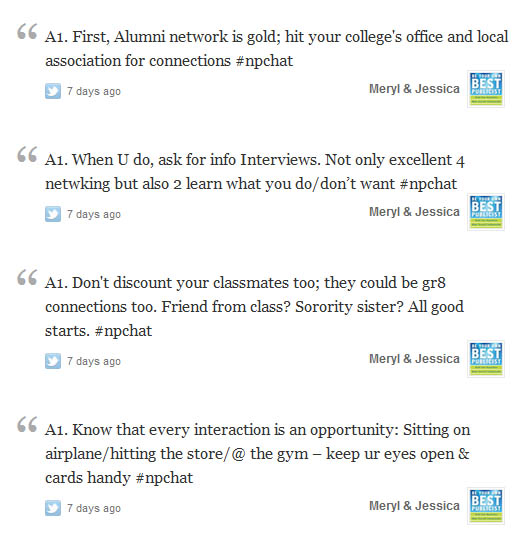
Boy were the tweets moving fast and furiously across our timeline. From the first question to the last, the chat provided valuable advice for recent graduates looking to kick start their career and new pros striving to get to the next level. We kicked the discussion off with best way to network as a new graduate. Here are a few tweets of advice from our authors:

If you weren’t able to stop by our #NPchat or want to access the transcript of the event, click here. The response to this event was positive, and we thank everyone who attended.


If you have topics you’d like to read about on our blog or discuss on a future Tweetchat, comment below, Tweet @PRSANewPros or share on our Facebook and LinkedIn pages. If you really want to get involved, fill out our volunteer interest form and be a part of our 2012 Executive Committee!

Save the Date: New Professionals Week 2011

I love planning events for the New Pros especially when it’s a national weeklong event celebrating young professionals! You can never have enough young professionals in your Chapter; after all, they are the future.

This year, during November 14-18, we will host our very first New Professionals Week. This week was designed to celebrate young professionals, but also to help connect young PR pros with their local PRSA chapter.

Who’s invited? Everyone. We’re encouraging everyone who’s interested in this week to get involved! PRSA New Pros National will support your local event via guest blog posts and social media channels.

How can I get involved? If you interested in contributing to our blog, contact blog co-chairs, Heather Sliwinski and Diahnn Henderson. For events, visit our website and download a fact sheet and an event registration form. This website will be the hub for all events held during New Pros week. Once registration forms are submitted, you’ll be able to see a list of events on our website, promoting local events.

We understand that not everyone may have a budget to host an event this year. For those of you who have tight budgets, here are a few budget friendly ways to participate:

  1. Host a private showing of a PRSA New Pros webinar. During New Pros Week, we feature a webinar on a topic of interest for new pros. We anticipate the webinar will be held in the afternoon on Wednesday, Nov. 16 available for purchase (only $35 for New Pros Section members) to host a private showing – invite local new pros to an office, bring a bag lunch and have a discussion after the presentation. The playback will also be available for purchase and our guest speaker can be reached throughout the week for questions via Twitter.
  2.  Host a New Pros focused PRSA Chapter meeting. What topics are particularly interesting to young professionals? What issues are they concerned with during their first few years as a PR professional? Schedule a Chapter meeting during this week and cover one of these topic(s) and/or issue(s).
  3. Participate in New Pros week via our social networks and blog. Follow our hashtag #NPWeek to join the coast-to-coast virtual networking. We’re always looking for a fresh, new perspective on any aspect of PR for our blog; consider drafting a post about your Chapter’s local new pros group, or your personal experience as a new pro.Elizabeth Rhoads

It’s going to be great week of celebrating young professionals. If you have any questions about getting involved, please email me .

Elizabeth Rhoads
PRSA New Professionals Section Programming Chair

Intro to Healthcare PR Part Two by Debbie Harvey, APR

Let me start by saying that growing up, I never considered myself to be a science nerd.  Science was never really something around which I foresaw my adult life revolving.  As a student, it stood for spilled chemicals in laboratories, confounding physics equations and the dissection of poor, defenseless organisms.  However, a turning point that perhaps, looking back nearly 20 years later, drove me toward the scientific side of public relations was the day my best friend and I had to make up a high school biology class after hours.

The assignment wound up being a horrendous but hilarious experience—we had to dissect a fetal pig, separating and marking each organ.  While we vacillated between bouts of laughing and gagging, the lab door opened and in walked our admissions director—and actor Martin Short!  He was filming in New York City and looking at our school for his daughter at the time.  He took one look at our messy “operating table,” our filthy lab coats and our horrified faces and said, smirking, “You two aren’t enjoying this too much, I see,” to which I responded, “Imagine how this pig feels!”  I was already lobbying for the rights of the patient at a young age.

But I digress. Suffice to say, the 15-year-old me did not prophecy that the 30-(ahem)-something-year-old version would spend her days researching countless medical conditions, reading scientific abstracts, meeting with advocacy organizations, developing social media programs and media training healthcare professionals and patients.  But that’s what I do nearly every day after catching up on the morning’s news about this ever-evolving industry. And, admittedly, I still love it.  So long as no one hands me a scalpel and a pig.

How Do You Define Healthcare PR?

I’ve come to find throughout my career that healthcare PR is somewhat undefinable, which is what makes it undeniably exciting.  Healthcare is a niche that is constantly changing, given legal and regulatory challenges in spaces like social media, coupled with the powerful changes that healthcare reform has – and will continue to have – for patients, healthcare professionals, advocacy and payors.  For me, PR wasn’t a hard career choice, as it’s the perfect confluence of strategizing, socializing, researching and writing. In fact, I’m pretty sure it found me.  The healthcare focus, though, was a happy accident, one that started as just a job but wound up becoming a fulfilling career. 

Like nothing else, healthcare PR provides the satisfaction of knowing you are helping people at the end of the day: helping patients better understand what a diagnosis may mean; helping patients and loved ones manage through life’s health challenges with tools and resources to be better informed and empowered; helping discover ways to jumpstart and facilitate meaningful conversations between patients and healthcare professionals that may not have been happening. Some of the most moving moments in my career have been when I’ve helped coordinate patient speaking opportunities at client headquarters, bringing together employees across multiple disciplines to hear first-hand how their work positively impacts people’s lives.  It’s a gratifying feeling to know that an idea you had, a meeting to which you contributed or a program you built went to helping people get better and feel better at the end of the day.

Your Career Roadmap

As a new professional, you may occasionally (or often) feel like a sponge, looking to soak up as much information as you can.  Healthcare PR offers an opportunity to never lose that feeling: continuous environmental, economic and societal changes make healthcare PR a rewarding challenge, and I would encourage you to learn more about it.  At GolinHarris, we often say healthcare PR is the art and science of blending clinical understanding and knowledge with best practices of consumer marketing.  But regardless of what area of PR you may choose to pursue, seek to be challenged every day.  Read industry publications.  Get more involved with PRSA and network.  Find a mentor.  Ask questions.  Don’t balk at “no.”  Learn and adjust.  And above all, have a good time doing your job. 

Debbie HarveyDebbie Harvey, MS, APR, is a senior vice president in healthcare at GolinHarris.  She holds a master’s degree from Northwestern University in integrated marketing communications and is president-elect of the Public Relations Society of America (PRSA) Chicago Chapter.  A Big Apple native, she has learned to love the Windy City nearly as much. Follow her on Twitter, connect with her on Facebook, or email her at dharvey@golinharris.com.

Intro to Healthcare PR by Christine Kotler

Styrofoam wig heads. Wig heads?!? I needed two and I needed them fast because the news media was coming in one hour. My featured physician expert wanted to use Styrofoam wig heads to demonstrate a point about deep-sea diving and respiratory function. After a half-dozen calls and old-fashioned research in the Yellow Pages (years ago, in a pre-Google era), I finally found wig heads! I knew then that public relations, and especially healthcare PR, was going to be an adventure. This field requires resourcefulness, creativity, confidence, strategic thinking and endless amounts of energy. With more than 20 years in the business, my career in communications has been rewarding, challenging, interesting, exciting and fun.

I currently serve as the assistant vice president for marketing and public relations at Baptist Health South Florida—the largest not-for-profit healthcare organization in the region—based in Miami. On a typical day, I grab coffee (essential!) and my iPhone and start checking email. I also scan news headlines and social media sites on my iPad to see what is happening locally and nationally. Most days involve meeting with internal clients, handling media requests, brainstorming with staff, strategizing about opportunities and developing creative communications plans. Whether promoting a new center, treatment or pitching a unique story, we are constantly looking for ways to position Baptist Health as the go-to source for leading-edge healthcare information.    

Healthcare is one of the few growth industries in today’s tough economy. Recently, the national dialogue on healthcare reform has cast a negative spotlight on hospitals and healthcare organizations. To me, this is a great opportunity for PR professionals to reframe the conversation and focus attention on what is right about healthcare through meaningful and compelling stories.

The realm of healthcare PR is broad – from promoting hospitals and physician services to developing patient education materials to promoting medical devices, new technology and new treatments. You may handle everything from crisis response to event planning, community relations to employee communications, to media relations and more. The variety is what makes this field so interesting – no day is ever the same.  

Whether you are just entering healthcare PR or considering a career in the field, you may find the following tips helpful. I try to keep them top of mind in my own practice.

Top 10 Tips for New Professionals in Healthcare PR (not necessarily in rank order):

1. Be flexible:  Every day is different in PR – whether you are in healthcare or another industry. You need to be nimble, ready to change course and quick to seize opportunities on behalf of your clients.

2. Ask questions: You are new at this. Your boss expects you to work hard and to bring your best each day, but she also expects you to learn by asking questions.

3. Listen, listen, listen: And then, listen some more. Often, I hear students and young professionals comment that they entered the PR field because they “love people” and they are “good communicators.” Good communication starts with good listening. Before you can offer a client a solution, you need to really listen to how they define the problem or challenge.

4. Appreciate failure: This field is not for the faint of heart. Despite neurotic planning and the development of a dozen backup plans, things happen. Your beautiful outdoor event is blown away with hurricane-force winds or your celebrity speaker is a no-show as more than 500 guests eagerly anticipate her arrival. When something goes wrong, learn from it.

5. Play nicely with others: Throughout your career, you are going to work with a lot of people – some of whom you will like and others you will not. Business is about relationships.

6. Be resourceful: Know how to find the Styrofoam wig heads. And many other strange things that you will be asked to magically produce minutes before they are needed. Thank goodness for Google and FedEx.

7. Accept criticism with grace: Remember to say “thanks” when a supervisor or boss offers feedback or criticism about your work. Appreciate the fact that an experienced pro took the time to provide guidance.

8. Do your homework: Healthcare is complex. As communicators, we have to sort out the clinical jargon and develop materials that are easy to read and understand. Learn the terminology. Take classes or seminars in marketing, budgeting, healthcare administration.    

9. Show compassion: In healthcare, we have the unique position of caring for patients and their families when they are most vulnerable. We have a tremendous responsibility to be thoughtful, transparent and compassionate in our communications to various audiences.    

10. Look before you leap: Your mom was right. Before jumping into a project or charging ahead to seize an opportunity, pause for a minute to make sure you have a solid plan. PR is fast-moving, but a wise mentor once taught me that “speed kills.” While you need to be ready for action, PR requires strategic thinking and careful planning.

Rapid change and growth in healthcare, coupled with dynamic changes in PR and communication, make it an exciting time to be in this field – for new professionals and for seasoned practitioners.

Christine Kotler is assistant vice president for marketing and public relations at Baptist Health South Florida. She is a member of the PRSA Health Academy Executive Committee. She can be reached at ckotler@baptisthealth.net. Follow Baptist Health on Twitter.