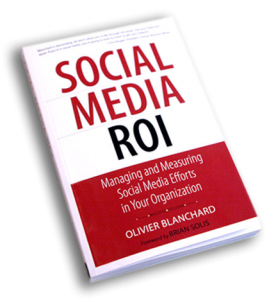
Book Review: Social Media ROI by Olivier Blanchard

Image credit to smroi.net.

Image credit to smroi.net.

Paying it forward has been a popular buzz-theme as of late, especially within the context of professional development and social responsibility. When applied to social media, C.W. Leadbeater said it best, “You are what you share.” and if this book is any indication of paying it forward, Olivier Blanchard has embodied this ideal.

Blanchard starts with the basics; he delivers insights into the social media world with a no-nonsense light in Social Media ROI: Managing and Measuring Social Media Efforts in Your Organization. This “meat and potatoes” business guide, will help the inexperienced as well as the experienced develop and hone excellent social communications habits, mindsets and insights into effective social communication programs. A quote within the forward from Brian Solis best describes the affect that it will have on readers. Solis states, “Thanks to Olivier, you’ll find the answers to your questions and also answers to the questions that you didn’t know to ask.”

Social Media plays an increasingly larger role within communications and marketing. The digital landscape is arguably the fastest paced environment for PR practitioners and communicators to work in. Whether one works full time within the digital/social media realm or part of a team that implements social communications into strategy, it is of no consequence, this read is a MUST.

For years, the debate has raged as to how to prove or justify the ROI on digital/social efforts and surrounding the debate, many questions arise such as: Can it be measured, If it can, what should be measured and how does it correlate? How do I translate this to executives? These are but a few of those questions and the answer to all these questions, via Olivier Blanchard is a resounding yes!

Blanchard challenges professionals to take a much more serious and in-depth look at the organizational structure and base purpose of their programs. Blanchard says, “A social media program is not a mere marketing add on. More than anything, a social media program is neither simple nor easy.” This direct approach cuts through buzzwords and attributes what is important, why it is important and how it can be important for the reader.

Social Media ROI is a true resource. Blanchard aggregates some of the best lessons a communicator can use to assist their programs or to even develop a program that doesn’t exist. Some of the “KPI” of Social Media ROI are how to:

  • Align social media to business goals and functions
  • Get started by “listening before talking”
  • Leverage mobility and the “on-the-fly” social media culture
  • Establish the importance internally and externally the need for social media policies, guidelines and training
  • To deliver real-time digital support and customer service

If the “KPI’s” given freely in this book weren’t enough, Blanchard in his generosity of spirit with his pay it forward mentality, provides a free online edition when his paperback has been purchased.

 

264032cJR Rochester is the current membership co-chair for the PRSA New Professionals Section. Connect with him on Twitter @TrulyJR

Gain A Competitive Edge with International Experience: Part 2

Image credit to letsgoglobal.ca

Two weekends ago, I had the opportunity to attend the Go Global Expo in Boston, which was produced by Verge Magazine. This event was targeted for anyone who is interested in either working, studying or volunteering abroad. I have always set a long-term career goal to work abroad, but as I enter the early stages of my career, I have also considered other options, such as completing my master’s degree, interning, or volunteering in another country.

This event featured many exhibitors that offered global opportunities for all ages, as well as hourly seminars with professionals who have significant international experience. I gained a ton of insight that is really useful for anyone who is interested in going abroad. More specifically, I took away several important points to consider when pursuing an international career:

1.     Have a clear vision

–        Where do you want to go? What are you okay with doing? How high up the ladder do you want to be in your career?

2.     Identify companies where you could see yourself working in

–        What are its entry points?

3.     Network with like-minded people

 4.     Do your research and get involved

–        Find and join organizations that work locally, but carry projects abroad

–        Join local chapters

5.     Stay informed with international news

 6.     Learn a second language

Completing an internship abroad is another great way to gain international experience. This is something I have considered for a while now, but it is definitely easier said than done. Finding a paid communications-related internship, with a work visa and housing arrangement included is extremely hard to find. After hearing what many of the speakers had to say about interning abroad, I came to the conclusion that going through an internship provider is the best way to do so, especially if you are seeking opportunities in the fields of public relations and marketing.

While you receive placement in an internship geared towards your interests, there is a program fee you have to pay if you choose to go through a provider. However, by paying this fee, you are guaranteed in-country support, security and safety, housing, orientation, and overall structure. The best providers to choose from are those who only offer opportunities in a few select countries in more specific fields, as opposed to those who basically promise you the world. By focusing on a few countries, these providers have closer relationships with your prospective company and are more involved with them.

To get you started on your search for gaining international experience, I have compiled a list of the exhibitors who were present at the Go Global Expo. These are excellent resources for anyone who is looking to intern, study, or volunteer abroad. Enjoy!

Internships

Graduate Studies

Volunteer & Gap Year

 What other resources and search tools have you found helpful for finding opportunities abroad? Please share in the comments.


Screen Shot 2014-11-17 at 12.10.20 PMCatalina Gomez is a graduate of Philadelphia University with a Bachelor of Science in Professional Communication. She specializes in public relations and has experience working with lifestyle and consumer brands. Catalina is also an active member of the Hispanic community and currently resides in Maryland. Connect with her on LinkedIn or Twitter.

Gain A Competitive Edge with International Experience: Part 1

This is a part of our month-long participation in PRSA Diversity Month

I wasn’t just bit by the travel bug at an early age; I was rather infected. I first got my peek of the world outside of the U.S. when I visited my family in South America. Later on, I participated in short trips to Europe with my high school and university. Though, it was not until my experience of studying abroad in Spain last spring that really triggered my desire to live and work abroad.

Image credit to UCLA

As a new professional entering the market place, I strongly believe that now is the time to kick start our international experience. The older we get, the more responsibilities we are bound to, and the harder it is to just drop everything and leave. For this reason, it is better to start early in your career.

The benefits of gaining international experience are endless, however, I have narrowed it down to just three that I think are the most important and meaningful of going abroad:

1.     Gaining a different perspective on the world

Many of us grow accustomed to the same surroundings everyday. We forget about the world around us, the one beyond our so-called “bubble.” Traveling abroad is an eye opener, and for some, it is the reason why you experience culture shock. Encountering a completely different culture first hand means you are educating yourself on all aspects of a new country, such as music, food, religion, political and economical issues, and so much more.

Experiencing and understanding a foreign culture allows you to become more global minded and aware of a life different from your own. Your perspective on the world can change drastically, causing you to not only form an appreciation for the country you traveled to, but also to have an appreciation for the one where you are from.

2.     Personal Growth

Change can be a scary, yet exciting, thought for some. Going abroad means getting out of your comfort zone, and challenging yourself both mentally and emotionally. No matter where you go, there will always be different values, customs, and mannerisms. Therefore, you will learn to become adaptable. This rings a huge sense of personal achievement because you are facing and embracing change all at the same time.

According to research published in the Harvard Business Review, “People who have international experience are better problem solvers and display more creativity.” In addition to this, being abroad allows you to grow as an individual, granting you the independence and confidence to adapt to unfamiliarity.

3.     Career Advancement

International experience gives you a huge competitive and global edge in your professional career. For example, an employer is going to remember a person who had an incredible story to share about a time in South Africa compared to a person who has basic industry experience. Employers look for candidates who can contribute to their company’s diversity. Whether it is a new client or coworker, you will often encounter someone in the workplace who is of a different ethnicity or background. By having international experience and intercultural awareness, you become a bridge to a gap of cultural differences.

When you go abroad, you are also expanding your network globally. In order to do so though, you have to make the effort to create and maintain relationships. In my previous blog post with The Edge, I explained the importance of networking and staying connected. When you take networking to an international level, you not only create a large space of opportunities for yourself, but you also bring valuable business contacts to a company.

Traveling abroad is undoubtedly a life changing and valuable experience. Whether you choose to work, study, or volunteer in another country, each offers rewarding benefits to both your personal life and professional career. If any one of these global opportunities is something you seek, check out Part 2 of this blog post for things to consider before making a decision. A list of resources will be provided as well!

What has been your favorite travel experience and what is the number one thing you took away from it?


Screen Shot 2014-11-17 at 12.10.20 PMCatalina Gomez is a graduate of Philadelphia University with a Bachelor of Science in Professional Communication. She specializes in public relations and has experience working with lifestyle and consumer brands. Catalina is also an active member of the Hispanic community and currently resides in Maryland. Connect with her on LinkedIn or Twitter.
 

Why PR is Essential to Content Marketing

PR and marketing used to be separate. But now more and more of their job responsibilities are starting to overlap.

Image credit to 5wpr.com

Go to a well-known public relations or marketing blog, and you’re sure to see something about content marketing. Content marketing is kind of in the spot social media found itself in a few years ago: no one agrees on who should own it.

I won’t go into my thoughts on the topic, but I will say this: successful content marketing can’t happen without some PR. And while not every marketing team needs a designated PR pro, the team’s success depends on having strong public relations skills.

Good Content Means Nothing Without Good Distribution

Sure, it’s great that you wrote an awesome ebook. But tell me this: how is your company planning on getting people to read it?

Many content marketers say you should spend twice as long promoting a piece of content than you do creating it. That may sound daunting at first,  but think about the ongoing nature of blog promotion. One hour of that promotion may be broken up into creating several one-off shares over the course of a few months.

A rounded content distribution plan might include:

  • Sharing on social media

  • Including links in a company newsletter

  • Syndicating the content on other websites

  • Optimizing the content for shares

  • Personally emailing content to interested contacts

  • Linking to content in guest posts

  • Earning inbound links to the content

  • Getting influencers to share or endorse the content

Those last four bullet points? Yeah, they take some PR savvy.


Public Relations for Content Marketing

The most important reason that content marketers need a grasp on PR is the need for relationships. PR pros are experts at building relationships – it’s one foundation of PR as a whole.

Content marketing is a whole lot easier when you have strong relationships with people who can help you get your content out there. It all boils down to knowing how to write a pitch. Let’s look at those bullet points again:

Personally Emailing Contacts

You just wrote a post about something and think several of your contacts would enjoy it. Don’t leave it to chance that they’ll see your social shares of it or find it on their own. There’s nothing wrong with sending a quick email saying you wrote something on a topic they’re interested in. But if you don’t know how to write a good pitch, you may come off sounding more pushy than helpful.

Linking to Content in Guest Posts

Guest blogging can be as valuable for content promotion as it is for personal branding. You can link to content in the body of the post, provided it’s related to what you’re talking about in the post. Or you can highlight specific content in your bio instead of including a link to, say, your blog’s home page.

But once again, to secure great guest blogging gigs, you need to know how to pitch yourself and your writing to relevant outlets.

Earning Inbound Links

Have you ever seen 10+ outlets writing articles about the same company’s recent report or whitepaper? Think about how valuable those links are, especially when they’re from authoritative, high-ranking sources.

Do you think that those publications all just fell upon that data? I’m betting that in most cases, they received a great email from the original company. It probably stressed why the report would be valuable to readers. I’ll also bet that the publications receive pitches like that a lot, and only pay attention to the good ones.

Getting Influencers On Board

I love stories where one tweet boosted a company’s subscribers or conversions by crazy amounts. It may seem like exaggeration, but it happens. Influencers can drive hundreds of visits to a small company’s website. That may be twice as many visits as they usually see.

This kind of success depends on targeting the right influencers and building a relationship with them. Then you need to show them the value in your content. If you spam them, are pushy, or use any other combination of bad pitching tactics, you’re making that success next to impossible for yourself.

So while everyone debates on whether content marketing should fall under marketing or public relations, you can focus on how to combine the two for content success.

What PR tactics do you think are most important in content marketing?


710T3ue1Brittany Berger is currently a Digital Content Supervisor at eZanga.com. She graduated from University of Delaware in 2012 majoring in Mass Communication with a public relations focus and minoring in Interactive Media and English. Connect with her on Twitter @bberg1010.

Finding New Diversity in an Increasingly Diverse World

There’s a problem in this country. No, it’s not the latest in celebrity break ups. (sorry Hollywood) And it isn’t whether Johnny Football is overrated (hint: he is). No, this problem touches everything, public relations included.

That problem is working with a diverse population. But what makes a population diverse? I guarantee your first thought was race or ethnicity, followed closely by gender or sexual orientation. Yes, you are right. But it is more than just those four points.

Image credit to lvcil.org

Beyond socio-economic status and even religious and cultural viewpoints, there is a side of diversity no one talks about. That unseen and rarely discussed side is disabilities. Whether you have a disability yourself, I can also guarantee this: You know someone with a disability. So look at the issue like you look at Facebook impressions. If you gain three friends to your current 1,000 and one of those three has a disability, the impression of that person can now be relayed to your other thousand-plus friends.

Let’s first clear up what a disability is. According to the Americans with Disabilities Act, “an individual with a disability is a person who (1) has a physical or mental impairment that substantially limits one or more major life activities; OR (2) has a record of such an impairment; OR (3) is regarded as having such an impairment.” [1]

What exactly does this mean for you and the public relations profession? Four things:

1)    There is a vast market that isn’t even considered. According to a report by Christina Ng of ABC World News, one in five Americans have a disability with spending power for this group estimated to range between $200 billion to $500 billion. [2] Quite a hefty purse that isn’t being sought by your client or employer.

2)    Don’t offend one fifth of the American population. This includes those with mental illness, which is included under ADA regulations. Let’s just say Burger King wasn’t up for any awards with the “The King Gone Crazy” campaign. Take a look at their campaign.

3)    People with disabilities have families too. And that is only now in the last couple of years starting to spark some light in the public relations and marketing industry. Carol Cone, then Edelman’s Managing Director for brand and corporate citizenship (now Edelman’s Global Practice Chair, business + social purpose) stated in an Andrew Adam Newman New York Times article from October 2013 regarding a mental illness PSA, “Instead of focusing on a person with the issue, [the PSA] focusing on family members has a lot of resonance because the whole issue of mental illness is about, not just the person who is affected, but rather the whole ecosystem. They’re riveting.” [3] So, you aren’t just targeting and affecting those with disabilities, but their friends and family too.

4)    Finally, and this loops back to number one, commercials dealing and pitching to the disabled can be more than just your average PSA. But most companies just don’t go there. Apart from a few campaigns, such as Guinness’s wheelchair basketball commercial, advocates say the disabled are being left in the marketing dark. For a $200 billion to $500 billion populace, this is astounding.

But it still isn’t exactly perfect yet. In the same World News article, Nadine Vogel, president of Springboard Consulting, a company that consults on how to market to people with disabilities, stated, “In general, nobody is really doing a great job. We could go through every single industry and we could pinpoint where the opportunities are in each and every one and that’s just being ignored.” [2]

I’ve identified the problem turned into an opportunity. Now what are you going to do?


Twitter PicWes Trainum is the IT and Social Media Specialist at Bob Ross Auto Group in Centerville, Ohio. Wes graduated from University of Dayton, where he was an active member or PRSSA, and now PRSA. Though dealing with mental illness, Wes still enjoys time spent working in his field and travelling. Continue the conversation with Wes over on Twitter and connect with him on LinkedIn.