Consulting 101: Uncommon Tips for Agency Success

Public relations agencies are microcosms of the greater industry, embodying the most dynamic and challenging elements of communications work. Achieving success in the agency setting requires hard work, long hours and a laser focus on personal growth. After one year into my role at a global public affairs firm, I looked back to take stock on what I believe makes a communications consultant stand out.

Understand the business of the business. For a junior staffer, a comfortable understanding of budgeting, billing, staffing and client services can be a significant differentiator. Public relations agencies are professional services businesses, and employee billings are the primary driver of a company’s revenue. Whereas it’s certainly not all about the money, a budget-conscious approach to work is a paramount trait among strong leaders. The best way to position yourself for advancement is to look to those working above and alongside you to gain an understanding of the fundamental questions behind the business: How does my company make money? Am I doing everything I can to maintain top-quality and budget-conscious service? How can I help to keep my clients happy?

Master flexibility. Communications work is often unpredictable. Depending on your occupation, the degree of this unpredictability can vary dramatically. However, a basic principle of agency work is to expect the unexpected. As an agency professional, you will need to be able to work quickly and tactfully with a variety of issues. The best practitioners can approach an issue, dig into it with confidence and handle it competently. Learn to embrace the project-based and short-term engagements that tend to appear in the agency setting – every task is an opportunity to demonstrate your aptitude. If you’re unfamiliar with a topic or task, embrace it, and ask every smart question you’ll need to inform your success. Never say “that’s not my job” or appear reluctant to roll up your sleeves and engage.

Learn how to quantify your own successes. When you work in an agency, it’s easy to become consumed with the day-to-day rigors of short turnaround deliverables, meeting your managers’ expectations and articulating your work’s value to clients. Measurement is the key component of demonstrating the value of public relations, for both campaign outcomes and your individual services. Young professionals should maintain a file of professional accomplishments that quantify your hard work. This can include a list of valuable media hits, event results, campaign outcomes or any other computable metrics, including something as simple as a “good work” email from the client. When the time comes to discuss your performance, you’ll have a portfolio of your own achievements to lean on.

Don’t fear strategy. It’s easy for junior agency staff to feel like they’re running through the motions, often executing on the tactics assigned by mid-level account leaders and senior agency directors. Young professionals joining the agency world should be mindful of this dynamic, but never abandon the instinct to think and counsel strategically. You don’t need to have 20 years of experience to have a good idea, and you must embrace the reality that you are a part of the team. Be careful and measured in your proposal of good ideas, and be open to healthy scrutiny. Don’t be afraid to speak up, and always remember it is your remit to take the active role in bringing your ideas to life.

The best young professionals are always looking to take their roles to the next level, constantly asking, “what can I do to add value here?” What do you do to add value to your agency?

gary-bridgens


Gary Bridgens is a project consultant in APCO Worldwide’s New York Office, and the PRSA-NY Executive Secretary. Connect with him on LinkedIn, or email him directly.


Take part in New Pros Week 2017

For more information, and ways to get involved, with this year’s New Pros Week check out the below infographic schedule, or click HERE.

Full Schedule

New Pros Week 2017 Twitter Chat Recap

We’d like to thank everyone who participated in the 2017 New PRSA New Pros Week Twitter Chat as we discussed what it means to be a new professional and what steps we can all take to maximize success.

Review highlights of the chat below. What did you learn from the August chat? How can you maximize YOUR success as a PR New Pro?

Take part in New Pros Week 2017

For more information, and ways to get involved, with this year’s New Pros Week check out the below infographic schedule, or click HERE.

New Pros Week 2017

A Tale of Two Mentors

The first time I joined a formal mentoring program, I seriously lucked out. I was matched with a passionate, candid, talented vice president who answered all my questions, let me shadow her and her team, and provided invaluable advice. She helped me consider my career options, negotiate, and advocate for myself at the crucial point in my career when I was transitioning from grad school and freelance life into a full time job.

I knew even then, my situation was not typical. Finding a great mentor isn’t often so straightforward and effortless. Sometimes, formal arrangements fall short of expectations on both sides of the relationship. Or more often, a formal program isn’t available and you have to get creative in finding a mentor.

Recently, it occurred to me I have another mentor close at hand — just a few desks away, actually. Turning to my coworker when I need help solving a problem, learning from her years of experience at our company and other organizations, I find there are elements of our working relationship that look a lot like mentoring. It’s valuable because we share a work environment, and have similar goals and expectations about our careers. She’s inspired new ideas for my career growth and expressed support along the way.

One mentor was a conscious introduction, while the other grew organically, but both relationships have established a sense of trust and over time become valuable to me in their own, unique ways. And like all relationships, both have required effort and reciprocity on my part to maintain them as lasting connections.

There’s no universal formula, but there are certainly new ways of thinking about mentorship that can serve New Pros as they work to forge connections. Join us during New Pros Week for a special webinar, where you’ll get advice on how to find a mentor, be a great mentee, and fill your life with valuable connections.

Alyssa-Stafford


Alyssa Thys is a member of PRSA Georgia and a communications specialist at Piedmont Healthcare in Atlanta.  She serves on the New Professionals executive committee as the mentoring chair. Alyssa is a graduate of Agnes Scott College and the University of Georgia. Find her on LinkedIn or Twitter.


Take part in New Pros Week 2017

For more information, and ways to get involved, with this year’s New Pros Week check out the below infographic schedule, or click HERE.
Full Schedule

New Pros Week 2017

Think of your career like a garden. You’ll want to plant it in a fertile area with plenty of room to grow and access to the things it needs to thrive: sunshine and water; opportunities and professional development. You’ll need to spend some time on it, deciding what to cultivate, weeding out the unnecessary and giving it the care and attention it needs. You’ll need to fill your toolshed. Finally, consulting the experts is never a bad idea.

It sounded a bit outlandish before, right? Comparing your career to a backyard garden? But when you think about it, the fruitful, successful ones are the product of a great deal of love, sweat, time and attention. Without effort, they wither away.

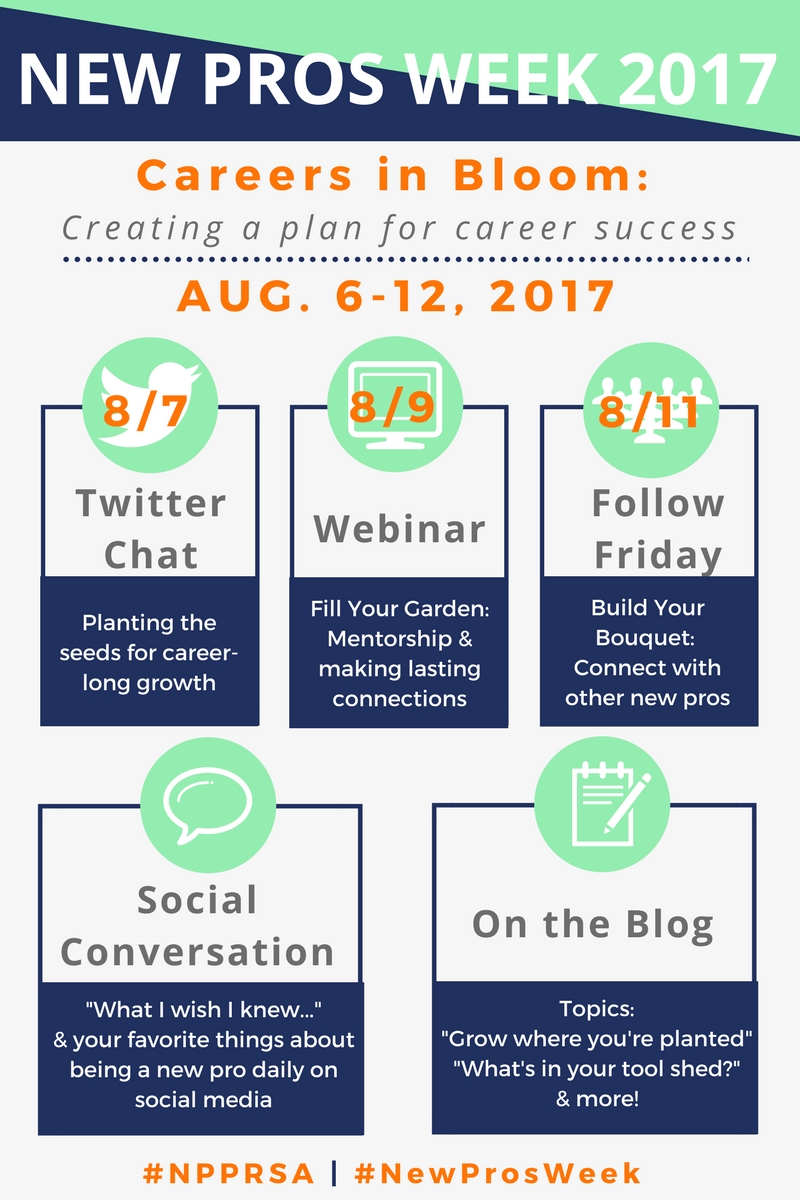
This year we’ve decided to give New Pros Week a theme of its own – “Careers in Bloom: Creating a plan for career success.”

Join us August 6 through 12, 2017 as we focus on all the tools and tips you need to continue to grow your career well past your New Pro years and celebrate the things that set us apart. We’ll talk about what tools you need in your PR toolbox, discuss the importance of mentorship to build lasting, mutually beneficial relationships, and connect members from across the country as we explore the ins and outs of being a New Pro.

New Pros Week 2017’s schedule includes:

  • “Planting the seed for career-long growth” TwiChat chat – Monday, August 7 at 8 p.m.
  • “Fill Your Garden: Mentorship & making lasting connections” webinar – Wednesday, August 9 from 3 p.m. to 4 p.m.
  • “Build Your Bouquet: Follow fellow New Pros” Follow Friday on Twitter – Friday, August 11
  • Social conversation around our favorite things about being a New Pro and advice from experienced pros on what they wish they knew as New Pros
  • Blog posts on topics such as:
    • “Grow where you’re planted: How to build a successful career in a new place”
    • “What’s in your toolshed: Essential tools and techniques for New Pros”
    • …and more!

Links to these programs and events will be shared across our social media channels very soon so keep an eye out and mark your calendars!

In addition to national events, New Pros Week is a great time for Chapters and Districts to celebrate their own New Pros by hosting happy hours or networking events, showcase members in blog and social media content and just generally engaging with their youngest members to highlight the great things we add to the PR field and to help us further grow and advance the profession.

Don’t forget to follow along on our social media channels and join in the conversation on Twitter using #NPPRSA and #NewProsWeek.

If you have any questions or want to get involved, please reach out to us!

Robyn & Veronica
@robyn_rl | @veronica_min
robynmrl@gmail.com | vmingrone.prssa@gmail.com

PRSA’s New Professionals Section 2017 programming chairs

Math for PR pros – What metrics you should keep your eye on?

math-pr-pros

Raise your hand if you took up a career in PR because you believed math was irrelevant to public relations?

Oh good – we’re all in the same boat.

Initially, I thought a career in public relations would mean I’d spend my time writing, planning events, connecting with audiences and stakeholders and sharing information far and wide. How silly of me to think that numbers wouldn’t play a part in any of that work!

Of course numbers and a bit of math are important to PR. How would you know what efforts were working, where to focus your time and attention when there’s a limited amount of it and where your budget is best spent without consulting the numbers?

If flying by the seat of your pants is your preferred method of answering those questions, think about how you’d answer them if your boss – or the CEO of your organization – asked them. Would anecdotes and generic statements be enough of an answer? Or would data be a better representation of the work that you do?

That’s really what it comes down to – what’s the best way to show that the work you’re doing each day has value for your organization? Numbers and data. Since the world of analytics is a vast and, frankly, frightening one, here are a few key metrics to get you started off on the right foot.

Email Engagement Metrics

Just about every communications program has an email component to it. Whether it’s to sell, to inform, to connect or a mixture of all three, email is one of the best ways to quickly and inexpensively connect with your audience. For that reason, looking at your email’s engagement metrics is important.

So what do you want to look at? There are a few things that are pretty easy to look at right off the bat. If you’re looking at your entire list (which should be broken down into segments, too!), you should be looking at the average cumulative open rate and who are your most engaged subscribers. Are people sharing your emails? Are other people signing up because of that? Who’s interested in what you’re saying? Are your email pitches getting being opened, engaged with and responded to? These are things you’ll want to know.

Once you have a good handle on these things, take a look at your individual email campaigns. What subject lines, formats and topics are performing well? Are your messages reaching the right people in your list? Is there a particular time of day that gets better engagement? Evaluate all of these things and, if you haven’t already, give segmentation and A/B testing a spin. Break down your subscriber list into segments based on demographics, engagement, location, interests – whatever information you feel is important to group your audience by – and begin testing different campaign elements. Test different subject lines, content, delivery times and more to find the ideal combinations for your messages. Be careful to only change one variable at a time and to keep track of what you test and how it performs each time.

Mentions

I’d bet the first thing that came to most minds were Twitter mentions. Social media mentions are a great thing to keep an eye on, but they’re not the only mentions you should be aware of. Which media outlets are talking about you? Who in the public is talking about you? Is it positive or negative? Who’s talking about your competition and your industry? Setting a handful of searches and alerts is the best way to keep your finger of the pulse of what’s being discussed.

Free options include setting up Google Alerts for your organization, key public-facing individuals in the organization, your competitors, your products, your industry, etc., running regular Twitter and Facebook searches using advanced options to fine-tune your searches. Paid services like Cision and Meltwater can aggregate and automate these searches for you into a central place, while identifying trends and streamlining your media outreach as well.

Website acquisition

Your website is the hub that connects your organization or brand with the rest of the world, right? It would make sense that you’d want to know how people find you and end up at your website. Using Google Analytics, you can set up detailed reports or use Google’s templates to analyze user acquisition and activity. These reports can show you where people come to your site from, what pages they’re interested in, how long they visit and more.

You can further drill this information down using Google’s URL Campaign Builder to build unique, descriptive links with campaign and origin information to help you keep track of where people are coming from. You  can track these in Google Analytics, along with goals and flow to see if users are completing the actions you’d like them to and what information they’re interested in.

Audience growth

Knowing what your audience is doing is important, but it’s also important to make sure that your base is growing in a healthy way. Tracking your subscriber growth, your social media audience growth and your website user growth is a good way to make sure that your brand and the content you’re sharing is still relevant and engaging. Check out how your subscribers subscribe to your email list. Take a look at your new social media followers and see what, if anything, they have in common. Same with your site viewers. If you can identify similar trends and commonalities, you may start to see other ways to engage your audience and new content marketing and PR avenues you can pursue to keep your organization growing.

Want to know more about PR metrics and measurement, including ways to use them to grow your own career? Join us on Wednesday, June 21 at 8 p.m. for a Twitter chat with Shonali Burke, independent PR pro and host of the monthly #measurePR chat, to learn more!

robyn-rudish-laningRobyn serves as PRSA’s New Professionals Section’s programming co-chair and is a communications and PR pro currently living and working in Columbia, S.C. In addition to volunteering with PRSA’s New Professionals Section, she also serves as the 2017 VP of Communications for the South Carolina PRSA Chapter and brought together the chapter’s first New Professionals group in 2016. She’s a native of southern New Jersey and currently resides in Columbia, S.C., by way of Pittsburgh, and currently works as the communications coordinator a statewide non-profit organization. In her spare time, Robyn likes to cook, read, spend time with her tail-less cat Izzy and write for her own blog – and almost always with a cup of tea in hand. Find her on Twitter & talk to her!