Member Spotlight: Hanna Porterfield

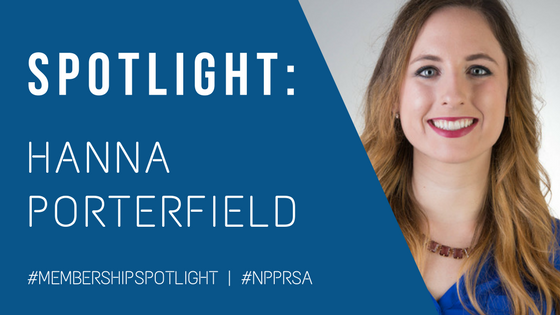
Name: Hanna Porterfield
Position/Company:
Senior Account Executive at Development Counsellors International
Location: New York, NY
Education: B.S. in Advertising and Specialization in Public Relations, Michigan State University
Social Media Handle: @citygirlhanna

How and when did you first become interested in PR and communications?
It’s funny, I was always reading and writing growing up, but never thought of it as a career because I didn’t necessarily want to be author. I began college as a mathematics major, with a goal to be an actuary. While that didn’t work out, loving numbers still comes in handy for calculating results and ROI of work. After changing my major I looked into advertising and marketing. Public relations was a specialization at the time, and the more I learned, the more it became for me. Internships and PRSSA involvement solidified my career choice.

How did you find internships/jobs?
Well, for internships I looked at my college job website and internship websites that I can’t even remember the name of (and they’ve probably since changed and been updated!). The question I think people actually want answered as a new professional is how to find a full-time position that will launch their career. For this, it takes time; looking for a job can be a full-time job, with late nights sending resumes, cover letters and follow-up notes all while you’re in school or working. I suggest setting up job alerts so that you can get potential positions emailed to you and all of your time isn’t spent going down a rabbit hole searching. LinkedIn and PRSA are good for this. Also think outside the box – literally every type of business needs PR.

I found my first (and current) job by putting my all into it. This means you’re going to have to make sacrifices. For me, that meant setting up 10 interviews during my senior year spring break and paying my way to New York City. When asked in an interview why I wasn’t on the beach, I said I could go to the beach the rest of my life, but I wanted a career in NYC. It paid off and I had two job offers before graduation.

What was the biggest challenge you’ve ever faced in your career? How did you overcome it?
One that comes to mind is when my first boss quit about a year and a half after I’d been at my company. It seemed like the end of the world to have a manager I liked and respected leaving so soon. In the end, it was for the better. Having a team member leave–while probably increasing workload–will ultimately give you an opportunity to step up to the plate and grow. For me, that resulted in my first promotion and an even more supportive manager than I previously had.

What has been the most valuable thing you have learned through classes or experience?
The most valuable things I’ve learned for my career have been though experience, not school, without hesitation. While college classes provide a good foundation, you cannot learn without doing. I cant stress enough the value of internships and your first jobs. When asked to present to public relations classes at my alma mater, I always share case studies of projects I’ve worked on, and try to apply to the topics in their textbooks.

What has been the best piece of advice you have received?
The best piece of advice I’ve received is simply to work hard. My dad instilled the word ‘industrious’ in our family, and that’s really motivated me to work hard no matter what I’m doing, in my career or otherwise.

Do you have any advice for PR pros early in their career?
Keep learning. It’s amazing how much can change in the PR industry just within a couple of years being in it. Read industry news and blogs, and keep any certifications you might have up to date. Bring up professional development budget in your annual salary reviews.

What do you think is the best benefit of PRSA and the New Pros section?
Having a network of PR professionals across the country who are going through similar things as you in their career. From Twitter and LinkedIn to MyPRSA, there’s no shortage of ways to get in touch with other members. While mentors are an important part of your career trajectory, being able to bounce ideas off people who are in a similar role to you, but at a different company, is helpful. Plus, make the connections now and run the world together later!

Is there anything you wish you would have known before becoming a new professional?
Outside of the actual office setting and your first career, I wish I would’ve known to keep balance and that it’s okay to say no to things. I have been extremely involved with lots of organizations during college and since graduating, but am just now learning how to balance priorities and make time for myself. You need time to rejuvenate to thrive. Put your all into organizations and side projects you’re passionate about, but don’t spread yourself too thin. For me, serving PRSA is one of those priorities.

Name one little-known thing about yourself.
I won my hometown’s Punt Pass and Kick in 6th grade for females and went on to the regional competition.

Hanna Porterfield is Chair of PRSA’s New Pros Section and a senior account executive at Development Counsellors International in New York. She is a graduate of Michigan State University. Connect with her on Twitter @citygirlhanna.

Porterfield,Hanna_headshot2017

If you are interested in being featured, or interested in nominating someone to be featured as a part of our #MemberSpotlight blog series, please complete the following form. Or reach out to us via email at prsanewpro@gmail.com.

Managing Up: What Does That Even Mean?

Stat: 85% of millennial managers worldwide have moved into management in the past five years (Ernst & Young).

Coming from a new professional classified as a millennial, and who recently moved into a management position last year, this is a terrifying daunting statistic.

Making the transition from an early-staged new professional to a mid-level new professional can happen before you even realize. Nonetheless, you still must be prepared as you make this transition to set yourself up for success (and ensure minimal stress-induced sugar binges).

What could this new transition include . . .

Overseeing staff? Say what?

Giving hard feedback instead of only receiving it? You’ve crossed the line, Greg!

Managing up? What does that even mean?

These are all questions we have to face as we produce solid work and move up the professional ladder, whether we’re ready or not. Let’s focus on the last of those three facets of mid-level new professionalism: managing up.

I was fortunate enough to deliver a presentation at 2017’s PRSA International Conference with two of my fellow colleagues (“colleagues” is what you say when you’ve transitioned into mid-level new professionalism, by the way) from the PRSA New Professionals Executive Committee. The topic in which we delivered captivating content to our session attendees? You guessed itmanaging up.

I’ll let you look over the presentation on your own time HERE (there are some pretty interesting stats and tips in there), but I want to pull out two main points:

  1. Managing up, the act of managing upwards to your superiors, is not something that’s often taught outside of real-world experience (and even that’s if you’re lucky).
  2. When done well, managing up takes foresight, strong two-way communication and a grounded perspective.

“But Greg, you say it’s only taught in the real world? I’m in dire need of this skill; where can I learn more?!”

Well, I just happen to know of the perfect event to recommend and it’s coming up next Wed., Jan. 24 from 3 – 4 p.m. EST in the form of a virtual teleseminar!

This session, PRSA New Pros’ first of the year and entitled Maximize Your Career Potential by Learning to Manage Up, will be presented by Scott W. Thornburg, APR.

This session is a crash course on managing up and you’ll end being armed with tangible takeaways! I met Scott last October and I’m so excited to hear what advice he’ll be offering attendees. Needless to say, I’ll be showing up with my Do Not Disturb active on my phone and the door shut to my office (no distractions, you know, as a mid-level new professional you’re now being pulled in 200 different directions both upward and downward).

>> REGISTER FOR THE TELESEMINAR HERE <<

So register, buckle up and get ready for a worthwhile learning experience to rock your mid-week next Wednesday.

With that kind of hype, how could you not register?

jan-24_teleseminar

greg-rokisky

Greg works full-time as the Marketing Manager for the Michigan Association of School Boards, as well as a freelance creative services consultant. With several years of strategic communications experience, he specializes in digital and creative marketing and public relations. His experience spans agency, corporate and nonprofit arenas. He serves as the social media co-chair for both the New Professional and Association/Nonprofit PRSA sections. When he’s procrastinating not working he enjoys pretending he’s Twitter famous @GregRokisky and checking off items on his never-ending Goodreads shelves.

Answering The Tough Questions

Weighing the ethics of any situation may seem like something better left to those with more experience under their belts than we New Pros. Questions of ethics are the tough questions.

But being an ethical professional isn’t magically bestowed on PR pros once they have a certain amount of experience. That would be nice, right?

As PR professionals, the closest thing we have to an ethics fairy godmother is PRSA’s Board of Ethics and Professional Standards, or BEPS. BEPS is responsible for developing PRSA’s Code of Ethics and counseling professionals through ethical dilemmas and practices.

Since an ethical professional can’t be born overnight, New Pros has teamed up with BEPS to answer any and all ethics-related questions to celebrate Ethics Month. Throughout the month of September, we’ll be collecting questions from New Pros via this form. BEPS will answer each question and we’ll share the answers in a blog post and across our social media between Sept. 25 and Sept. 30.

Have a question, but prefer to remain anonymous? No worries! Just select that option on the form before you submit your question.

ethics-banner

That’s a wrap!

Thank you for joining us for New Pros Week 2017!

Each year, PRSA’s New Professionals Section puts together a weeklong celebration of PR’s new, aspiring and up-and-coming professionals. Working together with PRSSA and PRSA, we organize conversations and programming that highlight the great things new pros bring to the profession.

This year, we decided to take it a step further and focus not only on our successes and newness, but to explore the opportunities out there for us to grow and learn as we progress through our careers. We worked to build conversations around what we need to know and what we can to to set ourselves up for career-long growth, how we can find and utilize a mentor relationship to grow as PR professionals, what we can do to give back and cultivate future PR talent, and the importance of building and maintaining our networks. In addition to conversations, we created handouts and guides to help members find their own path to success.

If you missed any of last week’s New Pros Week events, don’t worry – we’ve got you covered!

Celebrating New Pros doesn’t have to be limited to just one week of the year!

If your organization or PRSA chapter is interested in engaging New Pros and creating programming for them, here are a few of our tips.

  • Host a special viewing of a PRSA webinar for new professionals
  • Sponsor a Networking Mixer or Happy Hour at a popular local restaurant or bar
  • Coordinate a job fair or career connection event for new professionals
  • Host at an event or workshop at a local company or agency
  • Create a mentor program
  • Host a happy hour or meetup around one of our upcoming programs

What’s in Your Toolshed: Advice from fellow New Pros

When we began planning New Pros Week, we began discussing what kind of theme would best tie everything together and give members concrete advice and next steps once the week was over. As we mulled topics over for different programs, there were a few things we kept coming back to: what do New Pros need to be successful and what do we wish we had known before we entered the working world.

The answers to both of these questions are key to professional growth, the theme we decided on for New Pros Week 2017. To gather the best advice we could, we asked New Pros from all over to share their insight with us and the wider New Pros network. Below is advice from fellow New Pros.

What tools & skills do New Pros need in their toolshed?

New Pros need to be curious, whether it’s staying on top of new trends in the industry or learning a new skill, the genuine desire to learn something new everyday will keep you at the top of your game. I think it’s also incredibly important for PR pros to be level-headed and solution-oriented. PR is a balancing act of ever-changing priorities, client expectations, personal workloads, among other things. A calm demeanor and inquisitive attitude will definitely help you conquer any challenge thrown your way. Arielle Schrader, NYC

“New Pros need to know how to manage several projects at once and prioritize things.” Alyssa Thys, Atlanta

“PR pros need to know how to write!, AP style, understand social media, be able to see things from multiple perspectives, and be proactive.” Laura Fooks, Dallas

“New Pros need to be willing to learn and ask questions of professionals who have been in the business longer than you.” Ruthann Campbell, Tallahassee

“New pros need to be self-starters and pick up new skills quickly – especially in agencies. Things change rapidly and you have to be proactive about keeping up.” – Veronica Mingrone, NYC

“I consider two skills to be most vital. First, writing. You need to communicate clearly, and effectively to your co-workers, clients, and consumers. Second, decision making. This is particularly important if you want to be an effective leader.” Anne Deady, Houston

“The greatest skill New Pros, and PR pros in general, can use to their advantage is the thirst for lifelong learning. Many people get busy and don’t take the time to stay on top of certain trends or target audiences. If you make learning a daily habit, and seek out others who push and encourage you to learn, you’ll find great success! Additionally, seek out things that make you uncomfortable. If you’re comfortable you may have fallen into some complacency which doesn’t encourage learning (see above point). If you always push yourself into strategically uncomfortable situations, you’ll demonstrate a willingness to go above and beyond!”Greg Rokisky, Lansing

“It seems like the landscape of PR is drastically changing. So fast that it’s hard to keep up. New Pros need to have two skills: curiosity and persistence. I call them skills because I believe they can be fostered. Curiosity keeps you asking “why” and persistence “how.” Develop these two and you cannot fail.” Seth Kingdon, Charlotte

“Write well. This doesn’t apply only to media materials, but everything involving words – emails, presentations, social media and so on. Beyond spelling and grammar, being creative and concise are key.” –  Natalie Bailey, Charlotte

“The most important career skill is the ability to learn and adapt quickly. In a media environment disrupted by technology, young PR pros must demonstrate their ability and commitment to mastering new skills all the time. There is also a tremendous amount of media to consume. New Pros should be experts at synthesizing this information and developing relevant client recommendations.” Peter Walpole, NYC

“I think an incredibly valuable skill for new pros to have is self-awareness. Be aware of your strengths and weaknesses and understand what your value add can be from both a client and internal perspective. Once you hone in on your strengths, it will become easier to work on your weaknesses and help you become a more well-rounded professional.”Annelise Campbell, NYC

“I think the number one skill to be successful in PR is writing. From news releases to blog posts and even 140-character tweets, it’s so important to be able to communicate clearly and engage your audience.”  Caitlyn Ryan, Charlotte

What do you wish you had known before that may have helped you grow where you were planted in your first job?

“Find and be a mentor. Maintaining relationships in a variety of fields – not just PR – can be meaningful when you need advice or a reference, and there is nothing more rewarding than helping someone else be successful. It’s important to have someone ahead of and behind you on the career jungle gym that can offer a different perspective and help you navigate your journey.” –  Natalie Bailey, Charlotte

“In an agency setting, don’t always pine after the accounts you think you’d be good at – keep an open mind and an eager attitude and you may surprise yourself. When I first started out, I was determined to work with clients that I already had an interest in. When I joined a technology-focused team (an area I had zero experience in), I found myself learning and loving the industry more than I thought I would. It’s important to expand your creative boundaries and stepping outside your comfort zone is a great way to do so!” Paige Raiczyk, NYC

“I wish I was reminded that there are many different, unique paths to success, especially in such a vast industry like PR. My biggest advice to New Prosentering  the working world? Determine what success means to you individually, then work really hard to accomplish your goals. There’s no need to directly compare your path to anyone else’s and, remember, every experience is valuable.” – Arielle Schrader, NYC

“Before I entered the working world, I wish I really knew the power of networking. If I could go back in time, I would have joined my local PRSA chapter immediately. It’s invaluable.”Caitlyn Ryan, Charlotte

“I wish I would have known that life as a new pro goes quick, so say yes to as much as you can while you have the time. The more you grow as a professional, the more responsibility you take on and the less you can say yes to. Entering the working world means you have the freedom to explore and find your likes, dislikes, side projects and more!” – Greg Rokisky, Lansing

“Beware of the office gossiper.” Alyssa Thys, Atlanta

“There are high levels of turnover throughout the PR industry, particularly in junior-level roles. The lesson here is that your best network is the people around you. It is critical to build strong relationships with your colleagues, including those you intern with. The industry becomes smaller as you advance in your career and if you’re lucky, you will likely work with many of these people again down the road.” Peter Walpole, NYC

“The more you learn, the more you will be asked to do. Learn how to prioritize and say “no” when you can’t keep up with your current workload.” Ruthann Campbell, Tallahassee

“Don’t be afraid to ask for help! In agency life things can get extremely hectic. If you have too much on your plate, seek out a more senior person for help. Chances are a senior person can offer advice and solutions that you may not have considered. If you are feeling very overwhelmed, get in the habit of communicating it before you burn yourself out.”Annelise Campbell, NYC

“You need to adapt to your surroundings and be open to change. Be fluid. Sometimes you will be handed a task you are not crazy about – but it will grow your skillset and boost your value.” Anne Deady, Houston

“I wish I would’ve had a better understanding of analytics, Google AdWords and web development.” Laura Fooks, Dallas

“Your career is a marathon, not a sprint. Even if you don’t know exactly what you want to do, take every opportunity possible to learn and network. You’ll end up finding your place in the industry sooner than you think.” Veronica Mingrone, NYC

What’s the best advice you have for other New Pros? What skills do you think are essential? Comment below or tweet at us!