How My Graduate Degree is Advancing My PR Career

Editor’s Note: As part of our month-long topic on continuing education we’ve touched on the APR, Tools for New Pros and other professional development. Today, we’re interviewing members of PRSA’s New Professionals section that have completed some form of higher education or are in midst of earning their graduate degree, with an end goal of advancing their public relations career.

Meet our panelists and their earned or in-progress graduate degree:

Lindsay Moeller
Master of Education in Higher Education (Student Affairs), Iowa State University

Simon Oh
Master of Science in Transportation Management (administered by the Mineta Transportation Institute), San Jose State University

Brian Price
Master’s in Public Administration, Northern Michigan University

Robyn Rudish-Laning
Master of Science in Media Arts & Technology (focus in Creative Media Practices), Duquesne University

Alyssa Stafford
M.A. Journalism and Mass Communication (concentration in Health Media and Communication), University of Georgia

What made you decide to go to graduate school?

LM: First, I love school. Second, I knew I would need to get a graduate degree in order to pursue a career in Student Affairs.

SO: To prepare myself for a greater role in transportation, potentially managing a team, department or an entire organization within the business.

BP: I decided to stay at NMU after graduating with a bachelor’s because I had a graduate assistantship opportunity. I worked as a G.A. in NMU’s communications office both years. I couldn’t turn down the discounted tuition, stipend and relevant work experience (and faculty lot parking pass!) so I’d advise anyone looking at grad school full time to research G.A. opportunities. I thought about an MBA but lacked prerequisites for multiple classes and ultimately decided to build on my communications background by applying it to public administration and policy.

RRL: It was a perfect storm of things. When I finished my undergraduate degree in 2011, jobs were hard to find and I had had some internships, but nothing that turned into a real full-time lead. I didn’t feel like I had a completely firm grasp on what I wanted to do, besides work in PR, (I understand now that no one actually has it all figured out.), but I didn’t want to move back home to figure it out either. I knew that I would have better opportunities to gain experience in Pittsburgh and I had already begun to develop connections out there from my undergraduate work. It just so happened that my alma mater, Duquesne, also offered 25 percent off of graduate degree tuition for particular programs, mine included, to alumni. So in August 2011, I packed everything up and moved back up to Pittsburgh to pick right back up where I left off in May.

AS: My bachelor’s degree is in creative writing, and I ended up in a job where I was doing sales and marketing. When I discovered public relations, I knew I wanted to make the switch, but I had no idea where to start. I decided to get my master’s in PR, thinking a formal education was what I needed to make the transition. It turned out that while my classes got me up to speed academically, the most important thing for me was being exposed to professional development opportunities as a graduate student.
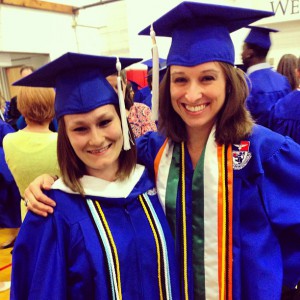
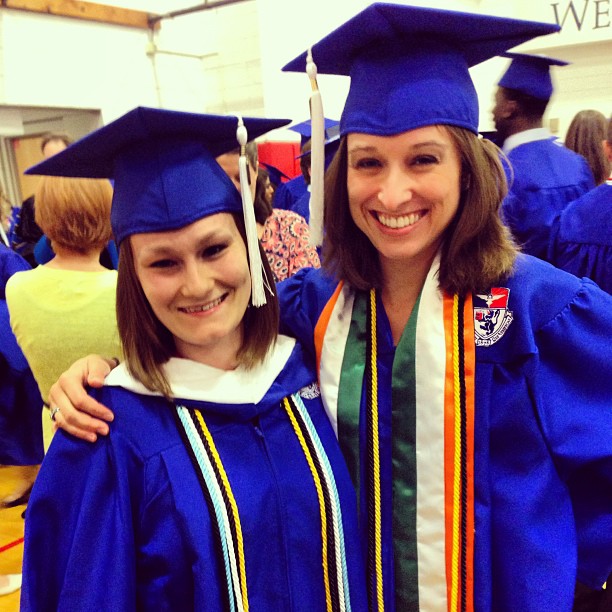
Robyn Rudish-Laning on graduation day.

Robyn Rudish-Laning on graduation day.


How has your degree helped or simply played a role in your PR career?

LM: It helped me to get my first job out of graduate school working in college admissions, which put me on the path to working in the marketing department and eventually PR.

SO: Although the degree is not required, it will almost certainly help me elevate to a position like a PIO or community relations manager for transportation projects down the line.

BP: In the classroom I learned general concepts like how to apply research, how to truly research a topic and honed my ability to read and digest complex issues; it was a unique opportunity to really build up those muscles. Outside of class, I applied that knowledge to executing digital and traditional media for NMU as a G.A. and just spent a lot more time crafting my skills. I was really in that student mindset where you try to read and learn everything while in grad school, which is difficult to maintain in a full-time job.

RRL: I felt like my graduate program was much more hands-on than my undergraduate program, even though they were within the same department at the same school. It also wasn’t entirely PR-focused. Instead, I learned a lot about related skills, like marketing, social media, journalism, advertising, web design, etc., on top of furthering my PR knowledge. The program wasn’t rigid, so I was able to pick and choose classes from a number of disciplines to round out my skill set. I think these things have been most helpful in my career because I was able to really dive into what I was interested in and what I thought would benefit me most. No two people in my program graduated with the same exact experience or degree, no matter what our diplomas said.

AS: I actually switched my concentration from Public Relations to Health Media and Communication, because I wanted to develop expertise in healthcare communications, social marketing. My concentration also emphasized health journalism, which trained me in writing about health topics for a broad public audience. I joined the Association for Healthcare Journalists and attended their annual conferences and reported at the Society for Neuroscience conference. I learned how to shoot and produce videos, worked on my writing craft and came away with a great portfolio of published work.

I also dove into professional development opportunities through UGA’s PRSSA Chapter. I served as the chair of the events committee my first year, and became president my second year. I really put myself out there in ways I hadn’t during undergrad. A big part of this was finding my passion. I didn’t know what I wanted to do in college, so I was much more energized and ambitious during graduate school. I also felt a sense that this was my last chance to make the most out of being a student. I credit PRSSA with helping me land my job at Piedmont Healthcare in Atlanta. I was hired on as a contractor in 2014, an opportunity I had because I met the PR manager at a PRSA/PRSSA networking event.

What is some advice you would give to PR pros wondering if they should go back to school?

LM: Graduate school was such a great practice for me in really learning how to buckle down and apply myself. Even if I didn’t get a degree in public relations, I think that it really helped me to learn how to research, plan and effectively communicate with multiple audiences and the importance of being able to do all of those things. I think it maps really well to PR.

SO: Think about where you stand now and where you want to go in your career. A graduate degree could expand opportunities beyond where you currently stand. Do your research before embarking on any program.

BP: Hard for me to say as I went straight through at NMU for six years. But I would think it’s important to have a vision for how this plays into your larger career goals, because this isn’t a challenge you’re going to want just for fun.

RRL: Only go back if you’re willing to put in all the work necessary and if you’re doing it to better yourself. Don’t go back to delay getting out into the real world or assume it’s going to be easy. The two years I spent working on my master’s were the two hardest years of my life so far. The best advice I can give is to be sure you’re pursuing it because you want to continue to learn.

AS: Even if you get funding through a graduate assistantship, grad school is expensive and time consuming. Think deeply about your goals and spend time asking questions of faculty and staff at your prospective grad school. Make sure that you really need and want a graduate degree before you commit. I usually encourage people to work for a year or more between undergrad and grad school, because it gives you time to establish yourself in the workplace. If you’re like me, you’ll learn a lot about yourself during that time and it will lend a lot of perspective to the decision-making process. Also, you’ll have work experience on your resume that will distinguish you from other graduate students who are job hunting at the same time you are.
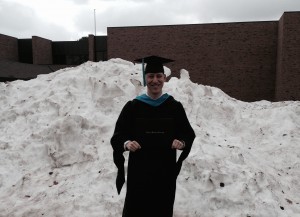
Brian Price with his diploma in snowy Northern Michigan.

Brian Price with his diploma in snowy Northern Michigan.

What’s a fun fact or your favorite memory from grad school?

LM: This won’t seem like a fun memory to most, but at the end of my first semester of graduate school I had to write four papers which were due during finals week for a total of over 60 pages. It wasn’t fun at the time, but it was really fun for me once it was over.

SO: Working on a group project about transit-oriented development and, by my suggestion, injecting corgis into nearly every aspect of our presentation. Too bad we couldn’t get corgi ears headbands as part of the bit…or actual corgis.

BP: Teaching. During my final semester I was an adjunct instructor in my undergraduate academic department, teaching Introduction to Public Address to 23 freshmen and sophomores. It’s fun and I learned so much having the chance to teach a class while in grad school.

RRL: As a grad student, I worked for the Duquesne’s student newspaper, The Duke. In addition to helping me fine-tune my writing skills, all of the hours and late nights spent working on it gave me some of the best memories. My favorite was the “awards” ceremony we did after we finished the last issue of the year each year. We’d spend a week coming up with awards or superlatives for each of the editors and our advisor. I use the word “award” loosely because most of them were poking fun at the recipient or an inside joke we were all in on. Some of them were incredibly heartfelt, though, even if they were tinged with a bit of sass. We’d try to get the issue done as early as we could that night and take turns bestowing these awards on our colleagues, before heading to the nearest pizzeria/bar to celebrate. My favorite award? “Most likely to keep the newsroom waters calm as a proverbial tsunami approaches.”

AS: Traveling to the 2015 Association of Healthcare Journalists conference in San Francisco, meeting incredible reporters from around the country who are telling important health stories.

Considering going back to school or have an experience to share? Tweet us at #NPPRSA 

PR Pros + the APR

Continuing education should be a focal point of every professional’s long-term career plan, but especially for PR pros. Working in an industry that is constantly changing requires lifelong dedication to learning, professional development and adapting. It’s not enough to graduate from college with a degree and to have done well in your coursework; continuing your education past graduation is necessary to be a successful PR professional.

There are plenty of ways to keep appraised of new trends, tools, practices and theories within the industry. Many websites and professional organizations, like Hubspot, PRSA, Skillshare, the American Marketing Association, and Ragan Communications, offer online courses and training opportunities on a wide range of topics. You can become certified in inbound marketing, Google Adwords and Analytics, social media marketing or a number of other skills in a matter of days or weeks. Then, of course, there’s the APR — or Accreditation in Public Relations.

Administered by the Universal Accreditation Board, the APR is a designed to “unify and advance the public relations profession by identifying those who have demonstrated a broad knowledge, experience and professional judgement in the field,” according to the UAB’s website. Professionals who sit for the APR exam must have at least five years of professional experience and a bachelor’s degree or higher. Once you become an APR, you’re required to earn 10 maintenance points every three years to remain an APR. Activities that earn maintenance points include professional development courses, teach, mentor, volunteer, serve in a leadership position, publish a book, and more. Five of the points must be in continuing education and professional development.

There are plenty of arguments out there for and against becoming accredited. Some say that the APR has no value and is just a gimmick to get members to spend more money on courses and memberships to remain accredited. Others say that becoming accredited is the best thing they’ve done for their career and understanding of the profession.

Conflicting opinions from respected professionals inspired my deeper survey into how PR practitioners of all experience levels feel about the APR. Using Twitter and email outreach, I gathered 40 responses to a survey I created to gauge feelings toward the APR. The breakdown of respondents looks like this:

apr

Fifty-one percent of responses showed neutral to negative attitudes toward the APR. Ten respondents were either completely on the fence about becoming an APR or leaning against becoming an APR. Eleven respondents are firmly against becoming an APR.

Of the remaining responses, six professionals had become accredited and 10 were planning to pursue an APR. The three remaining responders were on the fence, but leaning towards pursuing an APR.

Those who were not planning to become accredited cited a lack of value as their main reason not to pursue it. A common sentiment was that, given the way PR and marketing have fused and that PR is no longer strictly publicity- and media relations-based, the APR may be a bit antiquated and not quite relevant to today’s professionals.

One account executive from New Jersey pointed out, “I think it may be more beneficial in a strictly-PR career. For example, leading a large agency or working in-house. I also noticed that many of my professors in undergrad had an APR title. It seemed a bit “old school” to many of my colleagues, and I don’t see it much in the professional world of marketing.”

“I took the test a few years back and didn’t feel it truly represented where the field and professionals are in today’s world,” said the president of a Washington, D.C.-based communications firm.

According to a vice president of PR at an agency in Pittsburgh, “[I decided not to pursue an APR] A few years ago when literally everyone I spoke to in a marketing role had no idea what it was and the fact that many senior PR executives actively said it wasn’t worth it. There is no discernible value to it outside of PRSA and intrinsic personal development. No one knows what it is or why they should care.”

From the information I’ve gathered, the biggest hurdle to becoming an APR is in understanding what, if any, value there is. Many people surveyed felt that there weren’t enough career benefits to justify the time, effort and cost of the APR, especially since it’s not just a one-time investment. According to those professionals who were already APRs, there aren’t necessarily immediate or highly noticeable career benefits. The benefits are primarily personal and in the form of resources, networking and personal accomplishment.

“I think the biggest problem with APR is that many in the field are skeptical of what it can and should do. They point to the lack of rigor in the criteria and say it’s not like becoming a CPA, passing the Bar, or earning a CFP,” said a Pittsburgh APR with 31 years of experience. “They miss the point. In communications, we are free to communicate without license and that’s a good thing. But accreditation is only designed to demonstrate that the individual takes personal pride in his or her commitment to professionalism. Is committed to the code of ethics. And that a third-party (PRSA) has testified to this.”

The 10 responders who said they plan to pursue an APR pointed to a deeper understanding of the profession and validation, credibility and proof of skill as the benefits of the APR. Seven of the 10 professionals plan to begin the APR process in the next five years, while two plan to begin the process in the next year.

So should New Pros consider becoming an APR? Sure, we should consider it. We should have many conversations with other pros of all levels and experiences about it. When it comes down to whether to actually do it, that’s a personal decision.

When I started researching for this post, I thought I had made up my mind that I would become an APR once I had enough experience under my belt. After hearing thoughts from professionals on both ends of the spectrum, I’m not so sure. From my research, I’m not the only New Pro who’s a bit undecided. Seventeen New Pro-level practitioners completed this survey; nine are on the fence about the APR, three are uninterested and five would like to pursue one in the future.

There are so many options out there for professional development that an APR is just one of many options for New Pros to continue to grow over the course of their careers. Since professional development needs to be incredibly personalized, there is no one-size-fits-all formula for what the best options are. The best thing for any New Pro is to weigh all of your options – APR vs. graduate degree, extra courses vs. webinars, etc. – and strike up a conversation with as many other PR pros as you can to bounce ideas around, learn new things and find what might work best for you. 

Robyn Rudish-Laning (1)

Robyn Rudish-Laning is a member of South Carolina’s PRSA chapter and is communications coordinator for the South Carolina Council on Competitiveness. Robyn is also a member of the New Professionals executive committee. She is a graduate of Duquesne University and is currently located in Columbia, SC. You can connect with her on LinkedIn or Twitter or read her blog here.

They Are Not Gray Hairs…They Are Experience Highlights

As a 40-something with no career direction and an imminent layoff, I was at a crossroads in life. A friend recommended a life coach where I discovered an important aspect of my personality. The personal motivator for my feeling happy and successful was a need to elicit reactions from people. It was not about needing positive reinforcement or pats on the back from bosses, but simply having people react to something I wrote, designed, organized, or created. Unfortunately, acting was not an option, so I chose the closest field…public relations.

Twenty years in higher education presented opportunities to dabble in parts of PR. Plan an event here, make a presentation there, learn how to update a website, establish a social media presence, craft a new message to alumni. Rejection reasons for not getting PR jobs was due to not possessing the “right” writing skills or a degree in the field. Job offers actually received were entry-level and half the salary. There were moments of feeling I made the jump to this career too late in life.  Possessing the skills but not the job titles appeared to be holding me back and prohibiting any chance for becoming a PR professional.

Not having aspirations of staying unemployed for 26 weeks led to applying for and getting a position with a non-profit organization via LinkedIn. The job title is far from glamorous (Executive Assistant); however, the salary is competitive and matches the duties. Job tasks land in all facets of social media, branding, media relations, strategic planning, and marketing of the organization.

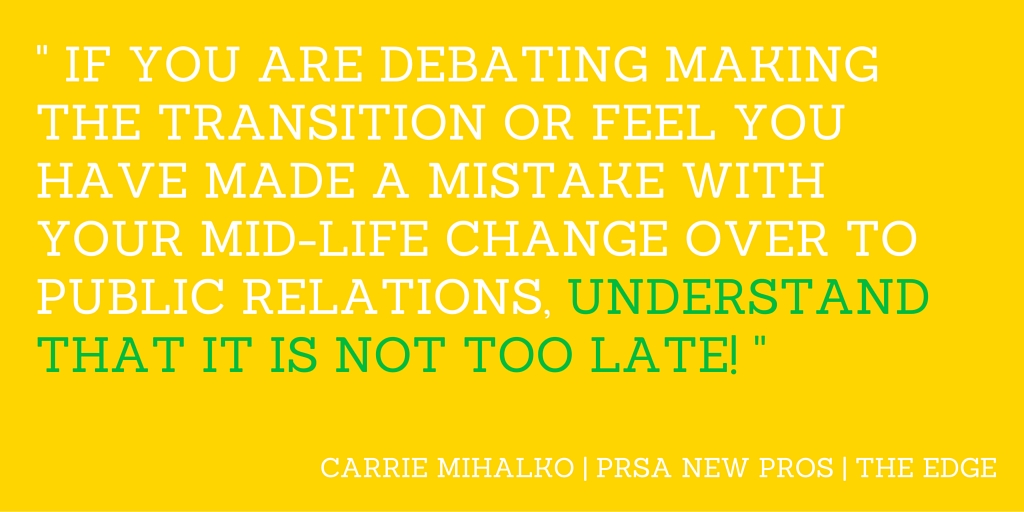
If you are debating making the transition or feel you have made a mistake with your mid-life change over to public relations, understand that it is not too late! Do not limit yourself to looking at corporate positions or competitive firms. As a more seasoned employee, you are what non-profits and small businesses are looking for. They appreciate broad experience and need individuals who are ready to hit the ground running.

If you are debating making the transition or feel you have made a mistake with yourmid-life change over to public relations, understand that it is not too late!

A recent article by Jenny Blake in Real Simple magazine provided strategies to keep in mind when contemplating a new career:

  • Never obsess about what happened in the last job. Those who are over the age of 30 remember the parental lectures of staying loyal to a company. It is not the norm any longer. Take the best parts of your previous positions and move along.
  • Self-Assess. Do the life/career coach thing. Even if you do not want to work with a professional, ask a friend. Take a stab at the StrengthsFinder 2.0 to look at your experience and get some direction.
  • Break up your job search: People, Skills, Opportunities. Jump on that LinkedIn page and schedule some Starbucks time. Register for a class on Coursera. Let Monster do the searching for you with job alerts.
  • Never stop looking. Always look at what else is out there, how you can improve your skills, and who can benefit in the long term. I am always scanning the job sites for the newest titles/duties to develop ideas for skills I may need or want down the road.

Do not lose sight of who you are and the years you have under your belt. Those articles for the company newsletter, Christmas parties planned, and posts on Twitter can transition nicely into a successful public relations career.

MeFiguring she will never have her dream job of writing jokes for Jimmy Fallon, Carrie Mihalko decided to pursue a new career in Public Relations. With over 20 years in higher education and non-profits, she feels like she has seen it all in event planning, fundraising/development, social media, website design, and marketing. Residing in Pittsburgh, Pennsylvania, Carrie works for the Steel Valley Authority as their in-house communications writer/graphic designer/jack-of-all trades. She also does freelance-work creating publications, websites, and social media plans with small businesses and non-profits. Connect with Carrie on Twitter and LinkedIn.


Tips for Mentoring a PR Newbie on the Art and Science of Media Relations

So you’ve been asked to train, mentor, or manage a PR newbie on all things media relations. Congrats! Now what? Media relations is an art and a science. Mastering the balance takes practice, and can be challenging to new PR pros starting out in the workplace as an intern or account coordinator. While some colleges teach media relations, many do not, and those that do often only skim the surface.

That being said, those starting out in the PR world could use media relations guidance – a task that often falls on more senior account coordinators, or account executives and account supervisors. Often the shift from new pro to “less new” pro, responsible for helping out the greenest team members, can be tricky. Here are some helpful hints that I’ve found to be helpful, both as I’ve been mentored and have mentored others.

1. Remember that patience is a virtue, and encourage questions.

lauren-leger_media-relations-mentoring

Be patient with newbies – while you might be an ace at media relations, this is totally new to your mentee, and they will need some time to become an expert. Being patient with them will both encourage and motivate them, and create a more positive experience for both parties. As a manager or mentor, you are responsible for helping newbies build their skillset and confidence. As The Power Group’s account supervisor shared with me when I asked for her advice for this blog post,

“Always have an open door policy for questions. If your new account team member is afraid to ask questions, chances are they’ll come up with their own answers, which can be risky and potentially damage your outreach campaign.”

2. Show and tell – employ a “face-to-face” edits model.

If you receive a less-than-stellar media list from a new pro, don’t be afraid to call him or her over to your desk and go through the list, talking through your thought process. It’s easy to hide not-so-nice feedback behind an email chain, but I’ve found that sharing insight into your own process can be really helpful for new pros. If you’re making a personal connection and talking through your own media relations lessons learned, even better. Don’t hesitate to talk through mistakes made by the intern or account coordinator. It can be tough to deliver that feedback, but it’s crucial for the mentee to hear in order to improve.

3. Give your mentees plenty of opportunities to watch and learn.

I learned so much from my first media relations manager simply by watching how she composed an email to a journalist, coordinated an editorial, or approached booking trade show press appointments. A great (and risk-free) way to learn is simply to soak up everything like a sponge. As a mentor, that means including your mentee in every media relations activity you possibly can. Sitting in on client interviews, tagging along to broadcast segments, and observing media training are all great learning opportunities. Leveraging industry publications and organizations, such as PRSA and Cision, is also a great way for mentees to learn. Mandatory webinars and lunch and learns are a great way for an intern or account coordinator to “familiarize faster,” according to my account supervisor Jordan Liberty.

What are some of the more helpful things your direct supervisors have done to guide you in your media relations learning? What are some tips that you would add to this list?

lauren-leger

As digital account executive at The Power Group, Lauren creates custom digital strategies, crafts tailored social media content, and manages social media accounts on behalf of clients. She also leads Power’s inbound marketing efforts, and is certified by HubSpot Academy in Inbound Methodology. Lauren’s expertise is in B2B and technology. She started at Power in the fall of 2014 as an account executive, and manages select PR accounts. (Connect with Lauren on LinkedIn and Twitter)

3 Questions to Ask Yourself Before Accepting a Job Offer

The internet is full of great advice about how to find a job – where to look, how to approach a hiring manager, what to say in a perfect cover letter – but I’ve noticed that advice on how to identify the right job for you isn’t as abundant.

When you graduate from college, the goal is to find a job in your chosen field with decent compensation, benefits, and an enjoyable work environment. New PR pros often go the agency route to get their foot in the door and soak up as much experience as humanly possible.

After that first job or two, choosing a job gets a bit more sophisticated – at that point you’re at a critical turning point in your career that shapes your professional future. I’m currently happily employed in my second job, after happy employment at my first job, and have been lucky to land two fulfilling opportunities. With that said, I know the questions I would ask myself before accepting my next opportunity would be entirely different than those I asked in the past. Here are three things I would ask myself the third time around.

1. How does this role fit into my long-term vision for my career and life?

At a certain point, the ultimate goal of a job isn’t about getting you to the next job – it’s about getting you closer to your ultimate vision. A job should support your long-term professional AND personal development. It shouldn’t be shortsighted. Does this job offer the work-life balance you will need to fulfill personal goals? What about flexibility and the compensation or benefits needed to save for retirement or buy a house? Time off to support a side hustle? This is the time to understand what is most important to you, and find a job that supports you in that quest.

2. Do my values align with the values of management and my peers?

So important. The more your values and goals align with those of your team, the more motivated job-offer_lauren-legeryou will be to progress together. Carefully notice those who speak with you throughout the interview process. What kinds of questions are they asking? How do they treat you? What’s their body language? All of these things can provide insight into their values and work style. If you don’t feel like it’s a fit, it’s probably not, and you’ll likely run into roadblocks in the job as a result. Go with your gut impression of people and be sure to consider how it will affect your day to day at work. If you don’t consider values in the job search, you may find yourself working with people who are not likeminded, facing an uphill battle every day at work – not fun!

3. Is there an opportunity to contribute something big and make a real impact on the company?

If you’re like me, you quickly get bored doing your actual job as described in your job description. At this point, I’m looking for positions that give me flexibility to explore different areas of marketing, communication and business. This is something I didn’t realize I needed or liked, until I started at my current company. Although I was hired as a PR account executive, I started to become interested in social media and inbound marketing. I talked to our president and CEO about inbound, and she got super excited about it – so excited that she asked me to run with it, so we could offer it to our clients. I also ended up taking over social media work from our then manager of digital services. It turns out she was trying to move into a business development position, and was psyched that someone on our team had the passion and skill to take over for her.

Lesson learned – share your passions and just speak up and ask! Now my role is multifaceted, which can be hectic, but I wouldn’t trade it. I’ve learned so much in the past year, and more than anything, learned something about myself – I need to be constantly learning and challenging myself, and working hard to make a big impact on whatever company I’m a part of.

Managing your own career is a long-term process, but by asking yourself the right questions at the right stages of your career journey, you can ensure you’re setting yourself up for professional success and happiness at work.

lauren-leger

As digital account executive at The Power Group, Lauren creates custom digital strategies, crafts tailored social media content, and manages social media accounts on behalf of clients. She also leads Power’s inbound marketing efforts, and is certified by HubSpot Academy in Inbound Methodology. Lauren’s expertise is in B2B and technology. She started at Power in the fall of 2014 as an account executive, and manages select PR accounts. (Connect with Lauren on LinkedIn and Twitter)