I wear a big “NERD” sign around my neck whenever I think of advanced degrees. I’m one of those who really enjoys learning and I ::cough:: likeschool ::ahem::
Truth be told, I already have an M.S. in Journalism. I graduated 4 years ago, and aside from being a better writer, I don’t think I’ve really seen the benefits I expected from of my degree. Sometimes I play around with the idea of getting another, different degree. Then I wonder whether all the things I assume about the long-term benefits of graduate school are true. Does the graduate degree really make you more marketable? Is it worth it to forgo experience to pursue a degree?
To answer these questions, I surveyed 32 of our PRSA members with graduate degrees, and asked them to weigh in on several questions. Some of them graduated 2 years ago. Some of them graduated 25 years ago. This post, I’ll cover the 24 members with MA/MS degrees. Next week, we’ll look at those with MBAs.
Overall, PR pros with MA and MS degrees believe graduate degrees either make you more marketable because the degree puts you “on par” with colleagues or gives you a competitive advantage. There seems to be
Will a graduate degree really make me more marketable?
If you’re considering it, you probably want to go to grad school for one of three reasons: professional development/advancement, a career change, or personal development.
More than half of the people we surveyed went to grad school looking for professional development and advancement. The idea is your gumption in the classroom makes you a little more interesting than other candidates for that promotion or position. But is this really the case?
“Yes!” say 66%.
Several said their graduate degree qualified them for positions they were interested in. But the greater benefits seem smaller, two-thirds of those surveyed said that their graduate degree has provided everything from strengthened skills to credibility. Here were some of the responses:“My Masters degree has earned me automatic respect amongst colleagues and supervisors and has gotten my foot in the door in places I may not have had the opportunity to get into otherwise.”
“I believe it has given me increased credibility when pitching PR programs, particularly among clients with advanced degrees.”
“Not Sure,” say 33%
8 people said either they didn’t know whether their graduate degree has helped them professionally, or that they suspect it didn’t help them. One person reflected the attitude of at least half the group, saying, “I don’t believe the credential has ever swayed a future employer or client positively towards me.”
Several who said they weren’t sure if their graduate degree helped them professionally said they still valued the experience.
What are the cons of graduate school?
Of course, graduate school isn’t all roses. It has cons, aside from time and money. Our respondents named three, including the most cited time and money, which was mentioned by 8 respondents.
Delaying Experience
5 (all with MAs) said a major con of pursuing a masters degree is “delay in professional experience.” In the words of one respondent, “Cons: Cost, time, effort, and you still need to obtain the on-the job training either during your studies or after.”
Overqualified
Another downside, highlighted by 3: being overqualified. “[A graduate degree] puts you in the marketplace a bit behind other people your age, earning begins later, ‘too qualified’ for the first few interviews.” One respondent with more than 5 years experience notes that the air of overqualified dissipates eventually. Those with less than 5 years experience didn’t.
How much experience should you get before grad school?
None necessary
Only those who said they went straight from undergraduate to graduate school said experience prior to graduate school didn’t matter. (“I went straight through to get the MA after undergrad, and I didn’t find lack of work experience a hinderance to the degree.”)2 to 5 years.
Everyone else (20 respondents) recommended 2 to 5 years experience before attending graduate school.Some note that experience gives you a practical perspective on the theories presented in class. “The best interactions/contributions came from students who had been in the workforce a while. More frequently, the students who when from degree program to degree program and never left the college atmosphere didn’t have anything to contribute.”
Others noted that work experience helped them to select the right graduate program. “If I went to graduate school directly out of undergraduate school, I would have chosen an advanced degree in journalism. But after working for two years, I had no desire to working in the field of journalism. My second job out of undergrad made me realize my love of marketing and public relations.”
Are graduate degrees becoming necessary?
It’s the old experience versus education debate. Are graduate degrees becoming so commonplace that they are necessary to get a job or advance in your career?
No. Go for experience.
3 people said they thought graduate degrees are nice to have, but are not necessary for careers in public relations. “Truthfully, an advanced degree is not needed to succeed in public relations.”Yes! Get that degree!
6 people believed a graduate degree will allow you to “keep up” with your peers. “A graduate degree is now considered a regular requirement for some positions so it may not provide as much of a competitive advantage as it did in the past.”
Which degree is best?
“If you’re not working in a field your passionate about, it will show, and it will be a miserable way to earn a living.” In other words, pick a degree that will help you get your dream job. Sounds easy enough, right?
9 people, more than two-thirds, who took the survey said that any graduate degree would work, as long as you’re choosing the degree that will help you meet your career goals. One respondent said, “Consider a law degree, or further study in your field such as political science, history, biology, art history, etc. Specialized knowledge in ofetn more saleable than theory of communications.”
Here are some suggestions, our respondents have some suggestions.
MA/MS Public Relations
9 of our respondents said an advanced PR degree would be the most beneficial, and only 6 of these individuals have MA/MS PR themselves.MA/MS Communications
4 said an advanced Communications degree would be the most beneficial. 2 of these individuals have MA/MS Communications themselves.MBA
3 said, hey, get yourself an MBA focusing in Business, Marketing, or Communications.MA/MS Journalism
2 said to go for a graduate degree in journalism.
“If I knew then what I knew now, I would…”
To finish the survey, we asked our respondents to give some advice to our New Professionals members. Their advice is posted to our eGroups page, and available for PRSA New Professionals members only.
_______
Some of the demographic info.
Overall, those who responded to the survey are experienced. Most have years of professional perspective between their graduation date and today.
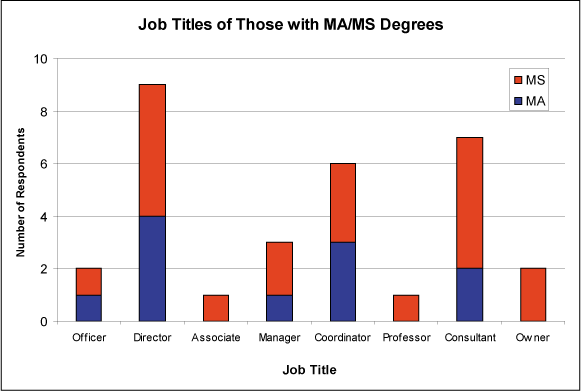
24 PR pros from PRSA weighed in on our survey. Their job titles ranged from Coordinator to Officer, Professor to Principal. (See the job titles of those who responded to the survey. Job Titles of Those with MA/MS Degrees)
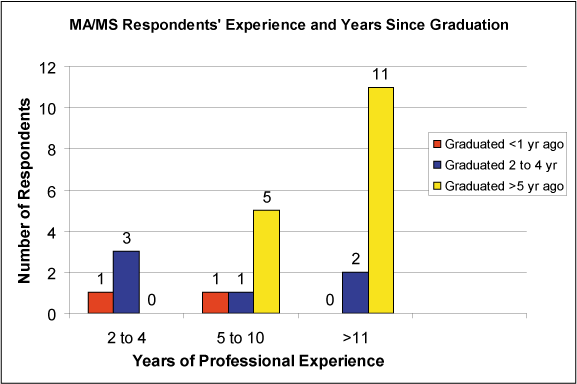
Of these pros, 11 (or about 50%) graduated more than 5 years ago and have worked in the PR for more than 11 years. (The graph describes the years of experience and the years since graduation of each respondent with an MA/MS. MA/MS Professional Experience and Years Since Graduation)
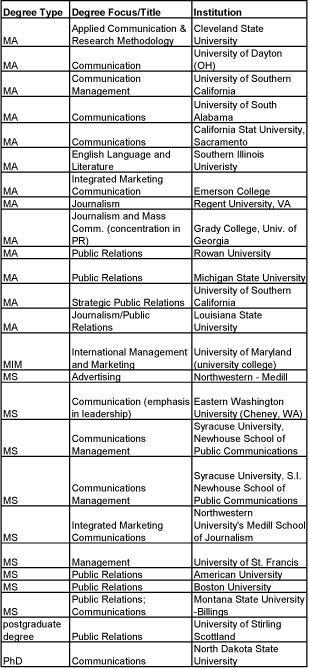
See the directory of schools our respondents attended. Directory of MA and MS Degrees