personal branding… My Personal Branding Experience by Brittney Gillison

Unlike most PR/Communication students, I did not complete any internships while in college and as we all know, the key to obtaining an entry level position is experience. Because I didn’t have any real work practice it was very important for me to build my personal brand. I needed to demonstrate professionalism and capability that could overshadow my lack of experience, and I needed to promote myself through networking.

After graduation, I took advantage of the discounted rate for recent grads and joined PRSA and the local PRSA chapter.  I attended as many networking events as possible (most chapters offer student and recent-grad admission prices).  I researched online for free business cards and got them printed through Vista Print. I developed business cards with my contact information so that I could hand out something at these events and more so to stand out and be memorable.  Although, I didn’t have a job or own my own company, I had business cards.  Pretty impressive!

I knew I wanted to pursue a career in PR, but I didn’t know what route I wanted to take, and I knew it was important to maintain my networks and build new relationships. The summer after I graduated was filled with informational interviews, internship interviews, full-time interviews, and volunteer positions because it was important to build my resume and get my name out in my area.

As summer came to an end, my professionalism and relationship-building paid off.  I was offered an internship in the PR department of a local advertising agency.  It was a perfect match–I was more mature than your typical intern; however, they didn’t have to pay me an entry level salary, and I was treated as an extension of their team. I had accounts and projects of my own to work on. It was a great resume and portfolio builder.

One key thing I learned that summer is that it’s important to develop your own brand to show companies just a taste of what you can do for them!

BRITTNEY GILLISON (PR Coordinator, University of Pittsburgh) is a graduate of Slipper Rock University with a bachelor’s degree in communication.  Brittney currently serves as the public relations coordinator for the University of Pittsburgh’s Office of Institutional Advancement, where she supports the communications and marketing program for the University’s $2 billion fundraising campaign.

your PR career… PR Graduate School (Part 2: MBA vs MA/MS) by Janet Krenn

“The earning begins later.” That’s how one survey respondent described career advancement after obtaining her MS.

I had a similar experience after obtaining my MS in Journalism. I had the advanced degree, but the riches were nonexistent. It made me wonder, was I lacking the right degree or was I lacking perspective and experience?

I thought, it would have been useful to talk with those who had a graduate degree and several years of experience under their belt before I decided on a grad program. That thought led to my survey.

I asked 32 seasoned PR professionals with graduate degrees to help me put graduate school in perspective, and (hopefully) gain some additional insight for those who are still considering a graduate degree, In last week’s post, we looked at 24 pros with MA or MS degrees (Seasoned Pros Talk About Grad School, Part 1). This week, we’ll hear from 8 with MBAs.

Why get an MBA?

Just like those with MA and MS degrees, the respondents with MBAs decided to pursue graduate school for career advancement, personal development, or career changing.

Unlike their MA/MS counterparts, however, MBAs who cited career change, chose an MBA because they believed it would help them become more specialized in corporate communications or it would help them to move from one branch of corporate communications to another. (Those with MA and MS degrees cited changing fields as impetus for getting their degree.)

What degree differentiates you best?

Those with MBAs were much more likely to say that their degree has helped to differentiate them from their peers. 75% of those with MBAs said their degree was a differentiator, compared to 40% of those with an MS degree and 0% with an MA.

What should you consider when choosing a grad school?

If you ask those with MBAs, 75% say you should choose a program based on the quality and variety of the courses offered. MA or MS grads say, choose a subject matter you like the most.

Is there a credibility gap?

Those with MBAs were more likely to perceive that their degree gave them “credibility” in the work place. 75% MBAs thought their degree made them more credible than their peers. 25% of those with MA or MS degrees sited increased credibility.

Benefits of getting a graduate degree?

Half of those with MBAs believed business school gave them a new, useful perspective in their job. The most respondents cited a “new perspective” as a major benefit of having attended grad school.

There was less agreement among those with MA and MS degrees. About 20% said the degree hasn’t seemed to help them get better jobs or earn more money. The same number said they believe their graduate degree has helped them to earn more.

“If I knew then what I knew now, I would…”

To finish the survey, we asked our respondents to give some advice to our New Professionals members. Their advice is posted to our eGroups page, and available for PRSA New Professionals members only.

_______
Some of the demographic info.
Overall, those who responded to the survey are experienced. Most have several years of professional perspective between their graduation date and today.

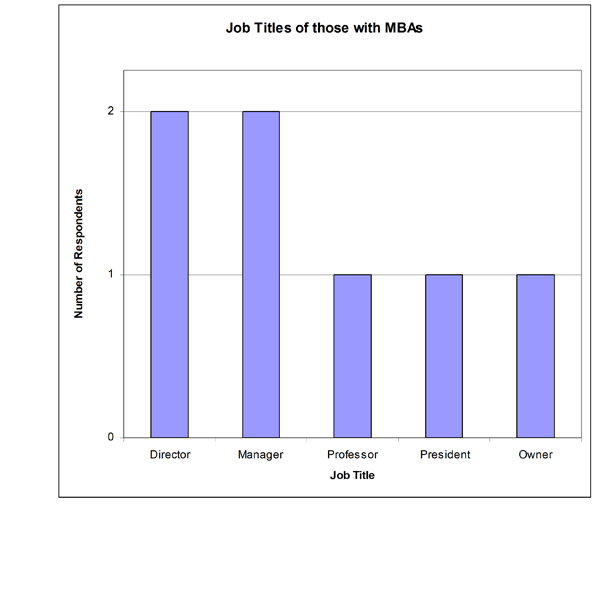
8 PR pros with MBAs. (See the job titles of those who responded to the survey. Job Titles of Those with MBAs)

Of these pros, 6 (or 75%) graduated more than 5 years ago. 7 respondents had more than 11 years experience in the PR field.

See the directory of schools our respondents attended. Directory of MBA Degrees

your pr career… PR Graduate School (Part 1: MA/MS) by Janet Krenn

I wear a big “NERD” sign around my neck whenever I think of advanced degrees. I’m one of those who really enjoys learning and I ::cough:: likeschool ::ahem::

Truth be told, I already have an M.S. in Journalism. I graduated 4 years ago, and aside from being a better writer, I don’t think I’ve really seen the benefits I expected from of my degree. Sometimes I play around with the idea of getting another, different degree. Then I wonder whether all the things I assume about the long-term benefits of graduate school are true. Does the graduate degree really make you more marketable? Is it worth it to forgo experience to pursue a degree?

To answer these questions, I surveyed 32 of our PRSA members with graduate degrees, and asked them to weigh in on several questions. Some of them graduated 2 years ago. Some of them graduated 25 years ago. This post, I’ll cover the 24 members with MA/MS degrees. Next week, we’ll look at those with MBAs.

Overall,  PR pros with MA and MS degrees believe graduate degrees either make you more marketable because the degree puts you “on par” with colleagues or gives you a competitive advantage. There seems to be

Will a graduate degree really make me more marketable?

If you’re considering it, you probably want to go to grad school for one of three reasons: professional development/advancement, a career change, or personal development.

More than half of the people we surveyed went to grad school looking for professional development and advancement. The idea is your gumption in the classroom makes you a little more interesting than other candidates for that promotion or position. But is this really the case?

“Yes!” say 66%.
Several said their graduate degree qualified them for positions they were interested in. But the greater benefits seem smaller, two-thirds of those surveyed said that their graduate degree has provided everything from strengthened skills to credibility.  Here were some of the responses:

“My Masters degree has earned me automatic respect amongst colleagues and supervisors and has gotten my foot in the door in places I may not have had the opportunity to get into otherwise.”

“I believe it has given me increased credibility when pitching PR programs, particularly among clients with advanced degrees.”

“Not Sure,” say 33%

8 people said either they didn’t know whether their graduate degree has helped them professionally, or that they suspect it didn’t help them. One person reflected the attitude of at least half the group, saying, “I don’t believe the credential has ever swayed a future employer or client positively towards me.”

Several who said they weren’t sure if their graduate degree helped them professionally said they still valued the experience.

What are the cons of graduate school?

Of course, graduate school isn’t all roses. It has cons, aside from time and money. Our respondents named three, including the most cited time and money, which was mentioned by 8 respondents.

Delaying Experience

5 (all with MAs) said a major con of pursuing a masters degree is “delay in professional experience.” In the words of one respondent, “Cons: Cost, time, effort, and you still need to obtain the on-the job training either during your studies or after.”

Overqualified

Another downside, highlighted by 3: being overqualified. “[A graduate degree] puts you in the marketplace a bit behind other people your age, earning begins later, ‘too qualified’ for the first few interviews.” One respondent with more than 5 years experience notes that the air of overqualified dissipates eventually. Those with less than 5 years experience didn’t.

How much experience should you get before grad school?

None necessary
Only those who said they went straight from undergraduate to graduate school said experience prior to graduate school didn’t matter. (“I went straight through to get the MA after undergrad, and I didn’t find lack of work experience a hinderance to the degree.”)

2 to 5 years.
Everyone else (20 respondents) recommended 2 to 5 years experience before attending graduate school.

Some note that experience gives you a practical perspective on the theories presented in class. “The best interactions/contributions came from students who had been in the workforce a while. More frequently, the students who when from degree program to degree program and never left the college atmosphere didn’t have anything to contribute.”

Others noted that work experience helped them to select the right graduate program. “If I went to graduate school directly out of undergraduate school, I would have chosen an advanced degree in journalism. But after working for two years, I had no desire to working in the field of journalism. My second job out of undergrad made me realize my love of marketing and public relations.”

Are graduate degrees becoming necessary?

It’s the old experience versus education debate. Are graduate degrees becoming so commonplace that they are necessary to get a job or advance in your career?

No. Go for experience.
3 people said they thought graduate degrees are nice to have, but are not necessary for careers in public relations. “Truthfully, an advanced degree is not needed to succeed in public relations.”

Yes! Get that degree!
6 people believed a graduate degree will allow you to “keep up” with your peers. “A graduate degree is now considered a regular requirement for some positions so it may not provide as much of a competitive advantage as it did in the past.”

Which degree is best?

“If you’re not working in a field your passionate about, it will show, and it will be a miserable way to earn a living.” In other words, pick a degree that will help you get your dream job. Sounds easy enough, right?

9 people, more than two-thirds, who took the survey said that any graduate degree would work, as long as you’re choosing the degree that will help you meet your career goals. One respondent said, “Consider a law degree, or further study in your field such as political science, history, biology, art history, etc. Specialized knowledge in ofetn more saleable than theory of communications.”

Here are some suggestions, our respondents have some suggestions.

MA/MS Public Relations
9 of our respondents said an advanced PR degree would be the most beneficial, and only 6 of these individuals have MA/MS PR themselves.

MA/MS Communications
4 said an advanced Communications degree would be the most beneficial. 2 of these individuals have MA/MS Communications themselves.

MBA
3 said, hey, get yourself an MBA focusing in Business, Marketing, or Communications.

MA/MS Journalism
2 said to go for a graduate degree in journalism.

“If I knew then what I knew now, I would…”

To finish the survey, we asked our respondents to give some advice to our New Professionals members. Their advice is posted to our eGroups page, and available for PRSA New Professionals members only.

_______
Some of the demographic info.
Overall, those who responded to the survey are experienced. Most have years of professional perspective between their graduation date and today.

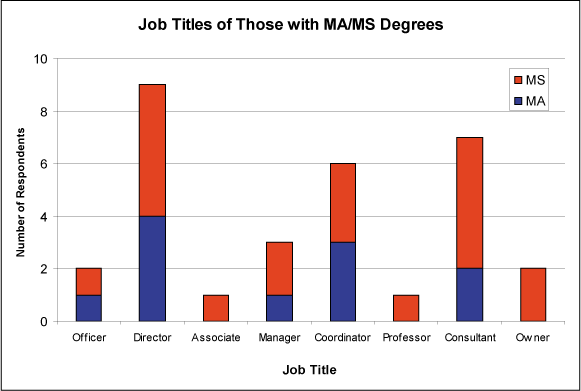
24 PR pros from PRSA weighed in on our survey. Their job titles ranged from Coordinator to Officer, Professor to Principal. (See the job titles of those who responded to the survey. Job Titles of Those with MA/MS Degrees)

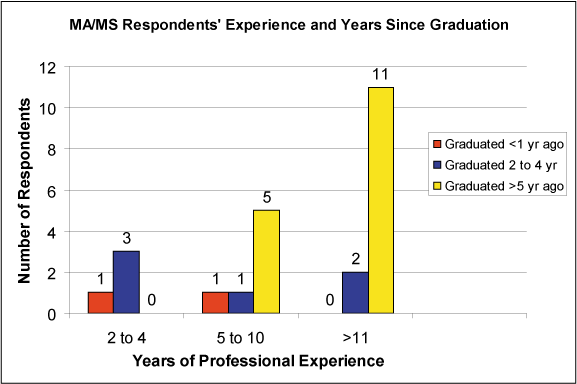
Of these pros, 11 (or about 50%) graduated more than 5 years ago and have worked in the PR for more than 11 years. (The graph describes the years of experience and the years since graduation of each respondent with an MA/MS. MA/MS Professional Experience and Years Since Graduation)

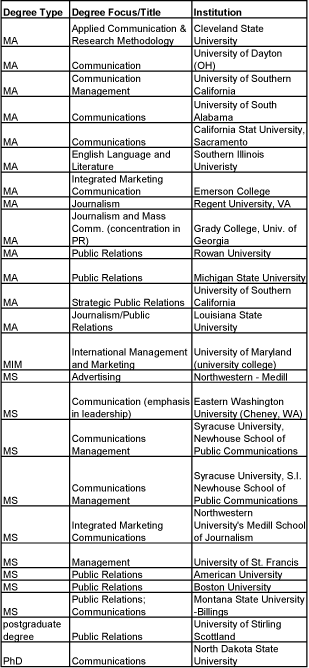
See the directory of schools our respondents attended. Directory of MA and MS Degrees

Who’s the New Girl?

“Show me an intern who never made a mistake, and I’ll show you an intern who stayed an intern.”

If someone hasn’t already voiced this sentiment, then I’ll take the credit for it. As a new intern at a small PR agency, I’m fortunate to have made my requisite Big Mistake. It was simple really, I printed something for a press kit on the wrong letterhead. But rather than calmly assess the mistake and set about the business of rectifying it, I had a little freak out moment. In earshot of an AAE. “Stop freaking out,” she snapped. “We’ll just print up some more letterhead, no big deal.” That would have been my solution to the problem in about 5 minutes, after I had finished my mini-spaz. But evidently, my snafu didn’t even warrant a full minute’s hysterics.

What I took from the experience (and what’s the point of making glaring mistakes if they don’t come with bonus lessons?) was not to keep my mishaps a secret. But to keep calm and carry on. As an intern, I’m expected to futz up a few things. But as a professional, I’m expected to rationally assess the situation and reassure those around me that there’s a resolution forthcoming or gain their assistance on how to go about correcting it. Disproportionate reactions inspire suspicion and mistrust. You don’t want to be known as the girl or guy who gets knocked off track by every paper cut. I’m pleased to say, composure regained, I set about the task of fixing the letter head and the press kit got out without further incident. My chant of “OMG! OMG! OMG!” was perfectly acceptable–as long as it stayed in my head.

Toni V. Martin is a freelance journalist making the transition into full-time public relations. She is currently interning at a full service PR firm outside of Atlanta. She is originally from Detroit and has her degree in English from the University of Michigan-Ann Arbor. She can be reached at tonivpr@gmail.com

Thoughts and Fears of a PR Newbie

With only one official year under my belt, I am still asking myself the same questions I had the day I graduated. Am I good enough? What am I worth as a professional? What do I have to offer?

I would be willing to bet that many of you are asking yourselves the same questions. Maybe you took a job that is less than what you had expected or wanted, and are now feeling unchallenged and underappreciated. Or maybe you feel ready to move ahead in your career, but are having a hard time finding the right fit for you.

How exactly do you overcome these feelings of intimidation and, sometimes, anxiety?

Here are some things that I have found to be extremely helpful in strengthening the beginning of my career:

Evaluate yourself on a regular basis.

What do you do? Do you like it? Have your projects been successful? What are some ways that you can improve? What would you like to be working on? How can you incorporate that into your daily tasks?

Ask yourself an insane amount of questions and answer them truthfully. You’ll be surprised what you’ll learn about yourself.

Make every moment of your job count.

Yes, this is so very obvious, but so very important. There are times when my workload is extremely light… or nonexistent. This is when I really dig deep into my skill set and find ways to improve how I work.

Another thing you can do is look into your company’s sales/marketing materials, press kits, and other documents and think of ways that you would update them. If you feel confident about your ideas, share them with your superiors (they’ll be surprised by your initiative).

Do freelance work.

Besides looking great on a resume, freelancing is tons of fun and allows you to explore other talents that you don’t get to use in your full-time job.

Sometimes you’ll have to take several jobs with no compensation, so it’s important to find something that you enjoy doing or that you really care about.

Volunteer.

Again, this looks good on a resume, and can also be a lot of fun and rewarding. Many organizations are looking for extra help in their public relations/communications efforts. If you feel passionate about an issue or organization, form relationships and offer to help whenever a need arises.

Doing these things will not only strengthen your professional skills and image, but it will teach you so much about yourself as an individual.

Have a few more tips that you’d like to share? Leave a comment and tell us about it!

About Paige Presley: With a public relations degree from Middle Tennessee State University and experience in both corporate and agency public relations, Paige now serves as a marketing assistant at Lightning 100, Nashville’s favorite independent radio station. She is also the Chapter Development Committee Chair for the PRSA New Pros group.When she’s not at work, Paige enjoys taking on various freelance projects and volunteer activities with organizations like the American Red Cross and NashvillePAW magazine.(This post can also be found here.)