What Every New Pro Should Know: As Shared by Edelman Immersion Program Employees and Graduates

Editor/Guest post note: The Edelman Immersion Program is a highly competitive program where participants spend 18 months rotating across different Edelman departments to learn the business and determine long-term career goals. 

Are you a new PR pro looking to succeed in this fast-paced and ever-changing environment? Graduates and current participants of the Edelman Immersion Program have gathered their wisdom to share with PRSA New Pros. Take a look at what members from all three of the company’s Immersion classes had to share from their unique experiences.   

edelman

Herschel Kissinger, Class of 2015 – Currently in Program

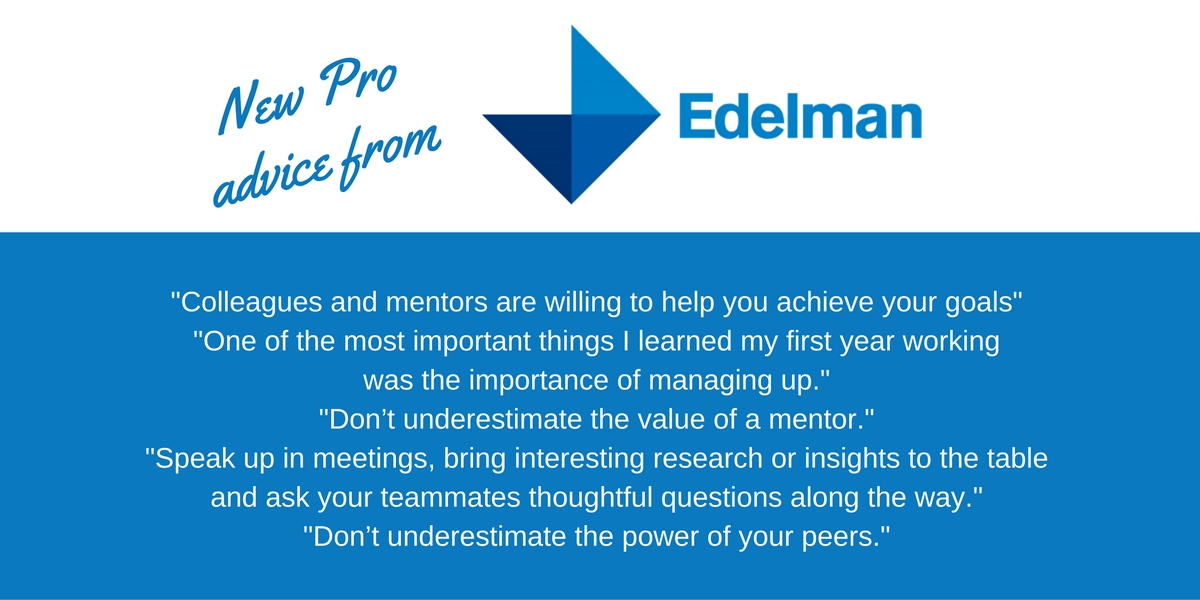
A piece of advice that I often need to remind myself of: nobody is a mind reader. Colleagues and mentors are willing to help you achieve your goals—if they know what those goals actually are. Don’t be afraid to start those conversations yourself.

From working across five different practices at Edelman, I’ve learned that we have an expert or specialist for nearly everything. If you’re starting a new project in an unfamiliar space, the good first question to ask is “Have any of my colleagues done this before?” Often a 15-minute conversation with a subject matter expert gets you a lot more information than an hour of Googling. 

Molly Shaheen, Class of 2015 – Currently in Program

Allow yourself to think of your role as you thought of college. In a communications agency, your clients and projects are your curriculum and each is an opportunity to gain knowledge on new things.

During your career, you’re going to have those core accounts that you always work on, much like the core classes for your degree. If you navigate things right, you’ll have room to take a couple electives down the line. Keep your eyes open and raise your hand for projects that pique your interest and are outside of your day-to-day role.

Don’t forget what your professors preached – participation! Speak up in meetings, bring interesting research or insights to the table and ask your teammates thoughtful questions along the way. It will help make you stand out.

Lissa Pavluk, Class of 2013

Don’t underestimate the value of a mentor. Find someone a few levels above you who is willing to help you navigate complex situations, give sage advice based on their own experiences and help you understand how to best grow your career. Your HR department should be able to help you facilitate this if you have trouble identifying someone on your own. The best part? You may end up with not only a mentor, but a good friend!

Jenna Wollemann, Class of 2011

One of the most important things I learned my first year working was the importance of managing up (or simply put, making the lives of your managers easier). Entry level employees are expected to be one step ahead, paying close attention to project timelines and various tasks for the team. When I joined Edelman, I quickly learned that you sometimes have to over-communicate with managers and team leaders so they know what the status of your projects are and when they can expect various deliverables. Over-communicating and managing up can be tough at first, but managers have no way of knowing what’s going on unless you tell them.

Additionally, be resourceful and don’t be afraid to ask questions! These traits go a long way. It’s always better to raise your hand to your manager before diving into a task if you’re unsure about something. Also, don’t underestimate the power of your peers. Other colleagues at your level can be fantastic resources if you have questions or ideas, considering it’s likely they have encountered similar experiences or issues.

Interested in applying for Edelman’s Immersion Program? More information can be found here.

Turning Your Internship Into A Full-Time Job

On the first day of my internship, I was handed a laptop, emailed a contract, and shown to my desk. That’s all. No new-hire orientation, no manual; the rest was up to me.

That was nearly three years ago. The trajectory of my internship relied entirely on my own ambition, and quite frankly, my desire to land a job. From my 8-month “audition” I found that there are three basic practices that interns should adopt in order to land a full-time offer.

Follow the Leader

It won’t be difficult to identify the individuals that you admire at your internship. Do some calendar stalking and you will find the leaders—their calendars will be packed with meetings since colleagues crave their input. Ask to join those meetings, as many as they will allow you to attend, and then, stop, sit, and listen. Really listen to the dialogue taking place inside the room, absorb what’s working, and make note of what isn’t.

As an intern, this practice almost felt like cheating. I had regular exposure to the most brilliant minds of the business.

Be a Duck

On the heels of one of our largest, most stressful, customer events of the year, my boss at the time, pulled me aside to share some advice that will stick with me for the rest of my professional career. “Today is going to be hectic,” she said. “Something will go wrong and it will be overwhelming, but all the while, you need to be a duck. Paddle furiously beneath the water and work through the chaos, but maintain cool composure up top where people can see you.”

Every day of your internship is a test of your ability to handle stress and problem-solve. Don’t let them see you sweat. Be a duck, and paddle like crazy. This is an indicator of how you will handle added responsibility as a full-time employee.

elizabethBe Better than Coffee, but Don’t be Above Coffee

Without question, your attitude will be one of the deciding factors of your future employment. In the investment banking world, it’s called the “punch test.” You’re working long hours, you’re stuck alongside the person in the other cubicle—is that person someone you want to be in the trenches with? Or will you fantasize about punching him after 2 months?   

In the tech world, there are common tasks that test your willingness to get your hands dirty. It’s  a “coffee run” or a seemingly never ending source of data that needs to be inputted into a spreadsheet. It’s something that every intern will and should have to experience. Don’t groan, don’t eyeroll, and for godsake, don’t mess up.

Be willing to do any job, but elevate yourself to the point where you’re trusted to do any job. What’s been stereotyped as a demeaning “intern task” is an exercise in teamwork and, depending on the complexity of the order, attention to detail. Be the person who gets coffee AND thrives in your role.       

In that same vein, I would be remiss to not call out to the employers who are reading this: there is a wealth of opportunity for you to learn from your intern and for your intern to learn from you. I was incredibly fortunate to intern with a company that recognized the value of giving interns an opportunity to earn their stripes and take on meaty projects. Interns don’t have to just be coffee runners and spreadsheet fillers, if you nurture their hunger and talent, you’re able to get a great sense of the type of full-time employee that will be. Hiring and onboarding an intern who has a deep knowledge of the company and a proven willingness to learn, saves you both time and money. And that’s just good business.

SamanthaSubarSamantha Subar is a Global PR Manager at Spredfast. She appreciates good sushi and data stories. Preferably combined, if possible. Connect with her on Twitter and LinkedIn.

Be Unstoppable: 5 Ways to Build Confidence as a New Pro

Beginning as a new PR pro is exciting, but it can also be unnerving. Suddenly, you are no longer a student or intern – you are now taking on more significant roles within projects. As a new pro, you may interact with or even work alongside managers, directors, vice presidents and possibly even C-level executives. Being the newest professional on a team may challenge your confidence, but don’t let self-doubt undermine your skills and abilities. Here are five things you can do to help build your confidence:

1. Ask Questions

You’ve probably heard people say “knowledge is power,” and in many cases, that’s true. It’s natural to want to appear knowledgeable in the workplace, but having incorrect or incomplete information is far more costly than simply asking for clarification. Asking questions show that you are engaged and focused on accuracy. On top of that, having accurate information and a firm grip on what you are working on will make you more comfortable and confident.

2. Be Teachable

Being teachable is an incredibly important attribute for new professionals. An important part of being teachable is being open to feedback from others. As you may see over time, many seasoned professionals enjoy helping those who are newer to the field. Be humble and listen to those who are willing to share their knowledge and wisdom. Learning this way will not only help you feel more confident, but it will also help you build relationships with the pros who want to help you learn.

3. Remember Your Accomplishments

When you are working on a challenging project, or things just aren’t going your way, it can be easy to lose sight of all the things you have accomplished. It can be helpful to just take some time and reflect upon where you are and where you began. Think back even just a few years ago – what have you accomplished in that timeframe? Now think about where you are and where you could be a few years into the future. Remembering your accomplishments can serve as a reminder of the great things you are capable of doing and help build your confidence.

4. Make a Plan

When it comes to confidence, knowing where you want to go will help. You don’t have to have your entire life figured out today, but perhaps you plan on earning a Master’s degree by the time you’re 28, or you’re thinking about completing your Accreditation in Public Relations (APR) through PRSA within the next three years. Having a plan will help you feel more confident about your future, which can translate to increased confidence in the workplace.

TWITTER_jeff-adkins

5. Learn from Mistakes

Mistakes – we all make them. Some are larger than others, but all mistakes have one thing in common: we can learn from them. Understanding what went wrong and why can help prevent the same mistake from happening twice. The most important thing about learning from mistakes is to not beat yourself up. Shake it off and learn from them – tomorrow is a new day to shine.

Jeff-200x300

Jeff Adkins is a public relations associate for Henry Ford Health System in Detroit, Michigan. An active member of PRSA Detroit, Jeff enjoys connecting with fellow PR pros and seeking out new professional experiences. He obtained his Bachelor’s in Public Relations in 2014 from Wayne State University (WSU), where he was a member of the WSU PRSSA executive board and a peer mentor for students entering the PR program. In his free time, Jeff enjoys kayaking and staying active outside. Feel free to connect with him on Twitter and LinkedIn.

How My Mentors Helped Me Decide to Make a Career Change

Editor’s Note: This post is part of our ongoing #MemberMonday series. Each week, we will share content focused on our New Pros members and how PRSA benefits them. Follow us on Twitter at @PRSANewPros and share your stories using #MemberMonday.

Deciding whether or not to leave your first job isn’t easy. There are a lot of questions to consider. Is it the company you don’t like or is it the industry? Is it the agency world or your particular agency? Have you done all you can to grow and love your job? Do you want to relocate and, if so, can you afford it?

Deciding whether or not to

Fortunately, mentors and other resources can help. As I debated whether to leave the agency world, here are a few lessons I learned from my mentors.

Build a network before you need one

When I started considering a career change, I decided to consult my mentors. Fortunately, I’d been building up a network for the past couple years, so it was easy to think of people to reach out to.

Here are the three types of mentors I consulted:

  1. Seasoned professionals. These are the well-connected, executive-level people who can relate best to the hiring managers who will be looking at your resume.
  2. Young professionals. Mentors who were where you are just a few years ago can relate to what you’re going through and offer timely advice.
  3. Mentees. I’ve found my mentees are so wise that they end up mentoring me in the process.

Don’t have mentors yet? PRSA Mentor Match is a great tool PRSA members can use to connect with seasoned professionals. I developed a corporate mentor who was very helpful in my decision.

Stop worrying about appearing like a job hopper

I, like most Millennials, was worried my résumé would look bad if I left my first job before the two-year mark. But then a mentor told me that’s a myth. Sure, some PR people may think you look like a job hopper, but it all comes down to the story you tell.

As long as you have a good story for why you jumped and if you are truly concerned with finding the right long-term fit, it shouldn’t matter if you leave your first job earlier than expected.

The key is to make sure you are making this change for the right reasons and that you’ve done all you can to be happy in your first job. Before leaving, outline the path you’d like your career to take. Will your current job help you get there? Have you done everything you can to carve the path you want? Have real conversations about your goals with your supervisor before deciding to leave.

Make a decision you can live with

Two people recently told me, “Your career is too short to be unhappy with your job. Why stay if you aren’t happy?” It seems so simple, but it can be hard to come to terms with. Just remember, there’s a difference between having a bad week and having a bad job.

Everyone will have opinions about your career path. But no matter what they tell you, you’re the only one who will be with your employer for 40-plus hours a week. You’re the one whose career is on the line.

Sure, some people will still tell you that you have to stick it out for a year or two. But in the end, it’s your decision. Make the one that feels right.

AAEAAQAAAAAAAAl1AAAAJGM5NWQyMTZkLWFlZTAtNDU1OS05NDZiLTgxYTU2ZDNjZGJmNgHeather Harder is the programming co-chair for PRSA New Professionals and a former national president of PRSSA. Follow her on Twitter at @HeathHarder.

Book Preview: “Public Relations for the Public Good: How PR has shaped America’s social movements”

public relations

Editor’s note: The below Q&A with Shelley Spector previews her forthcoming book, available in August. 

You have a forthcoming book coming out this summer, “Public Relations for the Public Good: How PR has shaped America’s social movements.” Could you provide a synopsis?

The book (co-authored with Lou Capozzi) explores how public relations activities have been used to make social movements more successful.  While they were not called “PR” at the time, nor did they involve “professional” PR people, these historical milestones were, nevertheless, powered by people who understood public opinion and how to influence it. So there’s a lot to be learned about strategy, messaging, impacting attitudes, and measuring one’s impact.

The topics in the book include a wide range of topics spanning the 20th century: including, the Triangle Shirt Waist factory fire, the Harlem Renaissance, anti-smoking campaigns and civil rights campaigns.  To me, the most exciting thing about the book is that my students wrote most of the chapters.  This was for the class I teach at Baruch College/CUNY:  “From Plato to Twitter: A History of Influence, Media and Public Opinion.”   It’s exciting that our students have a chance to be published!

IMG_0609What inspired you to write the book?

While I find PR history fascinating, I find PR in history even more fascinating. When you look at historical events through the lens of PR, it often reveals PR in its purest sense. With social media dominating much of the workday of PR people, it’s important that young professionals understood that the Internet is just a channel, just like TV, film, word-of-mouth, carrier pigeons, pony express and cave drawings. It’s the message that counts, not the medium.

IMG_0611You’re also the founder of the Museum of Public Relations. How did the museum begin and what is your favorite artifact or resource within it?

The museum was the brainchild of Edward Bernays. What a wonderful way to preserve historical documents, books and artifacts that tell the story of our field. The first collection we received was from Bernays himself: two dozen first-edition books from his library, artifacts from the Light’s Golden Jubilee, original newsletters published by his wife and business partner, Doris Fleischman. 

I have a few favorites: The 1966 press release announcing the formation of the National Organization of Women (N.O.W.) with Muriel Fox and Betty Freidan as contacts. The issues of magazines from the 1930s that explore the burgeoning new PR field. The photographs of civil rights marches in the 1960s and collection of anti-slavery literature from a century before. And, of course, Bernays’s inbox.

FullSizeRender_1And what are some other examples of early public relations throughout history?

Every PR student learns about Bernays’s campaign to promote bacon and eggs, or Ivy Lee’s counsel to the Rockefellers.  Some of the best campaigns, though, are ones that are not mentioned in the textbooks. You can find wonderful examples of modern PR at work throughout the 20th century. Take for example, the campaign to raise public awareness for the polio vaccine; the “Meatless Tuesdays” program during World War II; the campaign for Tobacco-Free Kids; and the promotion of the Works Progress Administration during the Depression.  Some of the best “PR” programs may not be called “PR” but are every bit as much “PR” as Bernays’s campaign to boost sales for Ivory Soap.

You are an adjunct professor at Baruch College as well as president of Spector & Associates, working with aspiring PR pros every day. What is your go-to piece of advice for new professionals in the public relations industry?

Get as much “real world” experience while you’re in school or immediately after graduation. You want to be able to walk into your first job interviews with an impressive portfolio of work that displays, not only your “PR” skills, but your professionalism, creativity and drive. That may mean taking on internships (whether paid or unpaid) whenever and wherever you can.  We see young professionals apply here who already have four of five internships under their belts. This shows us that he or she is truly serious about making a career in this field, and already has the required skills so they can hit the ground running from Day One… One other suggestion, equally as important:  Become familiar with the organization before you even send your resume in. Chances are, you’ll be asked, “So why do want to work here?” “What attracted you to us?”  You’d be shocked to see how many have no idea beyond, “I saw your post on Indeed.”  The more time you spend researching the company the better that interview is going to be.

 Any additional information you’d like to share about the Museum of Public Relations?(I’ll include a note about how it’s open to the public by appointment, link to website, etc.)

The museum has a very active online presence, with 90k views on our website and 6,800 followers on the Facebook page, representing some 60 countries from every corner of the world. We have hosted a dozen classes so far this year, some over Skype.  We also host events for organizations, such as PRSA and the Plank Center, as well as give tours for PR agencies, such as Burson Marsteller, Weber Shandwick and Ketchum.  Scholars come from all over the world to do research here, as it is the largest and most complete repository of books and materials documenting the history of the field.

Editor’s note: The Museum of Public Relations is free and open to the public by appointment.

Any other book recommendations or “must reads” for PR professionals?

I would recommend the writings by Bernays and Lee (you can find them through our Facebook page).  Although their work was written nearly a century ago, Bernays and Lee remain the top writers of our practice. Their writings are as relevant today as ever.  

I would also urge everyone who aspires to succeed in this field to read the New York Times every day.  Keeping up with the news is essential in this business.

shellyShelley Spector is the president of Spector & Associates. She has counseled some of the world’s largest defense, technology and communications companies — from Exelis and ITT to HP and AT&T — and has won more than four dozen awards, including the Silver Anvil and Gold SABRE.  Prior to founding Spector & Associates in 1991, Spector worked at Hill & Knowlton and  RuderFinn, and served as press relations manager for the American Stock Exchange. She is an adjunct professor at the graduate level at NYU and Baruch College/CUNY.  Spector is also founder of the Museum of Public Relations. Spector earned a B.A. Journalism at the University of Rhode Island and an M.S. at the Newhouse School, Syracuse University.