your pr career… PR Graduate School (Part 1: MA/MS) by Janet Krenn

I wear a big “NERD” sign around my neck whenever I think of advanced degrees. I’m one of those who really enjoys learning and I ::cough:: likeschool ::ahem::

Truth be told, I already have an M.S. in Journalism. I graduated 4 years ago, and aside from being a better writer, I don’t think I’ve really seen the benefits I expected from of my degree. Sometimes I play around with the idea of getting another, different degree. Then I wonder whether all the things I assume about the long-term benefits of graduate school are true. Does the graduate degree really make you more marketable? Is it worth it to forgo experience to pursue a degree?

To answer these questions, I surveyed 32 of our PRSA members with graduate degrees, and asked them to weigh in on several questions. Some of them graduated 2 years ago. Some of them graduated 25 years ago. This post, I’ll cover the 24 members with MA/MS degrees. Next week, we’ll look at those with MBAs.

Overall,  PR pros with MA and MS degrees believe graduate degrees either make you more marketable because the degree puts you “on par” with colleagues or gives you a competitive advantage. There seems to be

Will a graduate degree really make me more marketable?

If you’re considering it, you probably want to go to grad school for one of three reasons: professional development/advancement, a career change, or personal development.

More than half of the people we surveyed went to grad school looking for professional development and advancement. The idea is your gumption in the classroom makes you a little more interesting than other candidates for that promotion or position. But is this really the case?

“Yes!” say 66%.
Several said their graduate degree qualified them for positions they were interested in. But the greater benefits seem smaller, two-thirds of those surveyed said that their graduate degree has provided everything from strengthened skills to credibility.  Here were some of the responses:

“My Masters degree has earned me automatic respect amongst colleagues and supervisors and has gotten my foot in the door in places I may not have had the opportunity to get into otherwise.”

“I believe it has given me increased credibility when pitching PR programs, particularly among clients with advanced degrees.”

“Not Sure,” say 33%

8 people said either they didn’t know whether their graduate degree has helped them professionally, or that they suspect it didn’t help them. One person reflected the attitude of at least half the group, saying, “I don’t believe the credential has ever swayed a future employer or client positively towards me.”

Several who said they weren’t sure if their graduate degree helped them professionally said they still valued the experience.

What are the cons of graduate school?

Of course, graduate school isn’t all roses. It has cons, aside from time and money. Our respondents named three, including the most cited time and money, which was mentioned by 8 respondents.

Delaying Experience

5 (all with MAs) said a major con of pursuing a masters degree is “delay in professional experience.” In the words of one respondent, “Cons: Cost, time, effort, and you still need to obtain the on-the job training either during your studies or after.”

Overqualified

Another downside, highlighted by 3: being overqualified. “[A graduate degree] puts you in the marketplace a bit behind other people your age, earning begins later, ‘too qualified’ for the first few interviews.” One respondent with more than 5 years experience notes that the air of overqualified dissipates eventually. Those with less than 5 years experience didn’t.

How much experience should you get before grad school?

None necessary
Only those who said they went straight from undergraduate to graduate school said experience prior to graduate school didn’t matter. (“I went straight through to get the MA after undergrad, and I didn’t find lack of work experience a hinderance to the degree.”)

2 to 5 years.
Everyone else (20 respondents) recommended 2 to 5 years experience before attending graduate school.

Some note that experience gives you a practical perspective on the theories presented in class. “The best interactions/contributions came from students who had been in the workforce a while. More frequently, the students who when from degree program to degree program and never left the college atmosphere didn’t have anything to contribute.”

Others noted that work experience helped them to select the right graduate program. “If I went to graduate school directly out of undergraduate school, I would have chosen an advanced degree in journalism. But after working for two years, I had no desire to working in the field of journalism. My second job out of undergrad made me realize my love of marketing and public relations.”

Are graduate degrees becoming necessary?

It’s the old experience versus education debate. Are graduate degrees becoming so commonplace that they are necessary to get a job or advance in your career?

No. Go for experience.
3 people said they thought graduate degrees are nice to have, but are not necessary for careers in public relations. “Truthfully, an advanced degree is not needed to succeed in public relations.”

Yes! Get that degree!
6 people believed a graduate degree will allow you to “keep up” with your peers. “A graduate degree is now considered a regular requirement for some positions so it may not provide as much of a competitive advantage as it did in the past.”

Which degree is best?

“If you’re not working in a field your passionate about, it will show, and it will be a miserable way to earn a living.” In other words, pick a degree that will help you get your dream job. Sounds easy enough, right?

9 people, more than two-thirds, who took the survey said that any graduate degree would work, as long as you’re choosing the degree that will help you meet your career goals. One respondent said, “Consider a law degree, or further study in your field such as political science, history, biology, art history, etc. Specialized knowledge in ofetn more saleable than theory of communications.”

Here are some suggestions, our respondents have some suggestions.

MA/MS Public Relations
9 of our respondents said an advanced PR degree would be the most beneficial, and only 6 of these individuals have MA/MS PR themselves.

MA/MS Communications
4 said an advanced Communications degree would be the most beneficial. 2 of these individuals have MA/MS Communications themselves.

MBA
3 said, hey, get yourself an MBA focusing in Business, Marketing, or Communications.

MA/MS Journalism
2 said to go for a graduate degree in journalism.

“If I knew then what I knew now, I would…”

To finish the survey, we asked our respondents to give some advice to our New Professionals members. Their advice is posted to our eGroups page, and available for PRSA New Professionals members only.

_______
Some of the demographic info.
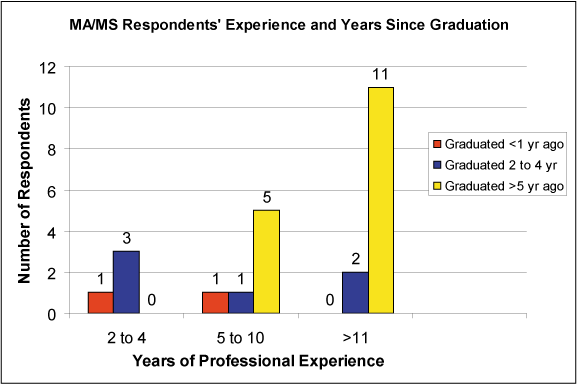
Overall, those who responded to the survey are experienced. Most have years of professional perspective between their graduation date and today.

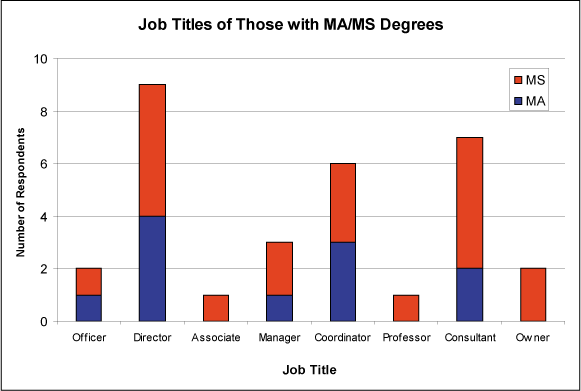
24 PR pros from PRSA weighed in on our survey. Their job titles ranged from Coordinator to Officer, Professor to Principal. (See the job titles of those who responded to the survey. Job Titles of Those with MA/MS Degrees)

Of these pros, 11 (or about 50%) graduated more than 5 years ago and have worked in the PR for more than 11 years. (The graph describes the years of experience and the years since graduation of each respondent with an MA/MS. MA/MS Professional Experience and Years Since Graduation)

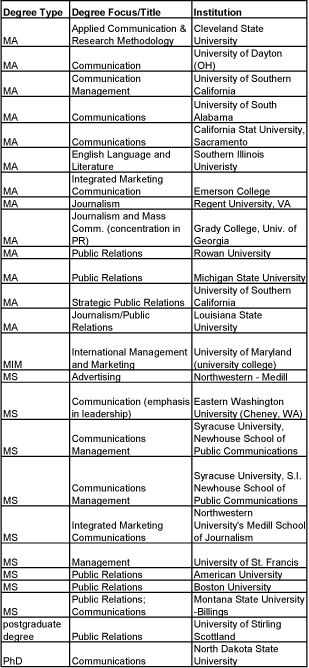
See the directory of schools our respondents attended. Directory of MA and MS Degrees

your pr career… Walking the Social Networking Tightrope by Courtney Vaught

Remember when we used Facebook to write funny comments on friends’ walls about the previous night’s blunders or to post pictures to keep memories alive? Now Facebook antics bear the same brunt of judgment as walking into work on Friday covered in sharpie drawings.

I recently read a blog post by Ari Adler titled, “Facebook Users Show Two Faces to the World,” discussing how some Facebook users are creating separate profiles for their professional and personal lives. This made me think about the challenges new professionals face in the expanding social media world–Facebook specifically. As Facebook’s 35-and-older demographic continues to expand, we are seeing our parents, aunts, uncles, clients and employers join in on a world that used to exist only within college walls.

The new professional’s generation (i.e. Millenials or gen Y) started using social media years ago, in a very different environment, for vastly different purposes than today. This is where I believe some of us find our struggle.

Personally, I maintain stubborn grounds in wanting to keep the fun, ridiculous college memories up for all to see. I say, if you have a problem with my photos, don’t look at them. However, some comments about my photos from colleagues led me to cave and block all the pictures on my profile. (Boo, I know.)

However, after discussing this topic with some fellow new professionals, I have found that I’m not alone. A former classmate of mine had an interview with a PR agency scheduled, but was e-mailed with a cancellation note a few days before the interview. When asked why the interview had been cancelled, the agency’s answer was that it had something to do with “social media content.”  My former classmate has since taken down all Facebook pictures and continues to monitor content closely. (And if you are curious, my former classmate was able to find a position at another PR agency.)

Others haven’t had as much trouble with their Facebook content but have taken similar steps to protect their reputation–and jobs. Jennie Ecclestone, General Motors, blocked all of her pictures and posts selective albums for public viewing. Ashley Mead, Fleishman-Hillard PR, closely monitors all photos that are tagged of her and “maintains a very genuine approach” in everything she has on her profile, and Nikki Stephan, Franco PR, uncluttered her profile by deleting all of the applications.

All of these privacy techniques may protect you professionally, but it begs the question, is this defeating the whole purpose of social networking sites? Are you really showing who you are when you have to monitor the content and only place pictures that show you in one, highly-monitored light? It’s an extremely fine line, one that I don’t think anyone has successfully balanced on yet.

Have you balanced on the social networking tightrope? Leave us your comments!

Courtney Vaught is an account coordinator at Eisbrenner PR and a member-at-large for the PRSA New Professionals Executive Committee. Contact her on Twitter @CourtV. 

___

NOTE

Thank you to those of you who were interested in commenting on this or other posts! Unfortunately, we’re having a technical problem that prohibits anyone, even WordPress users, from posting comments. We’ve notified the appropriate techies, and hope to have this issue resolved soon. Cheers~jk.

Who’s the New Girl?

“Show me an intern who never made a mistake, and I’ll show you an intern who stayed an intern.”

If someone hasn’t already voiced this sentiment, then I’ll take the credit for it. As a new intern at a small PR agency, I’m fortunate to have made my requisite Big Mistake. It was simple really, I printed something for a press kit on the wrong letterhead. But rather than calmly assess the mistake and set about the business of rectifying it, I had a little freak out moment. In earshot of an AAE. “Stop freaking out,” she snapped. “We’ll just print up some more letterhead, no big deal.” That would have been my solution to the problem in about 5 minutes, after I had finished my mini-spaz. But evidently, my snafu didn’t even warrant a full minute’s hysterics.

What I took from the experience (and what’s the point of making glaring mistakes if they don’t come with bonus lessons?) was not to keep my mishaps a secret. But to keep calm and carry on. As an intern, I’m expected to futz up a few things. But as a professional, I’m expected to rationally assess the situation and reassure those around me that there’s a resolution forthcoming or gain their assistance on how to go about correcting it. Disproportionate reactions inspire suspicion and mistrust. You don’t want to be known as the girl or guy who gets knocked off track by every paper cut. I’m pleased to say, composure regained, I set about the task of fixing the letter head and the press kit got out without further incident. My chant of “OMG! OMG! OMG!” was perfectly acceptable–as long as it stayed in my head.

Toni V. Martin is a freelance journalist making the transition into full-time public relations. She is currently interning at a full service PR firm outside of Atlanta. She is originally from Detroit and has her degree in English from the University of Michigan-Ann Arbor. She can be reached at tonivpr@gmail.com

Some Advice on Job Hunting From One New Pro to Another: Setting a Salary Range

Recently, I accepted a wonderful new position and gave notice to my previous employer. Everything went very well and I was asked to assist in the hiring process for my replacement. I prepared myself for the difficult task of sorting through resumes and agonizing over a hundred people with the perfect qualifications to fill my position. I was ready to carefully consider nuances in presentation and to weigh one person’s experience against another. As it turns out, the process was much easier than I had ever imagined.

At least 50% of the resumes were discarded almost immediately because of salary expectations. As for the other 25%, more on that later…

Advice Tidbit #1: How to Set a Salary Range
First of all, if they ask for your salary range, give it to them (after careful consideration of course). If you don’t, your resume could get passed over for others who are able to follow directions and have salaries in the company’s range. The way to successfully give a salary range is to consider both your own worth and the level assigned to the job by the hiring company. For instance, if the position is listed as an “entry level” position, you should have a clue as to their salary range based on other jobs in your area. If you are job-hunting in my area (Cleveland), you should know that a basic entry-level salary is much less than $50,000 -70,000. If the salary listed in your cover letter is more than $10,000 (or even $5,000) too high, your resume may be headed for the circular file. Here are some tips on the dreaded “please include your salary expectations” request:

• Just Do It – Sure you don’t want to take yourself out of the running by giving a salary that’s too high or too low, and it may be tempting to leave it off altogether. Stop and just do it. If the company asked for it and you don’t give it, it may look like you don’t/can’t follow directions.
• Always Give a Range – go from the lowest you would possibly accept to a little more than you would expect. If you give an appropriate range, you can always ask for more based on what you learned about the position in your interview.
• Never Lie (to the employer or yourself) – Don’t lowball them to get an interview for an entry-level position hoping that they will increase the salary for “the right” candidate (you). You’ll end up seeming dishonest if an offer is made. If the salary is too low for you, it’s not the right position anyway.
• Pay Attention to the Position Description – you know what your current job pays, and can look at the national averages on the PRSA website. If the position description says entry-level or junior – or director – you will have a good idea of a general range the company might expect to offer.
• Consider the Company – a small nonprofit will have a completely different salary range than a large corporation or a prestigious agency. Consider the size and prominence of a company when setting your salary range.
• Don’t Sell Yourself Short – If the title, responsibilities listed and company sound like they fit with a $50,000 salary, and you are qualified, then ask for it. If the company throws your resume to the side because your expectations are too high, the position is probably not worth pursuing.
• Be Flexible – Sometimes saying that you are flexible or that your salary is “negotiable” is a way to get a phone call even if you are out of their range. It doesn’t hurt to add it if, even after research, you don’t have a clue what the range might be.

Setting the perfect salary range for you and the company you are applying to is truly something of an art, but it’s an art worth mastering. Researching the company, reading the position description carefully and knowing the industry averages can not only help you set an appropriate salary, but can help you make the best decisions regarding your personal worth and avoid positions that don’t offer fair compensation for the level of experience and responsibilities. I hope to follow-up soon with another article based on my recent hiring experience, and in the meantime, best of luck job hunting!

Julie Cajigas is the president and owner of Inspired Copy & Communications, LLC, in Cleveland, Ohio. Inspired Copy & Communications, LLC provides freelance copywriting, ghostwriting and freelance public relations. She can be reached at Julie@InspiredFreelancer.com http://www.inspiredfreelancer.com.

Thoughts and Fears of a PR Newbie

With only one official year under my belt, I am still asking myself the same questions I had the day I graduated. Am I good enough? What am I worth as a professional? What do I have to offer?

I would be willing to bet that many of you are asking yourselves the same questions. Maybe you took a job that is less than what you had expected or wanted, and are now feeling unchallenged and underappreciated. Or maybe you feel ready to move ahead in your career, but are having a hard time finding the right fit for you.

How exactly do you overcome these feelings of intimidation and, sometimes, anxiety?

Here are some things that I have found to be extremely helpful in strengthening the beginning of my career:

• Evaluate yourself on a regular basis.

What do you do? Do you like it? Have your projects been successful? What are some ways that you can improve? What would you like to be working on? How can you incorporate that into your daily tasks?

Ask yourself an insane amount of questions and answer them truthfully. You’ll be surprised what you’ll learn about yourself.

• Make every moment of your job count.

Yes, this is so very obvious, but so very important. There are times when my workload is extremely light… or nonexistent. This is when I really dig deep into my skill set and find ways to improve how I work.

Another thing you can do is look into your company’s sales/marketing materials, press kits, and other documents and think of ways that you would update them. If you feel confident about your ideas, share them with your superiors (they’ll be surprised by your initiative).

• Do freelance work.

Besides looking great on a resume, freelancing is tons of fun and allows you to explore other talents that you don’t get to use in your full-time job.

Sometimes you’ll have to take several jobs with no compensation, so it’s important to find something that you enjoy doing or that you really care about.

• Volunteer.

Again, this looks good on a resume, and can also be a lot of fun and rewarding. Many organizations are looking for extra help in their public relations/communications efforts. If you feel passionate about an issue or organization, form relationships and offer to help whenever a need arises.

Doing these things will not only strengthen your professional skills and image, but it will teach you so much about yourself as an individual.

Have a few more tips that you’d like to share? Leave a comment and tell us about it!

About Paige Presley: With a public relations degree from Middle Tennessee State University and experience in both corporate and agency public relations, Paige now serves as a marketing assistant at Lightning 100, Nashville’s favorite independent radio station. She is also the Chapter Development Committee Chair for the PRSA New Pros group.When she’s not at work, Paige enjoys taking on various freelance projects and volunteer activities with organizations like the American Red Cross and NashvillePAW magazine.(This post can also be found here.)