#ThrowbackThursday: Jo Ann LeSage Nelson, APR

npprsa-tbt

Editor’s note: This is part of our monthly #ThrowbackThursday series, which features a prominent, successful PR pro taking a look back and sharing tips from his/her days as a new pro. Thanks for helping us out, Jo Ann!

This #ThrowbackThursday, we get to know Jo Ann LeSage Nelson, APR

Jo Ann LeSage Nelson May 2014

Question 1: What was your biggest challenge as young professional, and how did you overcome it?

I had the good fortune to have had a first boss who had been in the business for a long time and who was willing to teach me by example. He didn’t offer feedback often, however, and I came to understand that if I didn’t hear from him then I had to assume he approved of what I was doing.  As a young professional that was difficult for me for the first couple of years, but after having a conversation with him about his managerial style, it made more sense to me. I should have had the conversation sooner.

Question 2: How did you learn to network comfortably at large events like PRSA ICON?

I learned early on that showing an interest in what others are doing or thinking is a surefire way to get people to open up.  Ask questions, be curious and listen actively.

If you’re nervous about meeting new people, go into a networking event with two or three topics that you can talk about. Did you read an interesting news story today? Is there a community organization you are involved with that you want to tell others about? Did you learn something new and interesting about a client that you can share?  If you go into an event armed with some ideas it will help put you at ease.

As for large PRSA events… honestly, I think networking with other public relations professionals is easy!  Most of us like to talk a lot.

Question 3: When looking for potential employees, what young professional traits are most valuable to you?

I want to work with young professionals who are curious, creative and smart.  I firmly believe that a smart person can learn anything, even if at first the concept seems foreign or hard to grasp.  Having an intellectual curiosity goes a long way towards being successful in nearly any field, and that includes being curious about the world around you and what is happening in it.  Another trait that impresses me is a willingness to work hard, and long if necessary, to make sure something is done right.  And having personal and professional integrity is a must! (But don’t ignore the basics like strong writing skills.  You can’t be a successful public relations professional without them.)

Question 4: When did you get involved with PRSA, and what tips do you have on young professionals just joining for the first time?

In 1995 I joined a small group of professionals who were working to revitalize a dormant PRSA chapter here in New York’s Capital Region, and I’ve been involved ever since.  If you’re new to PRSA, volunteer for a committee or help out with an event.  Getting involved locally at the chapter board or committee level is the best way to get hooked on PRSA.  You’ll grow professionally through all the terrific resources and programs PRSA has to offer, meet some outstanding colleagues and make some lifetime friends.

Question 5: If you could go back in time and give advice to yourself during your first year on the job, what would you say?

I’d tell that 24 year-old starting her first public relations job that she shouldn’t doubt herself, that her instincts were often right on target.  As I said above, my boss didn’t offer a lot of feedback and so that sometimes led me to wonder if I was on the right track.  With more experience I gained more confidence and realized that I could handle any situation presented to me, as long as I did the appropriate research, asked the right questions and enlisted the help of people who had a stake in the matter.

More about Jo Ann:

Jo Ann LeSage Nelson, APR, vice president of client services for Pierce Communications, an Albany-based public relations/public affairs/crisis management firm, is responsible for strategic public relations and communications counseling for Pierce Communications clients.

Jo Ann is a member of the National Board of Directors of the Public Relations Society of America, serving a two-year term beginning January 2015. She is also a past Northeast District Chair of the PRSA, serving as the national association’s liaison to seven chapters in New York, Massachusetts, Rhode Island and Maine. In 2010, she served as the co-chair of the Northeast District’s annual conference. Jo Ann is also a past president, Assembly delegate and accreditation chair of PRSA’s Capital Region chapter.

In November 2008, PRSA’s local chapter presented Jo Ann with the first Outstanding Public Relations Practitioner Award, given to a Capital Region public relations professional who has achieved exceptional success, displayed the highest ethics and is dedicated to serving the community and the profession.

Connect with Jo Ann on LinkedIn.

Playing the PR Field: Keeping Your Career Options Open

Many of us approach looking for new opportunities as a necessity of job searching. We find a job, start off enthusiastically, become disappointed when it’s not everything we thought it would be, continue doing the job until we can’t anymore, and then desperately search for a new job. We repeat this vicious, frustrating cycle either because we only look for a new opportunity when we’re desperate for one, we don’t take the time to think about what we need or want in a career, or we don’t feel that turning down a job is an option.

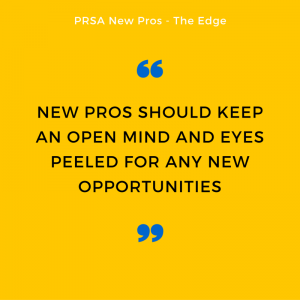
new pros should keep an open mind and an eye peeled for any new opportunitiesThis is absolutely the wrong way to approach finding a fulfilling career. Instead of pursuing opportunities only when we think we desperately need them, new pros should keep an open mind and eyes peeled for any new opportunities, no matter how satisfying their current position may be.

Actively looking around for what else is out there can help new pros decide what they want and don’t want in a career. Maybe there’s a great opportunity for a position with a well-known company that sounds like a dream available. If you ignore it just because you’re pretty happy with the job you have, you could be left wondering for the rest of your career if it was the one that got away. If you seek out an informational interview, you could find that it’s an opportunity you can’t pass up, that it’s not right for you—but is a great company—or that it’s just not a good fit at all. Early on in your career, learning more about a company or type of position is a great way to figure out what exactly you’re interested in and what you might like to explore more in-depth.

Keeping your options open also keeps you in control of your career. If you’re keeping an eye out for what else you could be doing, you can be the one to decide how long you’ll stay at a particular job—as long as your ‘looking’ is not negatively affecting performance in your current position. If you can juggle the job search while keeping up daily responsibilities, you can then decide if you want to keep learning and growing where you are or if you want to take a chance on another opportunity to grow your career. Being in the driver’s seat of your career is always a good place to be!

New opportunities often mean meeting new people, too. As you’re looking around at what else is available, you’re bound to make new connections with people you may not have met otherwise. Use informational meetings and events through professional organizations as a way to not only learn about new opportunities but to also build your network and strengthen your relationships. Actively reaching out to your network, new and old, will keep you the the front of  their minds for any opportunities that might come end up in their emails.

While you’re at the top of new connections’ minds, you should also be keeping your skills fresh. Look at what skills open positions are looking for and make sure that you’re keeping up with the latest trends and skills. Making sure that you’ve brushed up on the skills employers are looking for can go a long way in helping you land the perfect position.

What else can you do to stay open to opportunities and land your dream job?

Write a call-to-action into your LinkedIn summary.

It can be as simple as a quick line saying that you welcome emails regarding new opportunities. Keep it short and sweet and let people know the best way to contact you.

Make a list of your dream employers & contact them.

Find connections at these companies and ask for an informational interview to learn more about the company, its culture and any relevant opportunities. Even if there’s not an opening at that time, meeting with and keeping in touch with a contact or two inside will keep you at the top of their list when positions do open.

Set up informational interviews & meetings when possible.

If there are companies you know you’d like to work for, people you admire or colleagues whose advice you value, reach out to them. Set up informational interviews with the first two to learn more about what they do and what opportunities might be available. For those whose advice you trust, an informal meeting over coffee, drinks or brunch is a great chance to catch up and talk in a relaxed setting.

Let people know when & what you’re looking for.

Even if you’re not actively looking for a new job, letting people know that you are open to new opportunities gives you new sets of eyes and ears to be on the lookout. Share your resume with those you trust and ask that they share information of new openings with you. If you are looking for a new job, let as many people as you can know, while not jeopardizing your current position. Spread the word privately to close connections, rather than publicly where your current employer may see. 

Keep checking job postings.

Sometimes it can be fun to see what else is out there and what better way than checking job posting sites. If you want to make it even easier, sign up for weekly or monthly emails from PRSA Jobcenter, Indeed or any other job boards with specific keywords relating to what you’re looking for and where.

RoRobyn Rudish-Laning (1)byn Rudish-Laning is a member of PRSA SC and communications coordinator for the South Carolina Council on Competitiveness. Robyn is also a member of the New Professionals executive committee. She is a graduate of Duquesne University and is currently located in Columbia, SC. Find her on LinkedIn or Twitter or read her PR-focused blog.


Be a Rockstar PR Pro in 2016

Everyone wants to be great at what they do and the new year is a great time to reevaluate everything we’ve been doing and how we can make ourselves the best PR pros we can be, new or otherwise.

Rockstar PR ProNow’s the time of year when everyone comes up with resolutions for things they’d like to change or be better at. For 2016, why not make it a resolution to focus on professional development and becoming an extraordinary PR professional. Here are 10 things all New Pros can focus on to stand out from the crowd.

Be flexible.

PR isn’t one of those jobs where you can count on a strict 9-to-5 schedule. Not everything will fit into eight hours in the office and, more often than not, you’ll have early mornings, late nights and work that needs to come home with you. We can’t change these facts, so the best thing we can do is be flexible. Living by your to-do list will only add even more stress to your life. Instead, look at the list as a set of guidelines and accept that things will change, more pressing things will come up and, sometime, things are completely out of your hands.

Know how to prioritize.

So maybe your to-do list has some non-negotiable, must-be-done things that can’t be postponed. It’s important to know how to prioritize your tasks and your time. As new professionals, we sometimes struggle with doing what we need to when it means saying no to others or admitting that we just can’t take on anything else. There’s nothing wrong with declining an additional project if you know that you won’t be able to commit to it or provide a quality product, blocking off time on your calendar to work on pressing things on your list or taking your work to a quiet space – be it an empty conference room or a nearby coffee shop – to get things done.

Make a commitment to continued learning & growth.

Continuing to learn after you’ve earned your degree is a huge component of professional development. Knowing the latest trends and best practices, as well as having a few extra skills in your back pocket, can really give you an edge over your peers. Committing to reading one new professional or career related book or mastering one new skill a month will put you on a path to success and instill good habits through the length of your career and beyond.

Be a sponge.

A great way to commit to learning is to soak up everything you can. Whether it’s an insight or tip your boss shares, a book your colleagues are raving about or an article or piece of news a college friend posts, take it all in and file it away because you never know when those tidbits will come in handy. As a new professional, you can learn so much just by soaking in what the seasoned pros you know, work with or meet have to share.

Always be prepared.

Being prepared should be kind of a “no duh,” but not everyone is always on the ball. Making sure you’re prepared for meetings, projects and, really, every day of work will really go a long way. Take the time to properly prepare for everything that needs your attention, whether that means making notes, keeping a running list of questions or important items, or just doing your research, and you’ll stand out to your supervisors when you have all the answers at the ready.

Think big picture.

It’s easy to be caught up in the day-to-day in your career, but the important thing is to think big picture – both for your career long-term and for your current position. Think about where you ultimately want your career to go, what you need to do to get there and begin making your plan. Thinking about your job tasks on a bigger scale than just what you have to do each day or week will help you to create overall strategies and plans that will make your day-to-day work easier and turn out better results.

Dive into the news.

As PR professionals, keeping up with the news is something we should all do, but sometimes just get a little lackadaisical about. Sure, there’s a lot of news to be aware of and some of it isn’t really that interesting, but it is important for us as professionals to keep up on what’s going on in the world around us, beyond our own interests. Knowing the basics of current events, including pop culture, world events, business news, etc., can help you as a PR pro to make sense of how things fit together and be aware of opportunities you might have missed out on otherwise.

Sharpen your networking skills.

Networking is a huge part of having a successful career. You may be great at what you do, but if no one knows about it or has a reason to sing your praises, they won’t. Make an effort to connect with new people and grow your network this year by doing something you wouldn’t normally do. Join a Twitter chat, ask someone you admire to coffee or lunch, attend that after-work happy hour or stop by that event your PRSA chapter is hosting. You can learn so much just by talking with new people and listening to what they have to say.

Be relationship oriented.

One of the big misconceptions of networking is that it’s all about how many people you can meet. Too often people look at it as a way to grow a large network of people you know pretty much just in passing, but those connections aren’t worthwhile and won’t do anything to further your career or help you grow. Instead, we should focus on creating relationships through networking, not just gathering as many business cards as we can. If we look at networking as an opportunity to grow through lasting, meaningful relationships we’ll all get more out of it than just a large contact list.

Develop a thick skin.

Unfortunately, no matter how fantastic a PR pro you are or how great your work is, not everyone is going to like you. Sometimes your work will be picked apart, you’ll be criticized or told that what you’re doing is just not good enough. It’s going to happen, but it doesn’t have to leave a negative impression. Those people who have developed a thick skin are able to take constructive input out of the criticism and make themselves better. Focus on not taking negative comments personally and instead find the areas that maybe you could improve upon a bit by looking at your work objectively and reevaluating any critiques you received. No one grows by staying the same.  

—

Robyn Rudish-Laning (1)Robyn Rudish-Laning is a member of PRSA SC and communications coordinator for the South Carolina Council on Competitiveness. She is a graduate of Duquesne University and is currently located in Columbia, SC. Find her on LinkedIn or Twitter or read her PR-focused blog.


#PRTips from the Pros: Networking, Measuring & More

Throughout 2015, we’ve shared tips and insights from some of the most well-known PR pros in the business such as Deirdre Breakenridge and Heather Whaling. To close out the year, we’ll be sharing advice from PR pros who spent time with us during last month’s New Pros event at PRSA ICON. So, whether you missed the sessions, need some motivation for 2016, or all of the above, we have some great tips for you in our expanded #TBT series, #PRTips from the Pros!

In this post, we’ll be sharing tips from PRSA Fellow Anthony D’Angelo. D'Angelo


Question 1: What was your biggest challenge as young professional, and how did you overcome it?

Establishing an understanding of public relations with my employer, who had a limited view of the field’s scope and purpose. Over time, I was able to demonstrate the breadth and effectiveness of public relations by applying our profession’s strategies to the work at hand. When employers or clients see public relations research, strategy, tactical creativity and evaluation methodologies advance relevant metrics, they have an “ah-ha!” moment.

Question 2: How did you learn to network comfortably at large events like PRSA ICON?

I’ve found that asking colleagues about their interests and their about their opinions relative to professional topics is an engaging way to network and to gain knowledge simultaneously. Networking starts with careful listening.  

Question 3: When looking for potential employees, what young professional traits are most valuable to you?

Integrity, professional writing skills, inquisitiveness, helpfulness, a strategic perspective and a strong work ethic.

Question 4: When did you get involved with PRSA, and what tips do you have on young professionals just joining for the first time?

I was a PRSSA member as an undergraduate student, but I didn’t contribute enough effort to the chapter and count it as a lost opportunity in my early development. When I got my first agency job I joined PRSA and immediately volunteered to be the chapter newsletter editor. Mindful of how I underachieved with PRSSA, I gave it my best effort and it led to wonderfully rewarding relationships with local board members and additional volunteer assignments that were both enjoyable and career-enhancing. My tip to young pros is to raise your hand for an assignment and commit yourself to making it something you’re proud of. Then, “rinse and repeat” several times. You will be rewarded.

Question 5: If you could go back in time and give advice to yourself during your first year on the job, what would you say? “Tony, don’t focus so much on the work that’s right in front of you today, look to the horizon and reflect on all the ways you can help the organization advance its mission, goals and objectives. Commit to that bigger picture, and focus on it each day.”

About Anthony:  

Anthony D’Angelo, APR, Fellow PRSA, joined Syracuse University’s S.I. Newhouse School of Public Communications as a professor of practice in public relations in August 2015 after serving in public relations leadership roles in the corporate and agency sectors for more than 25 years, most recently with ITT Corporation. Prior to that he worked for the St. Joseph’s Hospital Foundation, Magna International, United Technologies and Sage Marketing Communications. D’Angelo’s practice areas include change management, reputation management, branding and marketing communications.

He is national secretary-elect of the Public Relations Society of America (PRSA), past chair of its College of Fellows, and a founder of PRSA’s MBA program to bring strategic communications content to MBA curricula nationwide. D’Angelo’s pieces on the importance of strategic communications to organizational leadership have appeared in BusinessWeek, the Financial Times and The Public Relations Strategist, and he is a regular contributor to The Wall Street Journal’s “Crisis of the Week” column. He has presented seminars on change management at several conferences and universities over the last 15 years. 


How to Know When to Leave (or Stay) at a Job

Should I leave or should I stay? When do you really know it’s the right time to move on from a job for something new? A difficult question to answer, but one that many people face in today’s working world. Gone are the days that you are expected to, or want to stay in the same job, in the same workplace, for the rest of your life, but when do you know it’s time to move on and start looking for a new job? Here’s what you should consider.

Is there room for improvement?

The first thing to look at is if there is room for improvement in your current role. Figure out what it is that you like and dislike about your role, and how you could potentially address the dislikes. Often time’s employees are so hesitant to speak up to their managers about their dislikes on the job, when in reality, their managers may be able to help you see a way to make it more enjoyable.

What are your long-term goals?

Next, think through what your long-term goals are. Think about where you would like to be in the next 5-10 years, and what you are going to need to do or learn in order to get you to that point. A good employer will want you to grow with them as oppose to leave for a different opportunity, so by expressing the things you’d like to work on, you could end up with new opportunities that will help you reach your long-term goals. If you don’t see your employer assisting you in reaching these goals, it may be a sign that you should look for one that will.

Can you grow in your current workplace?

Take a look at if there is room to grow within your own organization. Is there a position you can see yourself moving up into if the opportunity presented itself? Is there a chance that you could be promoted within your organization to something you’d enjoy better? In larger organizations this is often a plus, but in smaller organizations, where a higher and better position may not exist, that may be a sign you’ll have to move out of the company in order to move up and forward in your career.

Are you happy?

Last but definitely not least, ask yourself if you are happy in your current workplace. Sometimes it can just be the role you are currently in that’s making you unhappy but the actual workplace is a place you genuinely enjoy working at. Other times you may just be completely over the place that you work, and know that even if you had a different role, you still wouldn’t be satisfied. If there isn’t a chance that you think you could work with your current workplace to improve your role, or move to a position you’d like better—then that’s a sign that it’s time to move on.

Moving on from a workplace that you’ve grown in and are comfortable at can be a tough decision, but in terms of your happiness and your employment, it’s okay to be selfish. If you have grown out of your current career, and don’t see a chance for you to develop professionally anymore, your employers will understand your want to move on to something that is better for you.

Lauren Marinigh is a PR and marketing professional based out of Toronto. You can learn more about Lauren at www.laurenmarinigh.com or on Twitter at @marinighPR.