Book Review: ‘Spin Sucks’ by Gini Dietrich

This post is part of The Edge monthly series of book reviews on books relevant to new PR professionals.

The wise Ricky Bobby once told us: “If you’re not first, you’re last.”
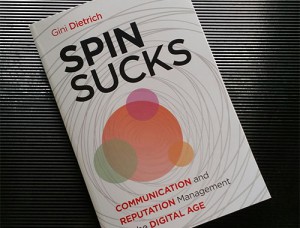
spin_sucks-500x380Well, after reading “Spin Sucks,” it’s obvious that Hollywood’s favorite NASCAR driver has never met industry thought leader Gini Dietrich. In “Spin Sucks,” Gini examines the evolving communications world, and shares actionable insights to help PR pros of all ages adapt to the changing industry both successfully and ethically.

Unlike Ricky, Gini says a quality communications plan is a marathon, not a sprint. If you’re cutting corners, vying for first – not best – even a full dish of fancy sauce can’t help you succeed.

But, follow “Spin Sucks’” fancy-sauce recipe for success, and you’ll get positive feedback from reporters, customers and, most importantly, company leadership.

Prepare your paid, earned, owned and shared media.

Curious how the four PR silos can work in tandem? In “Spin Sucks,” Gini explains how DirecTV used each avenue to execute its successful “Football on Your Phone” campaign.

“They used paid (because it cost them to produce it), owned media (it’s embedded both on their website and YouTube channel), and shared media [through social sharing] for this campaign, and earned media was the result,” she writes.

Add a cupful of content marketing.

Sure, it’s a buzz term now, but in a few years content marketing will be a successful PR pro’s bread and butter.

Think about it. You own this content. It has your brand’s messaging and voice with no third-party filter. And, as Gini notes, once you distribute content through social and email networks, you’ll conveniently (and strategically) bring the audience back to your website.

Not sure where to start? Gini has you covered. She suggests:

–       Subscribing to SmartBrief and Talkwalker Alerts for industry news,

–       Reading blog comments to get story ideas from readers’ questions, and

–       Looking through your sent emails to uncover recurring topics you’ve discussed with customers. (This tip from Andy Crestodina.)

Sprinkle in some SEO.

When it comes to content marketing, if you build it, they probably won’t come. But, if you build then optimize it, they’ll slowly start to find you.

As new PR pros, you’re likely seeing SEO quickly becoming a necessary skill. Here’s how Gini suggests getting in the SEO know:

–       Keep blog posts between 500 – 700 words with five or six keyword mentions,

–       Your keyword or phrase should be in the post URL (here’s how to change it), and

–       Always use an image and copy your headline into the “alt text” section.

Mix in your media relations.

Yes, SEO is an important skill for new professionals, but don’t forget the PR pro’s mainstay: media relations.

As Gini notes, the best media relations starts with storytelling, relationship building, patience and time. She also suggests:

–       Reading the outlets and reporters you’re contacting before drafting the pitch, then tailoring it to their niche.

–       Commenting intelligently on your target reporter’s articles to build your credibility as a source.

–       Writing short emails. For some reporters, you may even consider a handwritten note to break through the clutter.

Technically speaking, Ricky Bobby could be right. If you’re not first, you could end up last. But, as “Spin Sucks” illustrates, speed doesn’t always equal the best batch of fancy sauce.

Conversely, if you train for the marathon – not sprint – your company’s content will be read, news will be reported and goals will be met.

I’ve only skimmed the surface of the PR lessons offered in “Spin Sucks.” Whether you’re a new or seasoned pro, I’d highly recommend this book.

Have you read “Spin Sucks”? What industry insights did you glean from it?

 

Stephanie Vermillion headshotStephanie Vermillion is a senior account executive at Wordsworth Communications, a public relations agency in Cincinnati. She is on the PRSA Cincinnati Leadership Team and is part of the PRSA Cincinnati New Pros Committee. Connect with Stephanie on LinkedIn and Twitter (@SMVermillion).

 

Four Ways to Keep Your PR Skills Sharp Outside of Work

In our day-to-day lives and work days, it can sometimes be hard to keep some of our lesser-used skills up to date and sharp. We fall into routines and some things we learned years ago become fuzzy.

Here are a few ways to keep those skills sharp, even when you’ve finished your work for the day.

07fe6551. Work pro bono

There are many companies, especially nonprofits, that may not be able to afford to hire someone in-house or from an agency to provide professional public relations for them, although they may desperately need it. Find organizations that you would like to help and offer your skills and expertise without charge. You’ll expand your creativity and formulate plans for a cause or organization you want to stand behind, and help those people to further their programs and events.

2. Create great content in support of products and services you personally enjoy

When I find a product or service that I love, I want to shout it from the rooftops. Using your public relations expertise to promote and strengthen the brand of products and services that you personally use and would vouch for is a great way to sharpen your writing, social media, and interpersonal skills. Use your influence and honest thoughts to spread the word to people who can use them.

3. Network

Talk to and help out other public relations professionals. One of my favorite things about attending a meetup with other like-minded PR professionals is discussing what works and what doesn’t for particular situations, and sharing what you’ve learned through your personal work and education that can help someone else. Discussing these topics helps to refresh methods and skills that you may not have a chance to draw upon often.

4. Stay up to date

Public relations practices and methods are constantly changing, at a faster rate all the time. Play with and experiment with new technology, tools, and methods, explore and find out what works best for your brand and clients. Be proactive, and continue learning new technology, new content strategies, and what your clients want at the pace that it happens.

These are just a few of the ways to continue to hone your skills outside of the workplace. What tips do you have on staying sharp?


Screen Shot 2014-07-31 at 12.03.32 PMSamantha Owens is a writer, hobbyist photographer, and grammar enthusiast based in Napa Valley, CA. She writes her own blog, contributes at a literary fiction book blog, and freelance writing work. Find out more about her at about.me/seowens or follow her on Twitter at @sowensphoto.

The Artistry of Creating What’s Never Been Done Before – Part 1

Before the previous World Cup, Nike asked its go-to creative agency, Wieden+Kennedy, to create ‘something that’s never been seen before and never been done before.’ No pressure, right? What sounds like an overwhelming statement at first, has now become the industry norm. 

Creativity and innovation are not only critical in the public relations and marketing profession – they are vital to generating ideas that can differentiate a brand or an organization from a million others.

TheAmericanGenius_AGBeat

But what is the key to continuous inspiration – is there even one? Is it as simple as reading magazines, researching industry trends and talking to as many people as you can? Or is it about being awake, taking things in and experiencing life?

I consider myself a creator and love my profession, yet, sequentially having to come up with new concepts, innovative solutions and BIG ideas ads pressure. I do love the challenge but at the same time, it’s worth exploring how one finds continuous inspiration after having been in the industry for a few or even many years.

On my journey to endless imagination and artistry, I asked five leaders in the industry to share some of the secrets that keep their creative juices flowing:

David Bruce, Senior Director of Brand and Integrated Marketing at Major League Soccer

“I believe pretty firmly that inspiration is everywhere; it could come it the biggest or the smallest form. To me, the most crucial factor in being inspired is not closing yourself off to anything – not coming to judgments. A lot of my energy comes from the city I live in and the sources of inspiration it offers. Living in a city such as New York, gives you this rich tapestry – this energy – gives you this vibrancy. To me, that doesn’t necessarily mean having to go to a show, seeing an art gallery. It’s just walking around the streets having my music on, listening to a podcast and observing things around me. You see street graffiti and kids acting in a cult-like way. Here, they are all part of a small collective and express themselves a certain way, whether it’s through music, with art or how they dress. Every part of the city has its own style and sensibility. Chinatown is different from the Lower East Side, Midtown or East Village. That energy you get from experiencing those various communities and how different they are offers endless inspiration. It gives me direction.

I also enjoy experiencing cuisines from different cultures, seeing how a restaurant creates an experience from start to end: How you enter, how they greet you, what the waiters and waitresses are wearing, looking at the different types of menus, how everything is staged, what music is playing in the background, how you leave – all that, for me, is fascinating. You also see it in hotels, or when getting on and off an airline; it’s the small and unexpected things, the attention that people pay toward certain elements of an experience. I try to remember those things and create a memory log of things that I can regurgitate when I need to.”

Janet Froelich, Former Creative Director of the New York Times Magazine and Real Simple

“I think that a lot of what you do when you problem solve in an area that you’ve worked in for a very long time, is you feed off of it. It’s like a language that you learn so well, that you can use it without thinking about it any longer. You can structure new ideas by examining the nature of the problem. That also means, working off and with other people. I strongly believe that creativity is often collaborative. No matter which field you go into, you will work with other people. Today, I was reading an article in the paper, about how different Paul McCartney and John Lennon were. John Lennon was more of a wild spirit and undisciplined in his approach whereas Paul McCartney was very structured. They played off each other, sometimes battling it out, but often coming up with a much better solution than either of them would have had alone. So, some of it is about collaboration, learning to work with other people, developing a strong team, and understanding the nature of a problem solving in your specific discipline. The more you solve those problems often, the better you get.”

Check back on Monday for part two featuring Nicole Dobrzynski ‎(Global Football Brand Manager at Nike), Tony Telloni (Managing Director at Golin NYC) and Ben Roth (SVP Creative at MKTG Inc).


HelmaVonZadowHelma von Zadow works with the Brand and Integrated Marketing team at Major League Soccer and is a member of the PRSA New York Chapter.  She served on the 2013-2014 PRSSA National Committee as vice president of professional development. Connect with her on LinkedIn or Twitter.


New Pros Survival Guide: Hard Choices Leading To A Better Career

This is a re-post from PRSA’s blog PRSAY. As previously featured…

Most public relations graduates exit college somewhat overwhelmed by the myriad decisions they are faced with – which city to move to; should they work for an agency, boutique or corporate; what field of PR should they practice; etc…

The options might seem endless.

Now-What

For some, whether or not to join PRSA might be among the choices they’ll need to make. While the path to professional development and career growth often leads to PRSA, membership isn’t always part of the immediate career plan for young PR professionals – as Heather Sliwinski mentioned in the first installment of our New Pros Survival Guide – for others, especially PRSSA members, the transition to PRSA is anticipated and for a few it is already predetermined.

Lauren K. Gray, PRSSA Immediate Past President (until recently) and PRSA New Professionals Section Blog Co-Chair, discusses her unique path from PRSSA to PRSA and offers some advice for new pros making the transition from student to professional. She also adds a few career tips to your New Pros Survival Guide.

Q. How did your involvement in PRSSA affect your decision to join PRSA?

Lauren Gray: My situation was a little different in joining PRSA because I was technically still a PRSSA member. As the Immediate Past President for the PRSSA National Committee, it was imperative I join PRSA as my position served as the link between PRSSA and PRSA to encourage the transition from the pre-professional organization to the professional organization. Even if it would not have been mandatory to join, I still would have joined PRSA because of the value I received from PRSSA which I knew would continue in PRSA and I wanted to continue my own professional development.

Q. How does PRSA membership differ from PRSSA?

LG: It’s really not that different. You get out of both organizations what you put into them. I was very active as a PRSSA member and I’m still very active as a PRSA member. I still learn and grow through the volunteer opportunities I sign up for. All of my PRSSA friends are now PRSA friends and the fun continues! Professional development wise, I think the webinars and conference sessions are more in-depth over the basics and introduction levels of PRSSA sessions.

Q. What is your best experience so far as a PRSA member?

LG: This year, the best experience I’ve had is serving with a very talented and collaborative PRSA New Professionals Executive Committee. I’ve really had a lot of fun serving as the blog co-chair with Jess Noonanand we’ve done a good job rebranding the blog to The Edge and updating the design and layout. It’s been great to collaborate with many of the other chairs on the committee and I was really excited we were able to put together a presentation for PRSA International Conference on understanding the importance of today’s hybrid PR professionals.

Q. How has being in PRSA helped you to boost your career?

LG: Two ways: friendships and professional development. Most of my closest friends are PRSA members or will soon be members. They’ve supported me with career changes and personal council as well as providing friendship and support in other ways. Those types of friendships are invaluable. From working with so many people in PRSSA and PRSA, I’ve learned how to work with different personalities, how to plan large and small-scale events from conferences to career forums, how to manage a running blog and obtain writers, how to be a follower or adviser when it’s someone else’s turn to lead and the importance of continued learning throughout my career. That’s probably not even all the ways PRSA has helped my career, but it’s a start and I know that list will keep growing.

Q. What is one piece of key advice you would give a recent graduate or new pro to help their career?

LG: Take chances. It seems so many communication and PR majors are determined to land at one of the big agencies we all know, but they might not understand they could have an even better and more valuable experience at a smaller agency, a corporation or a startup. As new pros, now is the time to take chances and figure out what you want to do early before you’re stuck doing something you don’t want to do later. Apply for or take a job you never thought you would be in and see if you like it. You never know who you may meet and where you may land.

Q. Is there any rest of the “wickedly determined?” Can a recent grad take the summer “off” and prep for their interviews in August?

LG: Absolutely! I know many graduates may graduate on a Friday or Saturday and start work that next Monday, but it’s a good idea to take some time off because once you start working there are no more summer breaks and vacation time is short. Enjoy your last real summer! Take informational interviews, take some time off and prep for interviews in the fall. I think it’s great to land a job in PR or communications for the summer, but volunteering or moving to a different location for another job can be just as valuable. Success isn’t measured in jobs or job titles; it’s measured in the amount time you set aside to reach all of your goals, including just having fun and being young.

Q. Anything else you’d like to add?

LG: It’s one thing to be a PRSA member, but it’s another thing to be an involved member. Like I said above, you will only get out of this organization what you put in it. Take time to listen to the webinars, write a guest post for one of the PRSA blogs, attend local conferences and attend local meetings. Look into joining a national or local committee as well; we’re always looking for volunteers and committee members! Being in PRSA is rewarding in so many ways, but you have to put yourself out there and really get involved first.


0114bd7Lauren K. Gray is a new professional working in marketing, public relations and social media communications and currently works as a Project Manager at The Visual Brand in Westport, Connecticut. Connect with her on LinkedIn and Twitter.

So You Want to Start a PR Career in Government…

There are many perceptions about government in Washington D.C. – political campaigns or press conferences with a mayor or congressman. Yes, there is some of that, but there is much more. Let’s explore how government public relations works and some things I’ve learned over the years.

A-New

What is it like?

There are many opportunities in government. Think of the city you live in and the news. Every day you see stories about police, fire, public meetings, road closures, housing, rezoning and much more. In fact, government seems to make up a lot of the news and media relations is a part of the job. There are other tasks like websites, graphic designs, safety campaigns, community engagement, social media, employee communications and many more = similar to working in-house for a business. Depending on where you live you might work in a communications department that represents the whole city or you may work strictly for a department such as transit, fire, utilities or police. There are also county systems, state departments and federal departments.

What I’ve learned…

Everything is public information. Any time you send an email, write a news release or post on Twitter for your job, it’s public information. In fact when you look for a job, the public relations positions are usually classified as public information officers. In government, anyone can request information and you will have to provide information if it is available. So you need to save a lot of things and be proactive in pushing out information that is useful to the public.

Good writing skills and strategic thinking are essential. Like other PR jobs, good writing skills will go a long way. You still need to be able to write a press release and other content. Likewise, you will be involved in big projects that require research, identifying stakeholders and target audiences, creating goals and objectives, selecting tactics and measuring your success.

Try to be as proactive as you can, but sometimes you have to be reactive. A lot of times things beyond your control will happen fast and the media may come to you before you know about it such as a sinkhole forming on a heavily traveled road during evening rush hour. It may take some time to get your information together, but you learn to give what information you have at that time.  Remember that government is often a resource of information and a lot of times media will come to you first. It might seem like it is reactive, but you might already have a plan of what to say for different issues

When it comes to budget, think nonprofit. There is some money allotted to communications, but it is usually limited. Government works for the public and needs to be selective in where money goes. This goes back to why strategic planning is important. You can still be creative and create campaigns when needed, but it is usually on a tight budget.

Be patient. Sometimes priorities change or the budget is cut and your project is put on hold. Also, some pieces of information may need to be reviewed by many people before you can finalize it. Things will get done, but it may take longer than you expected.

You can really be proud of your work and make a difference. At our organization, we say “Public service is our business.” You will be involved in a lot of large projects. You’ll get to be engaged with your community and help bring projects together. I’ve worked behind the scenes during snow storms and realize how important it is to get the right information to the right people at the right time. I can walk down the street and see something I was a part of and it gives me a sense of pride. I’ve also met some of the hardest working people in government.

Government public relations is a great place to start your career. It’s similar to other fields and you’ll be able to use a lot of your skills. It’s challenging and rewarding. There are many options of where to work; you just have to find them.


Screen Shot 2014-06-30 at 2.33.03 PMNicole Ramsey works as a Strategic Communications Manager for the City of Charlotte’s Corporate Communications and Marketing department in Charlotte, NC. She also is a member of the PRSA Charlotte’s New Professionals board. Nicole graduated with a M.A. in Communication Studies from the University of North Carolina at Charlotte and a B.A. in Communications from the University of Louisville.