New Year, New Degree: The Road to Grad School

grad schoolWhen I graduated with my bachelor’s degree in May 2012, I couldn’t wait to be done with college. Passionate about starting my career and impatient to begin my new agency job, I was ready to leave behind tests, lectures and projects for the real world.

Exactly three years later, in May 2015, I’ll be in class again – this time, as a graduate student pursuing my master’s degree in integrated marketing communications.

Why grad school?

My decision to pursue a graduate degree was the direct result of a shift in my career path. After two years of working agency jobs – and an unexpected layoff after the loss of a client – I was unfulfilled, frustrated and ready for a change.

After much thought, I accepted a marketing position with a small liberal arts college where I focus on telling the stories of students, faculty and alumni who are doing amazing things. I assist in developing communications plans for community relations, development and alumni relations efforts. And I’m in an environment where education and the pursuit of lifelong learning are valued and respected.

Unlike the agency world, where experience is indispensable and graduate study isn’t a necessity, nearly all management and executive-level jobs in higher ed administration require an advanced degree. And, with more of their top communications officers reporting directly to college and university presidents than ever before, I’ve got my eye on the top spot and a plan to get there.

In addition, I hope to teach at the college level in the future – another position that nearly always requires at least a master’s degree.

For both of these reasons, grad school became a logical next step for me. But how do you know it’s right for you?

Is grad school the right move for me?

It’s a difficult decision to go back to school – one with personal, professional and financial implications. Before you sign up for a GRE prep class, here are some questions to ask yourself:

  • Will earning a graduate degree further my career? Think about where you’d like to be in your career five, 10 or even 15 years down the road. Search job postings based on those goals and look at the qualifications. Is a master’s degree preferred or required? Talk to your professional mentors and explore LinkedIn profiles. Understanding exactly where you want to be in the future will help shape your plan for how to get there.
  • What program fits my objectives? Part-time and online programs are flexible options for working professionals. MBA programs focus on business, while M.S. and M.A. programs can have professional and academic tracks. Since my bachelor’s degree is in public relations, I was looking for a graduate program that would complement my skill set while allowing me to focus on taking classes in areas where I was less versed. After narrowing down the choices, I reached out to alumni via LinkedIn and learned firsthand their experiences and how they were using their degrees.
  •  How much will it cost? Though grad school isn’t free, there are many ways to cover costs and make sure you’re not saddled with large debt in the process. Make sure to submit the FAFSA, which will help generate loan eligibility. Explore scholarships and fellowships. In addition, talk to your boss about going back to school. Many employers will look favorably upon an employee seeking education and may provide tuition assistance or reimbursement.
  • Does the timing make sense? It’ll take me a little more than two years to finish my degree taking classes part time while I continue to work full time. That’s quite a commitment. Will you be able to devote the time necessary to be successful? Each person’s situation is different; take a look at personal and professional obligations and be realistic about what you can take on.

With public relations and marketing professionals working in a variety of industries, each with their own set of requirements and qualifications, grad school may not be the right move for everyone. My best advice? Do your research. Ask the right questions. Create a plan. It will soon become clear if (and when) graduate school will fit. And, if you end up back in class in 2015, I’ll save you a seat!

Sarah LackSarah Lack is an alumna of Kent State University’s School of Journalism and Mass Communication. She works in the communications department at Notre Dame College in South Euclid, Ohio, and is the communications coordinator for Girls on the Run of Greater Summit, a nonprofit organization serving Northeast Ohio. Connect with her on LinkedIn and Twitter (@sarah_lack).

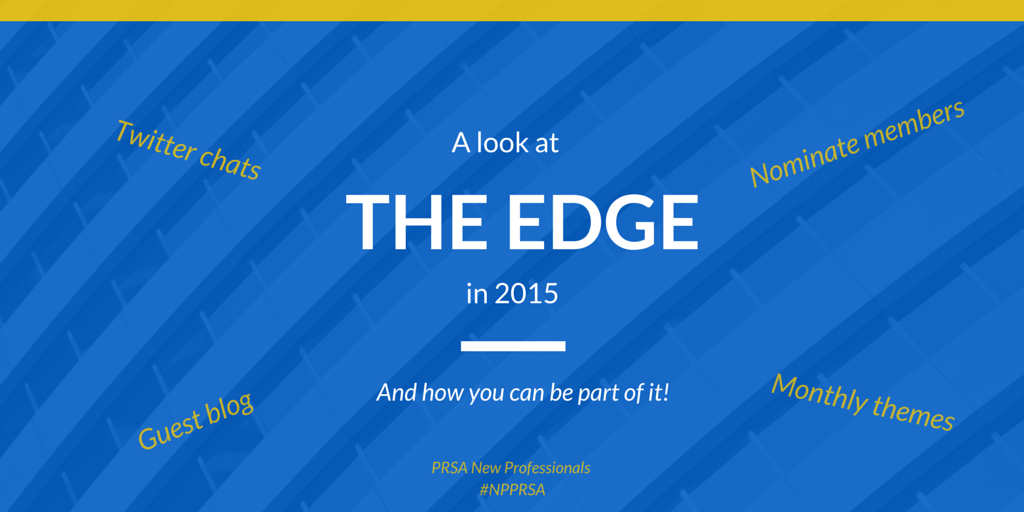
A Look at The Edge in 2015 – And How You Can Be a Part of It!

The Edge 2015

Who’s ready to take 2015 by the horns?

I’m sure you’re all standing up on your chair, chanting “me, me!” at the office now, right?

Well, here at The Edge, we’re pretty close. Ashleigh Mavros and I, the new blog co-chairs, have a lot of exciting plans for the New Year, from a thematic strategy to member highlights, and we’re going to spend a few minutes getting you in the know.

Monthly themes will guide our content strategy.

To keep content cohesive every month, we’re going to introduce new monthly themes. Some coincide with PRSA initiatives, such as Ethics Month. Others delve into issues facing new professionals, including this month’s theme: “Kickstart to 2015”.

So how are we turning this idea into a theme? We’ll focus on a few things:

  • Helping you achieve your 2015 career resolutions,
  • Discovering new productivity tools to help you accomplish more,
  • How to de-busy yourself to save your sanity, and
  • Whether or not you should consider going back to school for a master’s degree in 2015.

Of course, we are always accepting guest posts from new professionals, so if you have an idea that in some way relates to this theme (we’re open to all types of ideas, so get creative!), please email me or Ashleigh Mavros.

If you’re interested in writing for us in the future months, here’s what we have slated for February – June 2015:

  • February: Social Media Strategy
  • March: Integrated Marketing Communications
  • April: Building Your Network
  • May: Graduation Tips and Next Steps
  • June: PR/Career Book Review Series

Highlighting members going above and beyond.

Do you know a PRSA new professional who had a major accomplishment or works hard consistently? We’d like to profile him/her on The Edge.

These nominations don’t have to coincide with the monthly themes; the only requirement is the individual is a member of the PRSA New Pros chapter. Please email Ashleigh or me with nominations!

Posting schedule set, so mark your calendars!

Similar to last year, we will be posting on Mondays and Thursdays, so make sure to set those reminders.

Additionally, the social team is working on the #NPPRSA Twitter chat lineup for 2015, so make sure to check The Edge regularly for the latest news. If you have any ideas for Twitter chats, please email Erica Brown or Lauren Rosenbaum.

As you can tell, the PRSA New Professionals team is excited for a stellar 2015, and we hope you are, too. If you’d like to learn more about joining the New Professionals section, please visit the PRSA website.

Questions about this year’s blog strategy? Thoughts for how to improve it? Please leave a comment below or email our team.

Vermillion small 1Stephanie Vermillion is a senior account executive at Wordsworth Communications, a public relations agency in Cincinnati. She is the PRSA National New Professionals blog co-chair, and is on the PRSA Cincinnati Leadership Team. Connect with Stephanie on LinkedIn and Twitter (@SMVermillion).

Get Involved With New Pros in 2015

If you’re like me, the end of the year is a time to reflect on successes and challenges from the past year, as well as make plans for the upcoming year. New public relations professionals face a lot of challenges: a fast-paced and competitive job market, demanding clients and colleagues, and an evolving industry with an array of new channels and tools.

One of the best things you can do for yourself in 2015 is invest in your career to help stay on top of these challenges. The New Pros Section is designed for this person. My partners on the New Pros leadership committee are dedicated to building programs and opportunities for advancing the careers of our members. If you’re not already a member of the Section, consider joining now and jump starting your professional development.

If you’re looking for ways to get involved, here are three to plan for in 2015:

  • Take part in the PRSA New Pros Section: As a national group, you have the opportunity to engage with fellow new professionals across the country who work for agencies, nonprofits, large and small organizations and more. We offer regular virtual programming, a Section members-only e-group, a newsletter, engagement on our social channels including regular Twitter chats, and host a month dedicated to New Pros in November.
  • Get active in your local New Pros group: If you’re looking for more in-person programs and activities, you can check out your local PRSA Chapter. Depending on the sponsoring PRSA Chapter in your area, there might be a local group of young professionals who get together for different programs and networking events. Reach out to your local Chapter’s leadership to see how you can get involved.
  • Mentor a PRSSA student or Chapter: One of the best ways to enrich your career is to begin mentoring and giving back to students. Whether it’s an informational interview, guest speaking at a local PRSSA Chapter or offering to be a sounding board, giving back to the profession of tomorrow is an important part of a public relations pro at any level. You never know if that student will become a client, colleague or even your boss.

How are you planning to advance your career in 2015?

Lucido_NickNick Lucido is the incoming Chair of the New Pros Section. 

Mentor has more than one definition

We all know what a mentor means. But do we know who each of our mentors are? What about mentors who don’t have the professional title of “mentor” – what about “unofficial mentors”?

Let’s start with the first definition: mentors. These are the people you’ve either connected with through a program or have asked to provide guidance. Moreover, professional mentors.

Then, there’s unofficial mentors. These are the people who you to not only go to for career advice, but also for everyday life lessons.

Fill in the blank: I surround myself with ________ …like minded people, positive people, good-hearted people, etc. Whatever that blank is, that’s where you’ll find your unofficial mentors. Unofficial mentors are those you look up to but don’t always associate an official title with: your mom or dad, sibling, best friend, co-worker on another team, someone you met while volunteering, etc.

While mentors are usually the professional relationships you go to for career advice, unofficial mentors are the ones you go to for everything, sometimes subconsciously.

My unofficial mentors? My mom and dad who I always go to for not only family guidance, but also financial advice (I am two years out of college and still call them about insurance policies). My best friend and boyfriend who is in medical school, the most positive person I know and never lets stress overcome him (even though his field requires sick patients, surgeries and what seems like never-ending standardized tests). Also, one of my best friends and cousins who despite a few struggles has immediately and confidently started creating a new path that includes finishing school and building a family.

It’s good to find those mentors who share professional advice (when to make those career moves, how to gain leadership skills, etc.). But it’s also good to discover and not forget about your unofficial mentors. Both types of mentors can help guide you throughout life tremendously.

Who are your mentors and unofficial mentors?

NicoleBersaniNicole Bersani is the social media coordinator for Comcast SportsNet Chicago. She also serves as the PRSA New Professionals Section mentorship co-chair and volunteers at Midtown Educational Foundation as a tutor/mentor for young girls in Chicago. Connect with her on Twitter and LinkedIn

Three PR skills they don’t teach you in college (and three skills they do!)

College-Classroom-stockbyte-592px-304Whether you consider college the glory days or workhorse days, one thing is certain: You sure learned a lot.

But, once college is over, new pros quickly discover that the learning has only just begun. Real world success requires a mix of on-the-job lessons and your years of college training.

If you’re in the early stages of your PR career – or you’re a seasoned pro looking to enhance your experience – here are three skills they didn’t teach you in college that you should add to your toolkit.

  1. Be proactive. For most students, college is all about procrastinating. But, once you enter the real world, procrastination could become your worst enemy. Instead of waiting until the last minute, set personal project deadlines a few days ahead of your actual deadline so you can review and deliver your assignment early. Proactivity also extends beyond deadlines. You should constantly be looking for new growth opportunities within your workplace, asking for assignments that challenge you and build your career. Getting ahead of deadlines and demonstrating your desire to learn all things PR will help you stand out to company leadership – and who doesn’t want that? 
  2. Be flexible.  While in college, students usually know all assignment deadlines and tests dates from day one. The syllabus rarely changes, and when it does, the change is followed by complaints and chaos. But it’s different on the job. You must be flexible and open to last-minute changes and adjustments. This may mean you have to stay late to finish a project one day, or you must work through lunch to finish a last-minute presentation. Don’t get huffy about it. Adapt with a smile and get the job done. Your supervisor will notice and remember it. 
  3. Be engaging. This tip is two-fold. First, try as they might, it’s tough for professors to teach students how to be engaging on social media. You have to be natural when you engage with followers on behalf of a client, and it takes time and real world practice to build the right tone and develop your brand’s voice. Second, you need to develop interpersonal relationship skills early on. Whether it’s client relationships or interacting with superiors, the more comfortable and confident you are engaging, the better off you’ll be in the long run.

With so much to learn, the first several years on the job can be overwhelming. Fortunately, you did learn quite a few important skills in college that will come in handy down the road. You must remember and leverage these skills from day one. Some of these include:

  1. Research, including the SWOT analysis and communication research,
  2. AP Style, a requirement for pitching and writing in the PR world, and
  3. Public speaking in front of your peers and professors.

As you enter and thrive in the real world, don’t be intimidated by the amount you have to learn. Embrace it. You’re being paid to learn from some of the brightest leaders around – your co-workers!

What did you learn in your first year on the job? Share your thoughts below!

Stephanie Vermillion headshotStephanie Vermillion is a senior account executive at Wordsworth Communications, a public relations agency in Cincinnati. She is on the PRSA Cincinnati Leadership Team and is part of the PRSA Cincinnati New Pros Committee. Connect with Stephanie on LinkedIn and Twitter (@SMVermillion).