Spinning Millennial Stereotypes Into Professional Positives

hbo-GIRLSMillennials are taking America and its workforce by storm. We’re a generation 80 million strong and make up the largest age group in our nation’s history. We represent one in every three U.S. employees and will comprise 75 percent of the global workforce by 2025.

As we’ve grown in number and professional rank, sohave the stereotypes surrounding us. I’m here to show how our supposedly lazy, entitled and self-involved generation can debunk these misnomers and spin them into positives in our professional lives.

First and foremost, Millennials are anything but lazy. Multiple internships are all but expected to get any kind of job after college, which was certainly the case for me. Since many of us are unwilling to settle for a job outside of our industry, we’re often forced to complete free and sometimes prolonged post-graduate internships in order to land that full-time gig. (We’ve all watched GIRLS, right?) Frankly, I know few people in this field who have gotten where they are without doing one.

Doing these kinds of internships have taught us the value of hard work, sacrifice and building the all-important connections required to work our way up. After getting our foot in the door, we have learned how to effectively network and can now more fully appreciate finally landing that full-time position.

And besides, if we were so ambivalent about our futures, would young pros like me be taking the time to contribute to this blog?

Millennials have often found that there’s no one direct path to full-time work either. Our peers are taking on post-grad teaching and volunteer experiences like never before. As I can personally attest to, whether it’s the Peace Corps or Teach for America, many of us are giving back and in the process honing valuable life skills like adaptability, integrity and resilience that employers are demanding these days.

It’s this type of altruism that helps discredit the “selfish” label that’s habitually applied to our generation. Sure, taking that next step in our careers is always top of mind, but that doesn’t mean that we’re focused so fully on ourselves that we’re incapable of working with our colleagues. In fact, we thrive in collaboration, particularly as a result of our variety of internship experiences and the many group projects we completed during our college years.

Millennials actually make up a relationship generation in the sense that we’re concerned less about ourselves than building connections with those around us in the workplace. And yes, many of us are still living under our parents’ roofs (nothing wrong with saving some money and paying off those student loans!), but we’re often nowhere near college friends and many of us have moved away altogether, so finding a work family and the right fit culture-wise are foremost concerns. Playing up these values, which lead us to remain at our respective workplaces for longer than we’re given credit, and our ability to collaborate are key when marketing ourselves to potential employers.

A sense of entitlement is often associated with our generation as well. While we’re confident and many times precocious, we can at the same time acknowledge that we’re not likely to land our dream job right out of college, or in our twenties or thirties for that matter. As evidenced by our years spent as interns and entry-level employees, we recognize the reality of working our way up the professional ladder.

And while career advancement is important to us, money isn’t always the most significant factor in climbing the ladder. As mentioned earlier, we know how to network and clearly understand the power of leveraging professional connections. In fact, according to a recent report by Bentley University, 84 percent of us are willing to make a lateral move for more experience or better connections and 53 percent would take a lower-paying or even unpaid position to attain the same.

We Millennials aren’t impatient or money hungry so much as simply eager to advance our careers and cognizant of how to do it. And while we have definitive professional ambitions and are determined to work ardently to fulfill them, we still hold strong personal values such as time allocation and cultivating non-work relationships that help us stay equally as focused on maintaining a life beyond our office walls. In this light, we would be wise to keep perspective and remain willing to take different paths to higher-level or leadership positions than senior members in our offices who had to make significant sacrifices like long hours and time away from their families to get to where they are today.

So with all this said, Millennials must not feed into the many stereotypes out there about us, but instead embrace the positive aspects of our increasingly influential generation. We have to remain assiduous yet assured and continue striving to find that balance between tackling professional goals and living out our personal values. Focusing on the qualities that make us uniquely “Millennial” is a definite step in making this life a reality.

0aebbecZach Burrus is a marketing analyst at SHIFT Communications, a public relations agency based in Boston. He is an active member of PRSA Boston and the PRSA New Professionals Section. Connect with Zach on Twitter and LinkedIn.

Why You Need a Mentor

mentorWe have always been told that mentoring is important. As new professionals, it is critical that we find “that” person just as our careers are embarking. I was lucky enough to have mentors fit into my life as a student — admittedly, without much effort on my part. Yet, no one really sat me down to explain the true benefits derived from being a mentee.

While there is no formula to “get” a mentor, here are some reasons why you should consider having one:

It’s someone to ask those questions.

“How do you write a cover letter?” “Should I format my resume this way?” “What do I need to do to advance in the agency?”

A mentor is there so you can ask questions. At your job, you may not want to ask your supervisor something, and it may be easier to broach the subject with your mentor. From the student perspective, your mentor has certainly been through the ringer applying for internships and can serve as a resource once you receive that first email about a phone interview.

A mentor of mine, who at the time was an upperclassman at college, was always happy to help answer my questions. Looking back, I know I would not have been as successful applying for internships, and later jobs, if it were not for her help.

Mentors usually have similar interests.

But it’s not the end of the world if they don’t. In fact, it works to your advantage to get an additional perspective outside your normal course of work. If you work in healthcare PR, find a mentor who works in food, politics, etc.

On the other hand, a mentor who works in a similar job (or even above you in your company or agency) is also going to be a big help. They will tell you how to advance because they have already made it through.

It goes both ways.

As great as having a mentor is for the mentee, the advice you can give your mentor may even be more rewarding. That’s why many large corporations and agencies have instituted reverse mentoring programs. Keep in mind that this is across all business functions, not just communications. It illustrates how companies can be on the cutting edge by empowering new professionals and newly minted graduates to share their native skills (e.g., social, apps, data, etc.)  with older (er, more seasoned) colleagues.

Don’t know how to get started? Begin with the PRSA College of Fellows Mentoring Program here. You can get paired up with elite PR professionals. For more information on the program, check out this page.

flippy3Mike DeFilippis is an Assistant Project Manager at Direct Impact, a wholly owned subsidiary of Burson-Marsteller and a member of the WPP family that specializes in grassroots mobilization and outreach. He is fiercely passionate about public affairs, politics, government, public relations and technology. You can find him with a cup of coffee (or espresso) in hand while listening to country music.


Three Ways to Stay Informed in a Busy PR World

blog6Pitch targeted media. Handle company crises. Prepare media materials. Tweet, post, pin – then do it all again. Side note: You’re on deadline. Side, side note: The company’s reputation is in your (probably trembling) hands.

Ahh, a day in the life of a PR pro. And, on top of those responsibilities – and many more – you must find time to keep up with the latest trends and news about, well, everything.

Yeah, I guess that whole “PR executive is a top five most stressful job” is true after all. But it doesn’t have to be.

With the right mix of media – and some high-quality multitasking – you’ll be consistently on top of your game. It took me upwards of two years to perfect my “mix,” but I think I’m finally getting somewhere in the busy world of PR. Here’s how:

Email newsletters: If it’s in your inbox, it’s more likely to be read. That’s why I love my email newsletters. One note of caution, though: Don’t sign up for too many newsletters. You’ll end up overwhelmed, deleting them all before reading. (As someone who loves a clean inbox, I initially drove myself crazy).

But now I’ve narrowed it down to three newsletters. And yes – I read them all:

  • The New York Times features a comprehensive news-of-the-day overview with top headlines from all sections and short excerpts.
  • Social Media Examiner sends social updates as they happen along with tips for using the latest tools.
  • PRSA Issues & Trends compiles all the PR industry news you need in one place.

Aggregated news sites: With all the news sources around us, we could spend eight or more hours a day just reading. But with a full-time (ahem, top five most stressful) PR job, who has time for that?

No one. That’s why I love these aggregated news sites.

  • Alltop Social Media displays top headlines from hundreds of social and PR news sites.
  • Circa is an app that combines popular news headlines for on-the-go reading. I especially like to scroll through this in the morning before I start my day.
  • Facebook Trends turned out to be more helpful than I initially expected. It’s quick, comprehensive and features the most talked about news – from pop culture to politics – in one place.

Podcasts: If you’re like most new pros, you have several mundane – yet still important – tasks on your to-do list. Why not get some additional education during those tasks with a good podcast in the background? Here are my recommendations.

  • Inside PR features notable PR pros discussing the latest industry trends.
  • Brave Ad World gives a quick look at the changing social and digital media world.
  • NPR is probably a given – it has hundreds of podcasts to choose from based on your interest areas. If you can’t decide, try the Shuffle podcast. It randomly chooses the content for you.

Since our digital world is constantly evolving, this resource list is nowhere near complete. As new PR pros, we should always be on the lookout for the latest time-saving tools. But remember: These resources can only get you so far. It’s your job to use them for information gathering regularly.

How do you stay updated on breaking news and industry trends? Share your tips and tricks for new pros below.

Stephanie Vermillion headshotStephanie Vermillion is an account executive at Wordsworth Communications, a public relations agency in Cincinnati. She is on the PRSA Cincinnati Leadership Team and is part of the PRSA Cincinnati New Pros Committee. Connect with Stephanie on LinkedIn and Twitter (@SMVermillion).


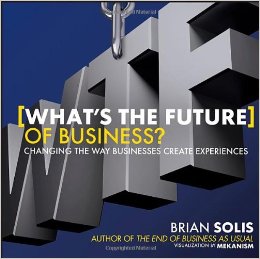
Book Review: What’s the Future of Business: Changing the Way Businesses Create Experiences

51NxMSgBwIL._SX258_BO1,204,203,200_This post is part of The Edge monthly series of book reviews on books relevant to new PR professionals.

I first heard from Brian Solis at the Social Business Summit in New York City last year and received a copy of his book [What’s The Future] Of Business from the summit. Solis is a digital analyst, anthropologist and futurist studying and influencing the effects of emerging technology on business, marketing and our culture today.

Not just another social media or customer service book, this is a detailed and insightful book on our changing customer experience and social commerce that revolves around a new generation of connected consumers (Generation C as Solis calls them) on the opportunities we are missing or underestimating. The book outlines actual recommendations on how to align your new business objectives and marketing plans based on the new world of engagement and the upcoming Generation C.

Solis focuses on how we can create and invest in meaningful and shareable experiences; this is the future of business. It provides great visual with well-designed graphics, sketches and examples of actual tweets. Personally, I appreciated the research and case studies Solis put in this book to make it even more authentic. From the design and layout of the book, it is one you will want a tangible copy of, not a Kindle version.

“In the circle of life, connected consumerism is the new reality. Those businesses that don’t disrupt their own markets will find their markets disrupted for them.”

Solis says now is the time to innovate as Generation C is taking place and innovation starts from within. The most dangerous words in a meeting can be “this is the way we’ve always done things,” but Solis says change starts with a vision. “To change takes two things: the aspiration and determination to change.”

The book provides inspiration around rethinking your business model, helping your company equip itself to change with your customers and learning how experience design helps businesses.

0114bd7Lauren Gray works within public relations and marketing from Stamford, Connecticut. She serves as a PRSA New Professionals Section blog co-chair and as a PRSA New York new professionals co-chair. Connect with Lauren on Twitter and LinkedIn.

Applying Your Education to Your New Position

diplomaAfter you’ve graduated and you’ve settled into your new job, college and your education starts to slip through the cracks of your memory. It may be hard to remember the theories and texts you read in college as it recedes further into the past. Here are some ways to apply your education to your new position, and keep what you’ve learned fresh!

Examine what the brand and messaging are for your company or client, and figure out how it was created.
Every company that has an established public relations staff should have an established brand and message in place. It is good practice to discover how that brand and message came to be, in order to offer educated suggestions later on to keep your work in line with them.

Ask questions and discuss best practices using your knowledge from your education.
The best way to learn is to ask questions. Each company will have its own best practices and methods to use that have been tried and established. Learn what you can from them to do your job better and apply your learned skills to make them even better.

Take the communication skills you’ve learned and be part of the solution to address communication issues, where appropriate.
The biggest problem that humans have – whether it’s in their career, relationships, friendships, and family life, is communication. Having studied how communication breaks down, what causes it, and the theories behind it, you are the perfect candidate to contribute to solving them as they come.

Education is ultimately about learning, and it doesn’t stop once you have your degree in hand. Remember to continue striving to learn as much as you can, stay well-read and up-to-date on what’s happening in the public relations industry and the world-at-large, and make sure you’re always searching for the information that you need to know.

What advice do you have for new professionals looking to apply their learning to their new job?

dTbWKDtT_400x400Samantha Owens is a writer, hobbyist photographer, and grammar enthusiast based in Napa Valley, CA. She writes her own blog, contributes at a literary fiction book blog, and freelance writing work. Find out more about her at about.me/seowens or follow her on Twitter at @sowensphoto.