August Twitter Chat Highlights: Preparing for Your Next Career Move

We’d like to thank everyone who participated in the August #NPPRSA Twitter chat focused on how PR professionals can prepare for the next shift in their career. We discussed how to lay the ground work for career growth, considering both internal promotions and jobs at new companies.

PRSA Twitter ChatSpecifically, we’d like to thank our special guest for the evening, Ron Culp, Instructor and Professional Director of the Graduate Public Relations & Advertising Program at DePaul University. Ron also manages the industry leading blog Culpwrit for new professionals establishing a career in PR.

Join us again on September 4 for our next #NPPRSA chat.

Stay up-to-date with PRSA New Professionals on FacebookTwitterLinkedIn and Google+.

Review highlights of the chat below. What did you learn from the August chat? How can you prepare for your next career move? What can you do to broaden your experiences in your current position to be considered for a promotion? What should a PR pro do if they don’t see a future for career growth within their company? 


Amy BishopAmy Bishop works in digital PR and marketing for DigitalRelevance, a content promotion agency. She is also Social Media Co-Chair for the PRSA New Professionals Section. Read her insights on customer experience and social business on her Marketing Strategy blog. Connect with Amy through TwitterPinterest or Google+.


The Artistry of Creating What’s Never Been Done Before – Part 2

Continued from the previous post:

Nicole Dobrzynski, ‎Global Football Brand Manager at Nike

“I find my creative inspiration when I am least expecting it. I find that if I sit too long at my desk and try to force an idea, it is hard to land on something compelling. It sounds cliché coming from someone who works at Nike, but inspiration usually finds me when I am out being active – playing soccer on the weekends, taking a yoga class on a Tuesday night, etc. Maybe this habit has been formed from years of playing soccer, but it always seems to happen for me. When my mind is not forced to think about something, random thoughts tend to come in that are different from a concentrated thought.

I also recently read an article that stated that the best creative thinking happens at night. The theory is that your mind is the most tired at this point, which allows the brain to bypass normal logic and think in new and interesting ways. Whether this is completely factual or not, I like to think that there is some truth to this thought. This would help explain why I am able to weave together a seasonal concept in the span of a 60 min evening yoga session, when I have been thinking about it for the past eight hours at work with little success of finding clarity.”

Tony Telloni, Managing Director at Golin NYC

“I think the key to any good creator is the skill of observation. There is creativity in just about anything and everything you come across. You have to be willing to look at things a little bit differently and embrace the thinking that comes with it. At Golin, we like to take creative field trips. We’ll go to a museum opening or an art exhibit. We’ll know that an event is happening at Times Square or Grand Central Station, and we’ll make a point of all going down to see it, even if it’s not an event that’s run out of our office. We do that to keep our creative skills sharp and go where we know you’re going to find sources of creativity and inspiration. I think, willingness to share what inspires you with others is another really important factor and lets great ideas grow to even greater ideas.”

Ben Roth, SVP Creative at MKTG Inc.

“I think you have to be an explorer and open up your frame of reference. You have to read things…things that you don’t want to read in order to explore different points of view. I also believe that in our business, you have to ask the obvious questions that most people think – they already have a simple answer to them. Even if you don’t ask them out loud, ask them to yourself, write them down, look them up – and learn.

Many times, people come in my office, and we have long conversations. I’ll bring up one topic, after another topic, and another. Often they ask me: ‘How come you know that kind of stuff?’ It’s easy. Every day, I write down questions I have, I think about them, look them up – and I ‘learn’ them. I am not smarter than anyone else but I created a ritual for myself that if I don’t have an answer, I’m not satisfied – I look it up and I write it down. The same goes for words. If you come across a word and don’t know its meaning, write it down and look it up. When I started my career and just came out of school, I had little notebooks full of words I didn’t know, full of things I’ve learned. It’s about creating that routine for yourself.”

Inspiration is powerful; on that we can agree. Not surprisingly, there isn’t a simple recipe to it. First and foremost, it’s about finding a balance that works for you; discovering what and who inspires you. It’s about exploring the world, being receptive and sharing your creative journey with others. Beyond that, understanding creative blocks as part of the experience and seeing every moment, encounter and place as an opportunity to learn, opens new doors toward creating the unseen.

HelmaVonZadowHelma von Zadow works with the Brand and Integrated Marketing team at Major League Soccer and is a member of the PRSA New York Chapter.  She served on the 2013-2014 PRSSA National Committee as vice president of professional development. Connect with her on LinkedIn or Twitter.

Doing It All and Then Some as a New Public Relations Professional

1397056226-10-ways-entrepreneurs-achieve-work-life-balance-2In the world of public relations it’s hard to find time to sleep. New stories always need to be pitched, thought-provoking tweets need to be sent and time-sensitive crises need to be extinguished. Learning to build and maintain an image, whether it’s for a brand, organization or individual can consume your life if you let it. As new professionals we feel like we have something to prove. Just the thought of turning off our phones might make us feel like we are going to miss the PR opportunity of a lifetime. I have good news! Another opportunity will come along.

As a new professional in the PR industry, finding a work-life balance can be challenging. We want to over deliver and work long hours to earn our spot at the meeting table. Also, our job is fun, which makes it hard to stop. In what other industry do you get to create engaging news stories, take over the social media world and throw memorable parties? Time flies in the PR industry and I often find myself begging the clock for a few extra hours.

Despite your love of the job, the hours and intensity will eventually catch up with you and your life outside of work will want to take center stage. So, how do we “do it all”?

  • Race Against the Clock – With limited hours in the day it is extremely important to manage your time. First, make a list of your tasks. Next, prioritize them by deadline and importance. This may seem obvious, but do the items with a tight deadline or items that need multiple approvals first. If you are at a standstill with an individual project, bounce ideas off a colleague or mentor. When booking meetings or after work socials, make sure you have a little time to breathe between each event. Rushing from one thing to the next will wear you out.
  • Divide and Conquer – You have a team surrounding you for a reason. If you need a press release reviewed, a few social media posts written or brainstorming support, don’t hesitate to delegate to an intern or co-worker on your team. Even if you work solo on a daily basis, you still have a network of PR professionals (i.e. PRSA) surrounding you to lend a hand. Using others around you as a resource will help you accomplish more within your work hours.
  • Learn The Art of Being Selective – With professional organizations, recreational sports, social events and service projects, when do we say no? Building networks, professionally and personally is extremely important, but be mindful of which organizations suck time and which ones add value. Join a select few organizations where you can commit and truly engage. Don’t join everything just to say you did.
  • Unplug – When the workday is over, disconnect from your electronics. We all need time to reboot. It has taken three years in the industry for me to realize doing this is okay. Our clients take vacations and our bosses sleep at night. We can too. Being without an iPhone, laptop or Wi-Fi can be scary, but take that time to enjoy the world around you. I promise you won’t regret it and your quality of work will show for it. 

hannahwilsonHannah Wilson works as an Account Executive at Spark Strategic Ideas. As a leader on the account management team she oversees the daily actives of over 50 Moe’s Southwest Grill locations, international toy manufacturer Schleich and North Carolina-based restaurant Hubee D’s. Hannah graduated with a B.A. in Communication with a concentration in public relations from Virginia Tech. She is a member of the PRSA Charlotte New Professionals board.

Book Review: Improvise: Unconventional Career Advice from an Unlikely CEO

This post is part of The Edge monthly series of book reviews on books relevant to new PR professionals.

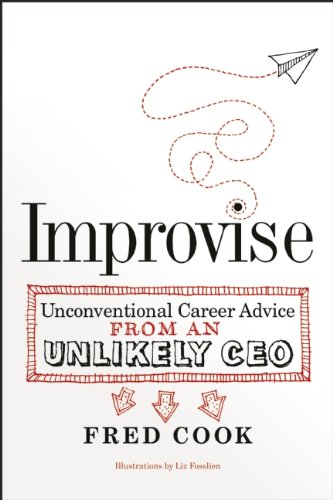
51rpj75I2fL“He has worked with some of the country’s most fabled business leaders, such as Apple’s Steve Jobs, Disney’s Michael Eisner, and Amazon’s Jeff Bezos. He has helped introduce the world to Teenage Mutant Ninja Turtles, Pokémon, and the seedless watermelon,” states a blurb about Fred Cook on the back of his latest book Improvise: Unconventional Career Advice from an Unlikely CEO.

If a description like that doesn’t inspire you to read a book then I don’t know what will.

This isn’t your average career development publication. It’s an entertaining education on leadership, creativity, business and getting ahead of your competition rooted in the very thing that propelled Cook to CEO of Golin—his unique experiences.

His outrageous stories catalog his adventures as a cabin boy on a Norwegian ship, a salesmen of leather goods in Italy, a doorman at a four-star hotel, traveling across the world, starting his own PR firm and many other experiences. These narratives, however, aren’t random. They all have a specific purpose: to keep you eagerly reading along and easily transferring otherwise complex lessons.

Much like the book’s title suggests, Cook puts a great deal of emphasis on the power of improvising. Employing his above-mentioned stories and wit, he details logical steps to embracing your weird thinking and harnessing it to advance your career. A consistent theme is the importance of gaining a variety of experiences to synthesize to your advantage.

The importance is showcased as Cook describes the very moments that equipped him to effectively maintain client relations and think outside the box to gain new business like Starbucks (before they were huge).

With so many qualified young professionals entering the marketplace, you’re going to be required to stand out. This book will help you do just that and is a must-read for the new pro as well as the seasoned veteran.

So start expanding your perspective and varying your experiences—pick up Cook’s Improvise, and I promise that your career will never be the same.

profile-benBen Butler is the founder and president of Top Hat IMC—an integrated marketing communications firm in Wexford and Pittsburgh, PA. You can connect with him on LinkedIn and on Twitter (@BenButlerPR).

Build Brand Buzz through Blogger Relations

Person-BloggingIn a PR pro’s world, what’s better than a group of thought leaders spreading the positive word about your brand?

Besides this summer’s World Cup-gone-social case study, I’d lean toward nothing.

To achieve that ultimate brand buzz dream, you need a thorough, targeted blogger-relations strategy. When executed well, blogger engagement will give your brand third-party credibility among its target consumer audience.

But unlike Clint Dempsey, PR pros can’t score big within the first 30 seconds of a blogger-outreach campaign. It requires research, patience, engagement and an overall good product or service for blogger relations to succeed. Here’s how to start:

1. Find your niche bloggers. Fight the urge to mass distribute to a media list; opt for quality instead. Complement a database media list with hands-on research. Tools like Twitter’s Advanced Search can help you find niche bloggers with a substantial social following. Let’s say, for example, you’re a cheese brand. Search “cheese AND blog” in the Advanced Search words section, and you’ll get a list of hundreds of people who blog and have a special place in their heart for cheese. Bingo.

2. Read their content. Before pitching, take time to read each blogger’s content to see how your brand fits, then reference specific posts during outreach. Let’s go back to that delicious cheese example. If you’re pitching a food blogger, point out some cheese-specific posts and tie in why he/she would love your brand. Did he/she write about a new Gouda dish? Share a tasty recipe that makes your specific cheese irresistible. By using this approach, you 1) prove you read their blog, 2) highlight your cheese’s unique attributes, and 3) illustrate how your product can be repurposed for content beyond that initial review post.

3. Set reasonable expectations up front. As new PR pros, we’re under tight, demanding deadlines every day. But, keep in mind that most bloggers write in their spare time, and they’re under similar pressures during their day jobs, too. From the beginning, set reasonable deadlines you both agree on for product reviews, tweeting, etc. And always remember: It’s the blogger’s site – not yours. It’s his/her prerogative to stick to blog guidelines and write about what best serves the audience.

4. Engage regularly. Have your solid group of bloggers secured? Nice work. Now it’s time to prove you’re a good partner. Share their content, +1 their updates, comment on their posts or tag them in tweets they’d find interesting (within reason, of course). When executed well, a blogger-relations campaign is mutually beneficial: They help your brand reach new audiences, and you help their blog reach new readers.

5. Have a good product. Cue the “duh” reaction here – of course your product is wonderful – but hear me out. Sometimes PR pros are asked to promote an unfamiliar product. Because it’s new, they may not know or recognize the product’s flaws – but the blogger will. And, depending on the blogger, this could result in a severed relationship or, worse, a negative review (followed by a “good riddance”). If you’re uncertain about a product, test it out firsthand, or see what the review sites say. By doing your homework, you could save your brand’s reputation while helping improve its product.

As you embark on your blogger relations journey, remember that quality trumps quantity. And, while time consuming, this thorough strategy will have reputable thought leaders building powerful brand buzz among your target audience. Now that deserves a hashflag raise, don’t you think?

Do you work with bloggers? What tips do you have for a successful blogger-relations campaign?

Stephanie Vermillion headshotStephanie Vermillion is a senior account executive at Wordsworth Communications, a public relations agency in Cincinnati. She is on the PRSA Cincinnati Leadership Team and is part of the PRSA Cincinnati New Pros Committee. Connect with Stephanie on LinkedIn and Twitter (@SMVermillion).