10 Questions to Make the Most of a Relationship with Your Mentor

A successful mentor-mentee relationship begins with asking meaningful questions. These key questions help you gain a deeper understanding, guide your growth and foster a stronger relationship with your mentor.

By Jesse Burke

The first few weeks of the year can be the perfect time to reflect on the previous twelve months by evaluating goals, celebrating successes and acknowledging the obstacles that led you to grow. Much like the gifts we exchange around the holidays, this time can bring a sense of wrapping things up – and, of course, excitement for what’s to come! 

One of my favorite traditions around this time is choosing a New Year’s resolution. Each year, I try to set personal and professional goals that align with where I am and where I want to be. In 2025, I aimed to keep myself moving forward by setting a personal goal of walking 10,000 steps daily and a professional goal of joining a professional organization, which led me to my current role as Co-Mentorship Chair of PRSA New Professionals. This year I’m aiming for 11,000 daily steps and officially launching our New Pros Mentorship program. 

If you’re a new pro still looking for a New Year’s resolution, a meaningful option to consider could be finding a mentor for yourself. Building a relationship with a mentor can be a great way to navigate not only the start of the year but also the early stages of your career. It’s a resolution that can turn simple meetings into a powerful tool for your professional growth. 

Ten Questions to Get You Started

To help you kick off a new year and a new mentor-mentee relationship with confidence, consider these ten thoughtful questions to get to know your mentor:

1. Can you tell me about your career journey? 

2. What advice would you give to yourself when you were just starting?

3. What skills or certifications would you prioritize if you were new in your career today?

4. How can I make the most significant impact as a new pro in my role?

5. How do you establish a healthy work-life balance? 

6. What inspires you outside of work?

7. How do you stay on top of PR, MarComms and industry trends?

8. What are some common obstacles I should prepare for in my career path?

9. What are you most proud of in your career so far?

10. What additional information can I share to make our relationship successful?

These questions serve as a good starting point for getting to know your mentor. However, some of the most meaningful relationship-building can happen through spontaneous and casual conversations. Ultimately, it’s essential to come prepared with organized thoughts and ensure that everything reflects your authentic self. 

Join Our Program

Of course, the above questions are irrelevant if you don’t have a mentor to ask them. If you’re looking, there are several ways to find one, such as through your workplace, a personal connection or by joining our New Pros Mentorship Program. We’re currently gathering names of individuals who are interested in participating as mentees. To join, please fill out this form by January 30, 2026, at 11:59 PM. .

Note: Filling out this form does not commit you to anything at this stage. It simply helps us gauge interest, form a waitlist and better understand what you’re looking for in a mentorship experience. Once we’ve finalized program details and secured mentors, we’ll follow up with next steps!

Have a question? Feel free to contact me at jesseburke2020@icloud.com.  

About the author:

Jesse Burke serves as the Mentorship Co-Chair of PRSA New Professionals, managing the section’s mentorship program. He graduated from The Ohio State University in 2024 and is an account executive at Slide Nine, a communications, public relations and digital marketing agency based in Columbus, Ohio. 
How to Network as an Introvert

Article title overlaid a handshake between two professionals

by Jonathan Mayes

As introverts, we’ve all been there. You’re at a conference and there’s a special happy hour at the end of the day, where everyone is invited to attend and “network” after a long day of sessions. Or if you think back to your college days when a career fair is coming up and you learned that the company you’ve dreamed of working for will be there. The only problem is that you will have to network, aka talk with the recruiters. 

As an introvert, I know that it’s sometimes a struggle to even talk with my closest friends and family. Then, adding the stress of trying to impress an employer or colleague, I might as well be swimming up a creek without a paddle. 

However, having experienced these situations before, I’m here to tell you that you can do it! Even though it might sound scary, stepping out and talking to strangers will actually help you build up confidence for future interactions. 

Now, I understand you may still not feel comfortable dipping your feet into the water, so here are three tips on how to prepare and network as an introvert. 

1. Focus on one-on-one or small group settings.

Large networking mixers can feel draining, but you don’t have to attend every one to be successful. Instead, look for opportunities like coffee chats, small professional breakfasts, or niche industry meetups where conversation is easier.

If you do attend a larger event, aim to connect meaningfully with just one or two people rather than trying to work the whole room. Choose the industry or company that you most resonate with and start there. That way, you leave with strong contacts instead of shallow introductions. Once you’re in the room and feel comfortable, you can always talk to more people. 

Online networking (LinkedIn groups, industry Slack channels, alumni networks) can also be a great fit since it allows you to engage at your own pace, plus it can be written and not live chat!

2. Prepare conversation starters in advance.

Having 2–3 open-ended questions ready helps you feel less anxious about awkward silences. A few examples that you can start with include: “What brought you to this event today?” “I noticed your role involves [X]—how did you get started in that area?” “What’s been the most exciting project you’ve worked on lately?”

These questions demonstrate genuine curiosity, invite the other person to talk about themselves (which most people enjoy), and provide an opportunity to discover shared interests.

You can also prepare a short personal introduction—just a 2–3 sentence version of who you are and what you do—so you don’t feel put on the spot when it’s your turn to share.

3. Use follow-ups to your advantage.

After meeting someone, send a personalized message within a couple of days. For example, you can say: “It was great meeting you at [event]! I really enjoyed hearing about your work on [specific project/topic]. Would love to stay connected and hear more about it.”

Sharing an article, podcast, or resource related to your conversation is a simple way to add value immediately and demonstrate thoughtfulness. Additionally, this will help keep the conversation going and demonstrate to the individual you’re networking with that you’re passionate about what you discussed with them, and that you value their insight and opinion.

Finally, because introverts often excel at written communication, this step allows you to deepen the connection without requiring constant face-to-face interaction. It’s the best of both worlds, honestly! 

Bonus Tip – Be Yourself!  

A lot of times, people (and employers) value authenticity over fake personas. If you’re trying to grow with your interpersonal communication skills, explain that to whoever you’re networking with. I’ve often found that the person I’m talking to is quite surprised and impressed when I tell them that I classify myself as an introvert. That then causes them to remember me, which is never a bad thing! 

I’m going to end this blog where I started, and that is, you can do it! Oftentimes, it’s taking that first big step, or in this case, walking up and saying “Hello, my name is X,” that’s the hardest part. Having had the great opportunity to hold multiple internships during college and now two jobs post-college, I can undoubtedly say it gets better with practice. You can do it!! 

About the Author 

Jonathan Mayes is the current PRSSA Liaison and Chair Elect for PRSA’s New Professionals Section. He graduated from The Ohio State University in 2022 with a Bachelor of Arts in Strategic Communications and a minor in Hospitality Management. He’s currently the Social Media Coordinator at Red Roof Hotels, which is based in Columbus, OH. 

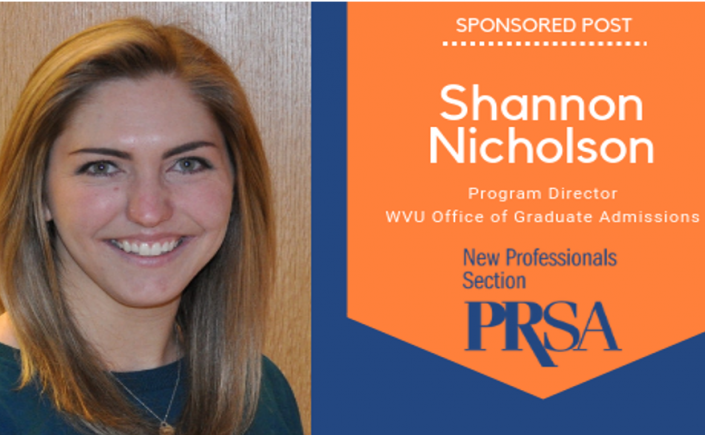
New Professional Spotlight: Shannon Nicholson


Name: Shannon Nicholson
Job Role: Program Director, West Virginia University Office of Graduate Admissions
Education: B.S. Journalism, ’14, M.S. Data Marketing Communications, ’17 – WVU Reed College of Media
Social Media: @shannonicholson (Twitter) and @shannonpauline (Instagram)

How and when did you first become interested in PR and communications?

My first job in the industry was at a small, B2B advertising agency in Morgantown, WV. I was exposed to all facets of marketing: content development, direct email, digital advertising, media relations, social media, traditional media, and website design (to name a few). What I did not know before I started my Junior Account Manager position was the importance of tying campaigns to business goals, breaking down department silos, and utilizing collected data to be relevant and timely. Enter the Data Marketing Communications, fully-online, graduate program. This program allowed me to bridge my interest in the business-side of marketing and my growing expertise in the field.

How did you find internships/jobs?

As a WVU student and alumni, I have an amazing resource at my disposal- MountaineerTrak powered by the Career Services Center. MountaineerTrak was my first line of defense. During my years as an undergrad, the Reed College of Media hired a Director of Student Careers and Opportunities, Eric Minor. Eric’s weekly “opportunity” email quickly became my go-to resource. Eric is the perfect liaison between current students looking for experience and alumni looking to provide that experience as a way to give back to their alma mater.

What was the biggest challenge you’ve ever faced in your career? How did you overcome it?

The biggest challenge I have faced in my young career has been introducing new procedures, and strategies from the ground up. In my current role, I assumed that after six months and I’ll be like a well-oiled machine and have already implemented new strategies. I soon realized that implementation would take closer to one year. The next year will be spent analyzing, and the following year will be about growth and optimization. It is hard not to get ahead of myself and want to be at year three, today! Really, the biggest challenge is not trying something new, it is pacing myself to check one step off the list at a time. Devoting 110% to each step without getting ahead of myself and potentially losing sight of details that could later derail all that the team has worked towards. Slow and steady wins the race.

What has been the most valuable thing you have learned through classes or experience?

Differing experiences, bring perspective. In my Data Marketing Communications cohort, students had varying backgrounds in data, graphic design, marketing, sales, etc. Listening to each other’s viewpoints helped the entire cohort approach problems with an open mind.

What has been the best piece of advice you have received?

You won’t know unless you try.

Do you have any advice for future PR pros?

There are a lot of different ways to apply your marketing/PR knowledge. Don’t limit yourself to certain industries or titles. Today, there are more opportunities than ever to be creative with your knowledge.

What do you think is the best benefit of PRSA and the New Pros section?

I think the biggest benefit of the New Pros section is the opportunity for engagement and networking. PRSA boasts amazing partners, and communities for growth and learning. I was particularly drawn to the #NPPRSA Twitter chats. Twitter chats have been a great outlet to informally discuss specific topics with others in the industry. I have found that those who participate want to engage and share. Even simply reading through threads has helped open my eyes to areas outside of my expertise.

Is there anything you wish you would have known before starting your career?

You will never stop learning. When you think you know enough, there is always more. It is important to be vigilant about the changes within your field.

Tell us a little-known fact about yourself.

I have a Bengal Cat that is about 20 lbs, who acts more like a small dog than a cat.

This New Professionals spotlight is sponsored by West Virginia University. If you are a member of PRSA New Pros and interested in being featured, or interested in nominating someone to be featured as a part of our #MemberSpotlight, please complete the following form.


Three Tips for Reaching Out to Other PR Pros

An intentional, well-written networking email can lead to a new job opportunity, a new mentor or a new perspective. You will find that most professionals, especially those involved in PRSA, are more than happy to help you, offer advice and share their expertise. But even if you have a strong relationship with the professional you are reaching out to, it is always important to establish professionalism.Whether you are a graduating senior seeking job opportunities or a young professional simply looking to make new connections, here are a few tips you should always keep in mind.

Be considerate.

It’s important to remember the person you are reaching out to has a full-time job, and is graciously taking time out of their schedule to help you. Be considerate of how much you are asking from this professional and understand it may take time for them to respond.

I recently got an email from someone “hoping to move to NYC” wanting to know “which companies they should apply to.” Seems harmless, right? Wrong. There are thousands of companies in New York City, and this young pro was essentially asking me to do their job search for them. You should make it as simple as possible for them to reply, which leads me to my next point.

Be specific.

About a month ago, I received a text from a recent grad from my university, who asked if I could tell them more about my last job. It was typical PR agency, so what exactly did they want to know? About the culture? The clients? Once I followed up and asked for more information, I discovered they wanted to learn more about the differences of working at a large agency versus a small agency, as I’ve done both.

When reaching out to a professional, avoid vague requests like this, and instead ask specific questions and make sure your goal is evident. Do you want to set up a call or meeting? Offer up a few days and times you are available in the next couple weeks for the professional to choose from. The more details the better. Speaking of details…

Be detail-oriented.

Before you reach out to a professional, triple check the body of your email and any documents you’ve attached. Then, ask a few friends to review everything. Don’t send a resume with grammar errors, formatting mistakes or a lack of specifics to a professional. It comes across as lazy and unprofessional.

Too often I receive emails with a low quality resume attached and the request to pass it along to one of my contacts. I’m always shocked when this happens because I’d never recommend someone I don’t truly believe in.

Hope this helps you as you prepare to reach out to a pro you admire!

–Arielle Schrader, @RELschrader

Three Tips to Take the Jitters Out of Networking

People who work in PR are known for being social butterflies who can drum up a lively conversation with just about anyone. But I’ll be the first to admit that, yes, I work in PR, and yes, I still get a little anxious right before I walk into a networking event. It can be intimidating to attend a luncheon or conference by yourself. There’s that first long minute filled with nervous energy while you look for a friendly face, and then everything melts away after you start your first conversation. And by the end, you’re glad you went. This quote from Kristin Newman’s memoir perfectly sums it up:

“I was a shy little girl and an only child, so on vacations I was usually playing alone, too afraid to go up to the happy groups of kids and introduce myself. Finally, on one vacation, my mom asked me which I’d rather have: a vacation with no friends, or one scary moment. So I gathered up all of my courage, and swam over to the kids, and there was one scary moment… and then I had friends for the first time on vacation. After that, one scary moment became something I was always willing to have in exchange for the possible payoff. I became a girl who knew how to take a deep breath, suck it up, and walk into any room by herself.”

One scary moment is almost always worth the trade-off. Here are three tips to get you through that one scary moment and become an expert networker.

1. Geek out together

The good thing about attending PRSA networking events is that you automatically have at least one thing in common with everyone else there: you work in PR (or aspire to work in PR). So bring up industry news that your regular social circle doesn’t get nearly as excited about, like Snapchat’s new glasses or the latest brand in crisis. In addition to industry news, it’s helpful to be up on the latest global and national happenings, always, but especially before a networking event. My go-to resource is theSkimm, which presents the news in a quick, easily digestible format. It’s ripe with conversation starters.

2. Go beyond small talk

Based on the idea that we’re not defined by our job titles (although I would argue a career in PR results in a serious work/life blend), I recently stumbled upon this great list of questions to ask people instead of “What do you do?” from Fast Company. Some of my favorite questions are:

  • Do you have any side hustles or passion projects?
  • Are you working on any exciting projects right now?
  • What’s your favorite emoji?
  • What was the highlight of your week/weekend?
  • What’s the most interesting thing you’ve learned recently?

These are guaranteed to spark conversations that won’t fizzle out after the first minute.

3. Volunteer

If you’re new to an organization or city, the fastest way to make connections is to raise your hand and volunteer. For example, in PRSA you can join a number of committees, from new professionals to membership to communications. Choose a volunteer opportunity based on your strengths, whether that’s planning events, running the check-in table, or helping with promotion on social media. When you get involved, it allows you to build deeper relationships with members. Plus, you’ll know a few friendly faces when you go to the next event.

What are your tips for becoming an expert networker?

c_ryan_648


Caitlin Rebecca Ryan is a PR writer for Eric Mower + Associates in Charlotte, NC, with a passion for live music, snail mail, and novels. Connect with her on Twitter, Instagram, and her blog.