Leadership Outside of the Office

Maybe you were a leader when you were in PRSSA, or honed your leadership skills through your on-campus involvement. Now that you’re a new professional, you get to start anew and take your leadership to another level. Natural-born leader or not, there are many ways to exercise your leadership outside of the workplace.

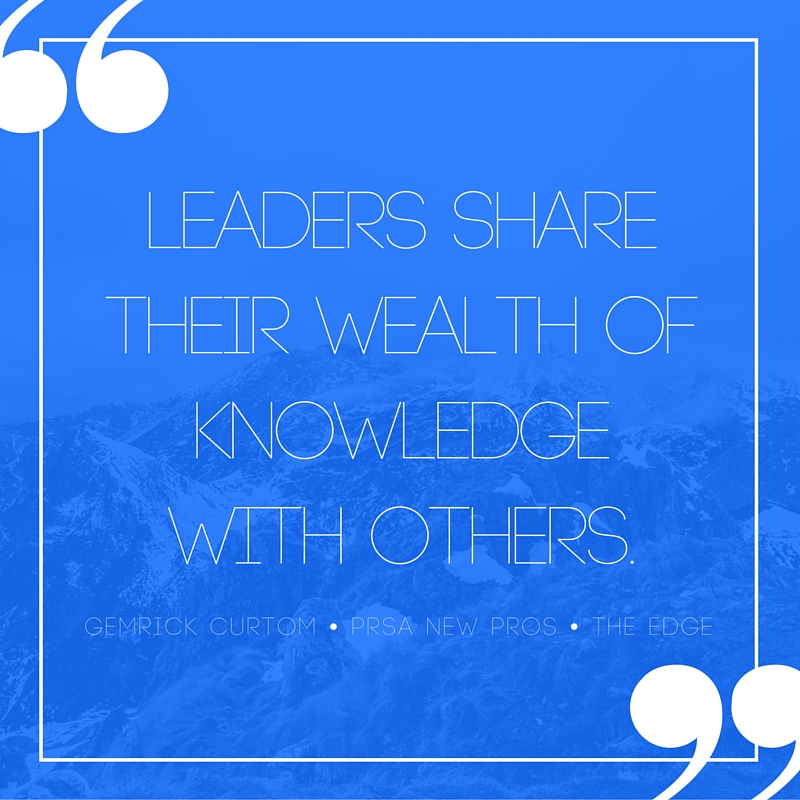
Leaders share their wealth of knowledge with others.

PRSA and similar organizations

Local PRSA Chapters and New Pros committees are always looking for new leadership. I always hear from seasoned PR professionals that New Pros are the future of every organization, so why wait until later when you can start making an impact today?

Every organization needs strong leaders to help make crucial decisions. The best way to get your foot through the door in PRSA leadership is by leading in a committee or undertaking a big event/workshop. It’s a great way to network and get some name recognition if you hope to join the board of directors one day.

Local nonprofits and philanthropies

Most nonprofits are in need of an extra hand, and what better way to cure that do-gooder itch than to lend your expertise to a local nonprofit? Find a cause that you’re passionate about, rally up volunteers and lead the cause calling your name. If there isn’t a cause that piques your interest, start one.

There are so many ways to give back to the community: food drives, local politics, animal shelters and the list goes on. Find an area that could benefit from your expertise. A lot of millennials care about cause-driven movements, so finding people to join the effort shouldn’t be too difficult.

Share your knowledge

Leaders share their wealth of knowledge with others. Leaders also build others up, which brings up the quality of people around them. Not only does this extend your authority on the topic of leadership, but it also helps aspiring leaders learn from you. This could include speaking at a PRSA workshop, PRSSA meeting or offering advice at an organization that helped you get to where you are right now.

Even if you don’t think you’re the strongest leader around, these are great ways to become one. If you believe you’re a great leader, bring those qualities to the table and make something better.

Gemrick Curtom_LinkedIn

Gemrick Curtom is a member of the PRSA New Professionals Committee and the PRSA Houston Chapter. He is a University of Houston alum and currently resides in Houston, TX. You can follow him on Twitter or connect on LinkedIn.

Just Keep Swimming: 4 Things to Remember During a New Chapter of Your Career

You’ve seen the memes complaining that adult-ing isn’t all cracked up to be. Truth be told, it isn’t easy but it is nothing you can’t handle. Believe it or not, your time in school has prepared you for the task at hand. One thing I admire about the public relations profession is that it is full of critical thinkers and crisis managers who think creatively.

As you navigate the real world, think of yourself as your first public relations client. What is your mission statement, what are your goals for the next six months to a year, what tactics will you use to reach them, and how will you set yourself apart from other brands? Now that you don’t have defining markers like grade levels to help you advance through life, you have to learn to identify both small daily achievements as well as significant milestones that move you closer to success. Below are some tips to remember as you start a new chapter.

Set 6 month or yearly goals…

Whether it’s a creative project you want to complete, a personal achievement like reading one novel a month, or a career goal such as getting a promotion. Setting goals are important because unlike when you were in school, the fall “back-to-school” season, and even a new calendar year, don’t present much change in the “real world.”

Remain poised, passionate, and professional…

Although millennials and Generation Z are driving change in the workforce, we must remember that professionalism never changes. Put your phone away at work, take notes during meetings, and ask questions. It’s the little things that will set you apart from your peers when it’s time for a promotion.

Be curious…

Yes, your role is to manage communications for your company’s brand but there is much more to your organization or agency. Talk to everyone! Initiate small talk with someone in the finance department or reach out to someone on LinkedIn in a different industry; you never know what knowledge you will gain and how it can contribute to your personal or professional self.

Just keep swimming…

Your career is a marathon, not a sprint and things don’t always pan out as planned. Plan A can turn it to Plan B which turns into Plan C all the matter of a few months but don’t let that discourage you. Before you know it, you’ll realize you needed Plan B and Plan C to be ready for Plan A. Remember that success is relative and is dependent on what makes you fulfilled. Success doesn’t happen overnight and if it were easy, everyone would have it.

As you start a new chapter of your career, remember to stay creative, give 110% to your work, and most importantly have fun!

i-zthGPGn-XL-230x300

Jasmine L. Kent, a member of PRSA-LA, is a fan of all things food and beverage, pop culture, and media. Combining all three passions, Jasmine builds community through engaging online marketing and dynamic events as a communications professional in Los Angeles, CA. Keep up with her on Twitter at @JaVerne_xo or visit LoveJasPR.com.

Transitioning from PRSSA to PRSA

You’ve put in the work, your finals are in and graduation is finally right around the corner. You’re making your post-grad to-do list and checking it twice. Joining PRSA as an Associate Member should also be at the top of your to-dos.

Why Join PRSA?

As a graduating PRSSA member you likely already know that being a member of PRSA is a step you should take to further your career. You probably also know that joining the world’s largest public relations professional organization gives you unlimited opportunities to connect with and learn from more than 21,000 other public relations and communications professionals at all career levels. You may also understand that participating in PRSA, volunteering and taking on leadership roles give you the opportunity to actively shape the future of the profession, as well as shaping yourself as a professional.

By investing in joining a professional organization like PRSA, you’re investing in your career and your own development. Beyond connecting with other professionals, PRSA membership offers the opportunity for continued professional development, career advancement, mentoring and more.

So how do I join?

Joining PRSA couldn’t be easier. All you need to do is fill out the online application, list your Alma Mater, select your local Chapter and special interest sections (please keep in mind both of these are optional) and submit your payment. Don’t forget to keep your receipt since professional organization dues are tax deductible.

Membership dues for PRSA are tiered, depending on experience level. Associate Membership is ideal for recent grads and young professionals. As an Associate Member, you have access to all of the benefits of PRSA with discounted dues. Current students who are within five months of graduation and PRSSA graduates (within two years of graduation) can join at $60 a year. Professionals with less than a year of experience, or those who weren’t PRSSA members, can join at $115 a year; those with one to two years of experience, $155 a year; and those with two to three years of experience, $200 a year. Associate members may also join the New Professionals Section at no additional cost with the promo code AM16. Professionals with more than three years of experience are simply classified as members. Regular membership dues are $255 a year for the duration of your career.

How is PRSA different from PRSSA?

PRSA differs from PRSSA  because it offers professional development for members in all stages of their careers. As a PRSA member, you can seek out ways to get involved and serve your Chapter by contacting your Chapter president or the chair of a committee you’re interested in helping with. PRSA has more than enough opportunities for every member to get involved, but it’s up to each member how much time and energy they want to invest in the organization.

What role does my local Chapter play?

PRSA and its New Professionals Section offer great opportunities for networking with other professionals all over the country, but your local Chapter is the most important piece of your professional puzzle. If you’re looking for a job, to relocate or both, searching your Chapter or prospective Chapter’s online job board is a great way to find positions located near you. Connecting with members of your local (or prospective) Chapter and meeting with them to discuss the opportunities that are available, who you are and what you’re interested in is another often overlooked way to become aware of new jobs within your area. Most new opportunities are passed around and come across the desks of seasoned professionals before they’re posted online, if they ever make it there. Having yourself fresh on your colleagues minds is the best way to become aware of what’s out there, whether you’re looking for a new job or not.

Are there any groups or benefits specifically for recent grads?

Joining the New Professionals Section, one of the organization’s 14 Professional Interest Sections, is a great way to make the transition from student to professional. If you already have an idea of which industry you’d like to work in or would like to have a little extra guidance in the industry you’re currently (or soon-to-be) working in, check out any of the 10 industry specific Sections PRSA offers. If you only join one though, make sure it’s the New Professionals Section. Membership is reserved to those with three years of experience or less and is a great community for young pros to get advice from peers, begin to get involved and give back to the organization, and learn to navigate the working world.

In addition to PRSA’s national New Professionals Section, many Chapters have their own New Professionals group to help connect members and offer resources on a local level. Chapters typically list special interest groups and contact information on their websites. The New Professionals Section also keeps a list of New Professionals groups and their parent chapters.

Will my employer pay my dues?

Some employers will pay professional organization dues for its employees, either through group rates or as part of an employee benefit package. Whether PRSA membership is included as a benefit depends entirely on the company or organization, but it can’t hurt to ask. If you’d like to discuss PRSA and its membership benefits with your supervisor or boss, mentioning items like the industry-focused publications, networking opportunities and the library of free resources and professional development opportunities may be great information to help make the case for employer investment in PRSA memberships.

How can I make the most of my PRSA membership?

All of these benefits are great, but the best way to get the most out of your membership is to get involved with the organization. It can be as simple as volunteering to help with an event or writing for your Chapter’s blog or as involved as taking on a leadership role. Jumping right in and getting your hands dirty is the best thing you can do to put yourself out there, make those important connections, gain experience and make your membership work for you.

Robyn Rudish-Laning (1)

Robyn Rudish-Laning serves on PRSA’s New Professionals Section’s executive committee and is an active member of South Carolina’s PRSA chapter. She holds a master’s degree in Media Arts and Technology and a bachelor’s degree in Public Relations, both from Duquesne University in Pittsburgh. Robyn is a native of Southern New Jersey and currently resides in Columbia, SC.  You can connect with her on LinkedIn or Twitter, email her or read her blog here.

New Pros Week is Coming: Here’s How to Get Involved

Celebrate PRSA New Professionals Week Aug. 1-7, 2016

Each year, PRSA New Professionals Week (Aug. 1-7, 2016) encourages new public relations professionals to share resources and advice with fellow new professionals across the country as we celebrate current members and encourage new members to join.

During this week, we encourage local Chapters to host events focused on providing networking and career development for professionals new to the industry.

Here are a few ways PRSA Chapters, new professionals and employers can get involved with New Professionals Week.

PRSA Chapters

Plan a New Pros Week event

While the PRSA New Professionals Section provides national programming, each PRSA Chapter can host an in-person event of its own. Here are a few ideas:

  • Ask a new professional in your Chapter to help plan an event
  • Arrange a mentor meet and greet in which young professionals are paired with seasoned mentors
  • Sponsor a networking mixer at a popular happy hour location
  • Host a “What I wish I knew as a Young Pro” panel featuring seasoned public relations professionals; invite students and recent graduates
  • Host a viewing of a PRSA New Professionals webinar over coffee, lunch or drinks

Once you set a date, be sure to register your event here.

Recruit new professionals to join your Chapter

New Professionals Week is the perfect opportunity to plan a membership campaign targeted at young professionals. Use this week to target your communications to new professionals who are not members.

New professionals

Participate in national programming

During PRSA New Professionals Week, we will provide national programming such as a Twitter chat, webinar and blog series. Stay tuned for more details, and continue to monitor our website for upcoming dates.

Organize an event

If your Chapter isn’t already planning a New Professionals Week event, volunteer to organize one. Once you set a date, be sure to register your event here.

Employers

Work with PRSA to host an event

If your company has a lot of new professionals, consider working with a PRSA member to organize an event to recognize your company’s newest hires. Here are a few ideas:

  • Promote your local PRSA Chapter’s New Professionals Week event to employees
  • Invite a PRSA member to host a training for new professionals at your agency or corporation
  • Write letters welcoming your new professionals to the company and thanking them for their work
  • Sponsor your new professionals’ PRSA membership and use the code AM16 to get a free New Pros Section membership

PRSA New Professionals Week 2016 will be here before we know it. How are you planning to celebrate?

AAEAAQAAAAAAAAl1AAAAJGM5NWQyMTZkLWFlZTAtNDU1OS05NDZiLTgxYTU2ZDNjZGJmNgHeather Harder is the PRSA New Professionals co-programming chair and an account executive at Capstrat in Raleigh, North Carolina. Contact her with questions about getting involved with New Pros Week.

Leadership In 2016 – Part 3

Editor’s Note: This is the third in a series by leadership and communication expert David Grossman, ABC, APR, Fellow PRSA.  In the first two posts, David discussed the importance of leadership today and the keys to effective leadership (with some great input from readers of this blog!)

Leadership Is Easier When You Are Authentic

Growing up, I found myself on the “Supposed To” track.  The feelings I allowed myself to have as a child, teenager and adult were solely happy feelings; the rest of my feelings went into this black hole never to be discovered or talked about.

At age 33, I had achieved all of what I was supposed to and more, and found myself in a therapist’s office.  In talking about my challenges, I had put on the veneer of my polished, professional self.  It’s then that I grabbed the pillow next to me and clenched it to my chest.  Hard.  In that moment, there was a huge disconnect between the words I was saying and my feelings.

My therapist and I now laugh about the pillow that launched my journey of authenticity – one I wish I had started years earlier.

As we think about leadership today, starting on (or continuing on) a path toward authenticity is a way all leaders can make a difference – for themselves and for others.  Authenticity matters today.  Authentic leaders get better business results, have healthier work lives, and excel in real, meaningful relationships. They sleep better at night.

The Road Less Traveled: A Journey of Authenticity

What’s essential for your Journey of Authenticity is to come at it from a place of self-knowledge instead of coming from a place of responding to stress, worry, or anxiety.  This means being as purposeful as you can on your chosen route.

What I know from my research and consulting, as well as from interviews with senior leaders and practitioners – authenticity isn’t a skill.  It’s a component of one’s self that a person can actually accentuate or work on to become better and lead a more fulfilling life – whether it’s on the job, in your relationships, or at home.

No one really learns the skill of authenticity.  Instead, authenticity comes through by improving our communication skills as leaders.   When you come at communication from an authentic place, communication becomes much easier and much more effective.

How To Be Authentic

For me, authenticity has 3 components:

1. Know Yourself

Early in my career, I was fortunate to work with some incredibly inspiring leaders who brought out the best in me. I gravitated toward them because of how they made me feel. I trusted them because they were genuine, authentic, and because they demonstrated much more confidence in me than I had in myself. They stood for my potential, which was incredibly motivating for me as a 20-something professional, and only spurred me on to be even better.

When it was my chance to lead, I was determined to lead in a similarly authentic way. I tried to take the best strategies from each of them. After all, imitation is the greatest form of flattery. Still, I made my share of mistakes as a new leader, and then I realized an important lesson:

Leading authentically isn’t about being “like” someone else. Instead, it’s about knowing yourself and being who you are. Sure, you can “try on” strategies that work for others. Yet in the end, leading authentically is about finding what works best for you. And when you are genuine, you have “full power,” which is what the Greek root of authentic—authentico—truly means.

2. Be Yourself

The second component is about acting in ways that are consistent with who you are. This is your own self-awareness as you relate to others.  This means behaving in ways that are in sync with your values instead of simply trying to please others or get something from others.

Early in my career, I acted like a chameleon, changing my thoughts and feelings based on others.  Today, I strive to be my authentic self regularly.  What it looks like and how I act really doesn’t change very much.  What does change is how I feel on the inside.  When I acted as a chameleon, I did it out of a desire for people to like me.  When I relate to others from an authentic place today, I do it with confidence.  I don’t worry that they won’t like me.  They might not, and that’s their choice – that’s okay.  I’m simply no longer consumed with the need for people to like me.

3. Have Quiet Courage As You Interact With Others

Authenticity is about this constant process of being truthful – first with yourself and then with others – to say the things that need to be said.  It can be very difficult to do it in a kind and respectful way.  Quiet courage is about saying the truth so others are able to hear it.  This isn’t “Rambo” courage but an internal kind of courage that comes from deep inside. It’s about knowing that being truthful is the only way to move people and the business forward. Failing to address the problems or areas of improvement won’t help the business succeed.

Must-Haves for Your Journey to be Authentic

If you’re up for the Journey – and I hope you are – here’s what’s important to have with you at all times:

  • First, your curiosity – You can’t be authentic without the ability to reflect and be self-aware. Your curiosity needs to be as strong – or stronger – than any of the thoughts or feelings you might be having – whether it’s concern or worry, or other much more complex feelings like fear or shame.  If you can be curious, you can look at anything.  You can say, “Hmmm… Wow, that’s interesting. Is there something worth exploring here?  Is there something I can learn about myself or others?” To get ahead in business, you need to continually learn and grow.

    Plus, curiosity will make you a better listener.  The better you listen to others, the better they will listen to you, and the better your relationships will be, including your most important relationship – the one you have with yourself.

  • Second, embrace who you are – It’s our imperfections that create connections with others. People say all the time to “let it go” – the phrase that made the movie, “Frozen,” so popular.  You can never let go what you haven’t embraced.

    You have to say, “This is mine.  I can hold it.  I can own it.  Now, I can let it go.”  And then once you really accept it, saying, “Yes, this is me.  It’s not my favorite part.  Now I can begin the process of letting it go and setting it aside.  It doesn’t really control me.”

  • Last, focus on what you can control – think about all you have control over, and focus on that. Not how your boss, colleagues, or clients behave.  Not the economy.  Not the fact that “stuff happens.”  Don’t focus on where you’re powerless to change things. Instead, focus on what you can do something about.

When In Doubt, Take A Step Back

If you find yourself stressed, or feel stuck on your Journey, just listen to yourself – to your gut.  Take a step back and try to see the forest through the trees.

When you’re approaching a mountain and are miles out, it seems really small.  When you get to the bottom of the mountain and look up, you realize it’s huge.  When life gets too big, back up a little bit.  Sometimes when you’re too close to something, it can feel overwhelming.  You feel incapacitated and can’t take the first step.  Or, the alternative strategy is to get to the base of the mountain and don’t look up; just put your nose down and start. A CEO I used to work with at McDonald’s often would say, “Jump in; the water’s fine!”

The process of looking at yourself can be very difficult in the beginning.  But the value at the other end can be so worth the process.  Very few things feel as rewarding as being who you are in the workplace.

How are you doing at leading authentically, and what’s a next step to advance your Journey?

New ProsEXCLUSIVEDeal-No-Cape-Needed-50-Off

David Head Shot High ResDavid Grossman, ABC, APR, Fellow PRSA is both a teacher and student of effective leadership and communication and helps leaders drive productivity and get the results they want through authentic and courageous leadership communication. He’s a sought-after speaker and advisor to Fortune 500 leaders. A three-time author, David is CEO of The Grossman Group, an award-winning Chicago-based strategic leadership development and internal communication consultancy; clients include: Hill-Rom, Eastman Chemical Company, Kimberly-Clark, McDonald’s and Motel 6, to name a few. His newest book, “No Cape Needed: The Simplest, Smartest, Fastest Steps to Improve How You Communicate by Leaps and Bounds,” was published in the fall of 2015 and recently won the Pinnacle Book Award for the “Best in Business” category. In addition, David teaches Internal Engagement at Columbia University, in New York City. To connect with David you can find him on LinkedIn and Twitter.