
Setting the Foundation for Ethics in PR

Setting the foundation for ethics in pr“Don’t make s*!& up.”

That sentence, uttered in one of the first classes of the year by my favorite journalism professor, is one of the ethical guides I follow through my career. The other is the PRSA Code of Ethics.

As new professionals, navigating the working world is complicated. PR professionals, new and old, are also responsible for maintaining a certain level of ethical behavior while in the public eye. Professionals across most industries are also expected to be honest and to observe ethical practices, but not many other industries are active in the public eye more often than they’re not.

Instead of the traditional methods of relaying messages through media, PR pros use more direct methods like social media, blogging, guest and sponsored posts, and other self-publishing options. Each method has pros and cons, but the ethics of how we present information and interact with our audiences are things we should also to factor into daily decisions.

Every year, PRSA celebrates Ethics Month in September and this year’s theme was “Ethics Every Day,” making the point that ethics are part of even the most routine, mundane decisions.

According to Kirk Hazlett, member of PRSA’s Board of Ethics and Professional Standards, in his piece in September’s issue of “Public Relations Tactics,” “Ethics should be an everyday reality for all of us. It should be intuitive, not haphazard and reactive.”

Too often, we look at decisions through an ethical lens only after damage has already been done. Companies, like Volkswagen, for a current example, only seem to think about the repercussions of the decisions, usually made by executives, after the shady practices are uncovered and made public. But those are only things that happen to big companies and famous people – unknown PR pros don’t have these sort of far-reaching important ethical dilemmas come across their desks, right?

Wrong. Everyone encounters decisions with ethical complications every day. Most of them are pretty simple decisions, like misrepresenting yourself, your company or your client, adding undisclosed fees to a contract, breaching client confidentiality or concealing information, that we might make without even thinking about the unethical alternative.

“It is part of everything you do as a public relations professional,” Hazlett said. “You can’t forget that people are looking to you for the truth…[Being an ethical practitioner] is not something you take off at night.”

The Code of Ethics lays out 12 ethical elements that decisions fall into and that are important to public relations. These include six values: advocacy, honesty, expertise, independence, loyalty, fairness, and six core principles: free flow of information, competition, disclosure of information, safeguard confidences, conflicts of interest and enhancing the profession. According to PRSA, “these values are the fundamental beliefs that guide our behaviors and decision-making process. We believe our professional values are vital to the integrity of the profession as a whole.”

A good tool to use to understand how these ethical elements fit into our everyday professional lives is the matrix of ethical dilemmas. The matrix outlines common dilemmas that occur within business conduct, general management, products, process, and client, competitor, government, employee, outsider and vendor relations, and matches them to the corresponding ethical category(ies).

Understanding ethical dilemmas is only part of our responsibility, though. Once we understand that these commonplace decisions do have ethical consequences, we have to know why these ethics are important and how to handle it when they are challenged in the workplace. As PR practitioners, the public depends on us to provide them with information and to be honest and truthful in our actions. Hazlett believes that the more honest a PR pro is, the more effective their organization’s methods and messages will be.

“[Being honest] is the one thing that opens the conversation and lends credibility to what we’re saying,” Hazlett said. “If I’m viewed as being an ethical person…it makes it easier for us to get our messages out. Ethics has to be there. You can’t be viewed as someone who will only tell the truth when it’s convenient.”

According to Jason Mollica, president of JRMComm and member of PRSA, pressure from a supervisor is a common dilemma faced by professionals of all levels.

“I think one of the most common struggles is feeling as if you HAVE TO follow the directive, even if it is something that is not right,” he said in an email interview. “New pros (or pros in general) should never be put in a position where they need to bypass their ethics to satisfy a superior or client.”

Mollica added that whenever practitioners are struggling with a decision or need a bit of guidance, there are plenty of resources for them to seek out. Professionals should always take the time to step back and really think about their decisions before making them. Consulting the Code of Ethics can help us to remember the importance of being an ethical practitioner and reaching out to colleagues, mentors or members of the Board of Ethics and Professional Standards can also be helpful in resolving difficult situations.

The most important thing we can do, though, is to simply commit to being an ethical practitioner and speak up against the things we feel are unethical practices.

Robyn Rudish-Laning (1)Robyn Rudish-Laning is a member of PRSA SC and communications coordinator for the South Carolina Council on Competitiveness. She is a graduate of Duquesne University and is currently located in Columbia, SC. Find her on LinkedIn or Twitter or read her PR-focused blog.

PRSA New Pros: The Gift of Ongoing Education

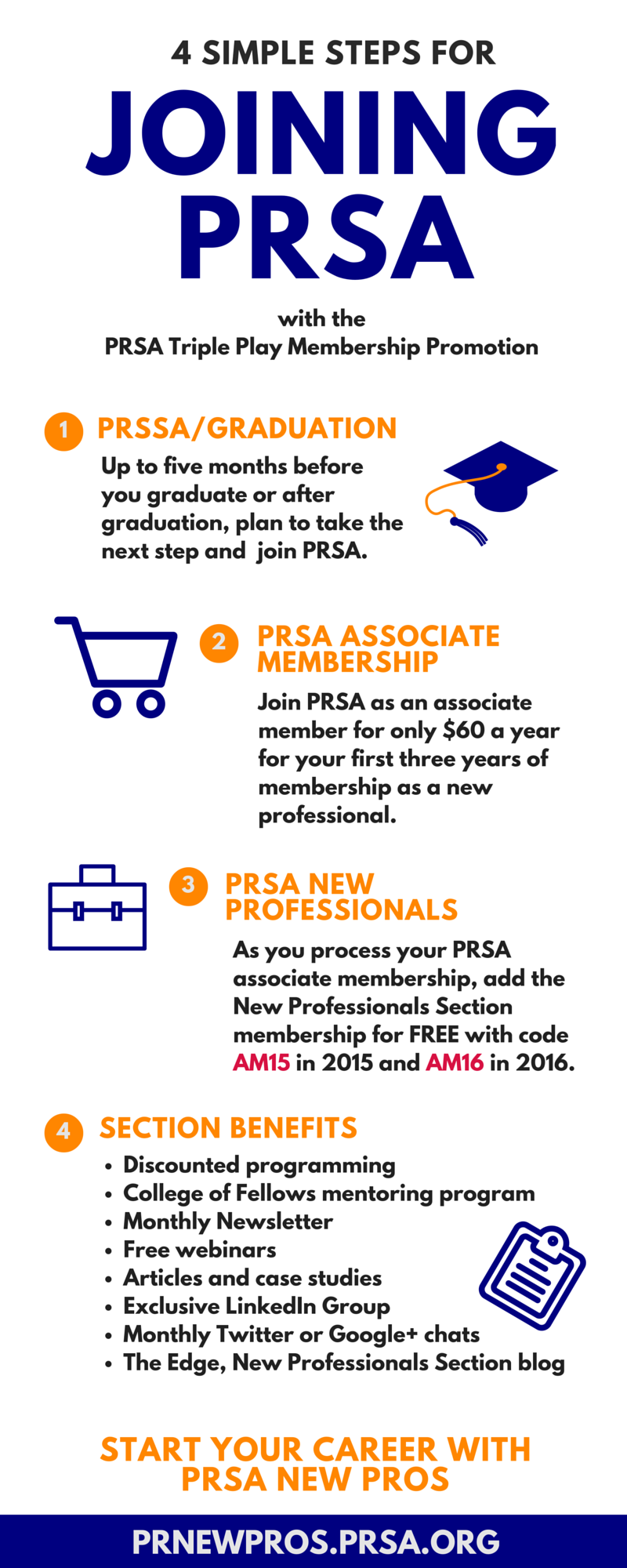
Whether you’re purchasing a holiday gift for a PR friend – or want to purchase a special holiday gift for yourself – consider the gift of ongoing education, networking, and more with a PRSA New Professionals membership!

NPPRSA Triple Play-3 (1)New PR professionals can join PRSA as an associate member for only $60 per year for the first three years of membership as a PRSA New Pro. And, once joined, PRSA New Pros can benefit from a variety of ongoing initiatives and programs, including:

  • Webinars
  • Discounted programming
  • Monthly newsletters
  • Articles and case studies
  • Twitter chats, Google + chats
  • And much more!

So whether it’s a holiday gift – or just to continue your PR education – consider the gift of PRSA with our PRSA Triple Play Membership Promotion!

How to Stand Out in the Sea of PR Pros

PRSA THE EDGE OCTOBERThere’s great news! The economy is looking up for today’s job seekers, but that doesn’t mean companies are just hiring anybody. In today’s job market, tenacity and creativity go a long way.

Employer’s want to know you were productive between the time you graduated and the time you applied to your dream job with their company. They love to see that you are committed to your career and gaining valuable experience independently. After tailoring your resume, updating your LinkedIn profile, going on informational interviews, and actually applying with a compelling cover letter, we often complain that the job hunt is a job within itself. The hustle is real but is well worth it once you land a job you love.

Prepare yourself for job-hunting success by creating a job hunt strategy. This goes beyond updating your online presence and applying to jobs but actually making strategic moves to land the job you want. Think organization. Create a list of companies you want to work at vs. companies you would love to work at. Use this list to prioritize time spent on cover letters and networking. Create a google doc and track the applications you send and the responses you receive. Keep in mind the date you applied and the date you followed up. Did you land an interview or was their no response at all? Log it!

Public Relations is a career that requires constant learning. While you are searching for full time positions, strategically introducing yourself by reaching out to companies you the companies on your “love” list. Share the relevant skills and accomplishments that would add value to their company and why you are interested in working with them. Show your passion by volunteering to assist in a project part time or on a paid contract basis. This is the perfect time to prove that you are an asset to the team.

Set yourself apart from other job seekers by taking on alternative positions that are related to the industry. A great way to gain experience is to serve as a Brand Ambassador at local events. Some of the top brands are represented at local festivals and doing a great job marketing their product is attractive to employers. Have you ever thought about asking your local coffee shop if they need some help with their social media? I mean you’re always there anyway applying to jobs, right? The least they can offer in return is a free cup of joe. Create a Social Media Strategy Proposal for them and if they like it, ask them to pay for you to implement it. If not, you have a social media strategy to add to your portfolio.

What are you doing to stand out from the crowded job market?

i-zthGPGn-XLJasmine L. Kent, a member of PRSA-NCC, focuses on building community through dynamic events and engaging online marketing as a freelance integrated communications professional in Washington, DC. Keep up with her on Twitter at @LoveJasPR or visit LoveJasPR.com. 

Transition to the Real World: A New Professionals Guide on the Transition from Student to Young Professional

A recap from the New Professionals session at the 2015 PRSSA National Conference in Atlanta, Georgia.

How did you find your first job out of college? How did you use your PRSSA membership in interviewing?

“I was working part-time as a cashier at my current company. As I was gearing up to graduate in December, I requested an informational interview with my now boss. I presented some ideas to improve/add-on to their current communications plan. He was intrigued and invited me to complete a three-month trial internship. A lot of my experience came from PRSSA activities and internships, so I was able to leverage my membership.”

What has been the biggest challenge transitioning from a student to full-time employee?

“Time management, by far, the hardest part about moving into full-time work is understanding when you should stay late or come in early. As PR professionals, we’re always plugged in and on the go. Don’t get burned out trying to impress the boss that already thinks you’re doing a great job. It’s also important to learn how to balance your extracurriculars. You did this in college and now you are learning to do it with a full-time job. Don’t hesitate to take 6 months to a year off to enjoy some free time. You’re allowed to dictate how much you want to put into your professional organizations.” —JR Rochester

“The initial transition from college to the real world can take some adjusting, but finding the right mentors to guide you can make all the difference.” —Jess Noonan

How did you leverage your PRSSA network for your career and transition?

“When I began my job hunt my final year of college, I made it a point to reach out to PRSSA members that I had met at National Conference, Regional Conferences and at my Chapter. We shared advice and tips we’d learned from our own experiences as well as what we’d heard from speakers and mentors. That kind of help and support was tremendous. Once I was hired, I leaned on PRSSA friends who had graduated one to two years earlier to talk about preparing for the transition. I also leveraged the professionals I had met through PRSSA, too. I told my mentors what type of position I was looking for and they helped me hone how to speak my experiences that highlighted relevant skills. During my interview at Edelman, two senior leaders on my current team knew people in my network, which I found out through LinkedIn mutual connections.” —Brian Price

What has been your biggest challenge as a PR professional?

“Showcasing all of my potential skills. Employers believed that executing social media on a daily basis was what I was solely interested in doing. I had to show them that I was interested in traditional PR, media buying and media direct relationship building, as well. It’s important to lay out all of your skill sets on the table when you enter the job and also communicate what you’re interested in learning more about. Staying organized and not being afraid to ask for help are two things that can help you better transition from student to a PR professional.” —JR Rochester

How did you build relationships at your first job?

“Ask questions. Take time to connect with people who aren’t in your department. If you’re short on work at the beginning, ask your boss if you can help with other tasks or suggest potential projects you’d like to research. Showing initiative goes a long way with a lot of people.” —Hilary Jurinak

Why did you stay involved with PRSA? How did you find a way to be an active PRSA member?

“I joined PRSA Chicago after months of attending events and seminars. I waited to join the Chicago New Pros board until I had a better understanding of the Chapter. I am now the Chicago Chapter’s PRSSA liaison, which is a role that is very comfortable for me.” —Brian Price

What advice would you give to your 21-year-old self?

“Challenge yourself to keep up with as many peers and professionals in your network as you can. Stay formal as much as you can, but also remember to relax. Visit Hilary and me in Chicago and we’ll connect you with peers that work in your similar interested fields.”

“Looking for a job can be a lot of fun. Find what you’re most passionate about and turn that into a career.” —Hilary Jurinak

“Be yourself. Employers love creativity and seeing what you’re fully capable of. Stay confident and your character will shine.” —JR Rochester

“Don’t get too caught up in the day-to-day and always try to look at the larger picture. Particularly, keep in mind where you want to go with your career and how what you’re doing today impacts your tomorrow.” — Jess Noonan

Connect with Brian, Hilary, Jess, and J.R. online!

Join New Pros at the PRSA International Conference!

Are you attending the PRSA International Conference this November? Lucky you! Not only will you have the chance to learn from some of the leading industry professionals, but you’ll have a chance to get one-on-one time with the PRSA New Pros group, too!

We’ll be hosting some exciting sessions at the conference this year, and we’d love for you to be part of them. If you’re unable to attend the conference in person, join the New Pros conversation online with the hashtag #NPPRSA.

Lucky enough to attend? Here’s how to join us for our exciting PRSA ICON New Pros event!

  • WHAT: PRSA New Professionals Meet and Greet – Join us for some networking, an update on the section and advice from senior PR professionals.
  • WHERE: Marriott Marquis, Room L 402
  • WHEN: Sunday, November 8, 11:00am – 12:00pm
  • QUESTIONS?: Reach out to Jessica.noonan@bm.com

Here are two other events that will be happening in the Atlanta area that week, too:

See you soon, New Pros!