From PR Student to PR Professional: Making the Leap with Some Help from PRSA

As a member of PRSSA, you have access to PRSA resources that can help you find an internship, follow industry trends and network with professionals near and far. Are you making the most of your membership? 

By Nigel Becker

I joined PRSSA during my third year of college at The Ohio State University. It’s one of the best decisions I ever made, but looking back, I feel a bit of regret, too, because I recognize that PRSA offered many resources that I never took advantage of. 

As a member of PRSSA, you gain access to the majority of the benefits of PRSA membership — but I didn’t realize that back then! If I had, I would have made better use of PRSA’s wealth of resources, like free-to-students webinars, internship postings and industry trend news.

Looking back as a New Pro, here are five great ways to use your membership in PRSSA or PRSA to advance your career while you’re still a student:

  1. Find an Internship or Job

The PRSA JobCenter offers a database of PR/communications jobs at all levels, from intern to VP, as well as comms-tailored resources like interview tips, making it a great job search tool for recent grads and for your future professional self alike. 

  1. Stay Up to Date on Industry Trends

Are hashtags in or out? Does anyone use Threads? What are journalists saying about AI-produced pitches? The world of comms is constantly changing, and employers are looking for plugged-in grads who can help them navigate that shifting landscape. 

PRSA’s menu of resources can help you keep track of the latest updates and bring fresh insights to class discussions, job interviews, staff meetings and client calls. Daily Issues & Trends emails round up the day’s big headlines and research, while Strategies & Tactics, a monthly newspaper, provides in-depth thinking and a glimpse at what industry thought leaders are saying. 

  1. Grow Your Skillset

Are you looking to learn more about AI and ghostwriting? How about podcasts, public affairs, web accessibility, (one day) launching your own agency or crisis communications? No matter what aspect of comms you want to learn about, PRSA probably has a guide, webinar or certificate for that. 

You can access many of these resources — like an “AI Prompting 101” guide — for free as a PRSA member, and other PRSA programming is heavily discounted for members.

  1. Connect with PR Professionals Around the Country… 

Through PRSA New Professionals social events, you can meet other new professionals, discuss pop culture trends and build connections around the country. Other PRSA events like ICON, also discounted for members, allow you to meet other pros while growing your skillset, too.

If you want to connect with mentors and more experienced professionals, PRSA offers resources for that, too. Through PRSA’s Mentor Connect program, you can learn from people who were in your shoes a few years or decades ago.

Plus, once you’re a member of the New Professionals section, you can sign up for the New Professionals’ own forthcoming mentorship program.

  1. …and in Your Community

PRSA isn’t just a national organization; it also includes more than 100 local chapters around the U.S., each of which may offer its own local events, conferences, happy hours and awards ceremonies. Local involvement can be a great way to learn about career opportunities and meet other members of your community. 

What Now?

If You’re Graduating Soon…

Make a plan to transition your PRSSA membership to PRSA. As a student member, you’ll qualify for a special rate for your first year of PRSA membership — just $67, with your first year in the New Professionals section included for free. Learn more here.

If You’re Graduating in a Year or More…

It’s not too early to take advantage of the many perks of PRSA membership! As a paying PRSSA member, you have access to almost all of the resources PRSA has to offer, and you may even qualify for a special student rate for certain workshops and conferences. 

All New Professionals programming is also free to PRSSA members. If you follow us on Instagram and connect with our leadership team on LinkedIn, you’ll stay up to date on upcoming webinars and other events to help you stay on top of industry trends and build your network. 

One More Note: Don’t hesitate to reach out to leaders from PRSSA and PRSA! They can help steer you to resources that are the best fit for you, and they’rew a great connection to have as you continue your professional journey.

About the author

Nigel Becker is an account associate at Slide Nine, a communications, public relations and digital marketing agency based in Columbus, Ohio.

In 2024, he graduated from The Ohio State University, where he served as Secretary of his PRSSA chapter and Account Lead at The PRactice, OSU’s student-run PR firm. Since 2025, he has served as the Social Media Co-Chair of PRSA New Professionals, overseeing the section’s Instagram and Facebook.
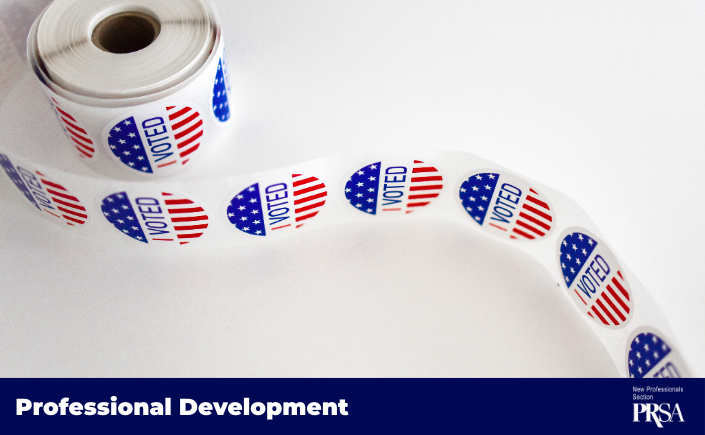

Three Reasons for PR Pros to Pay Attention to Politics

Political news shapes public sentiment, brand perception and communication trends. For PR pros, especially new professionals, understanding political developments can improve audience awareness, crisis management and campaign creativity.

By Nigel Becker

The last few weeks have been busy ones in American politics: Voters in Virginia and New Jersey elected new governors, New York City chose a new mayor and the federal government shutdown disrupted air travel, public assistance programs and more. 

If you’re a political nerd like I am, or if your clients operate in policy-related spaces, you may have been following these events closely. 

But even if politics don’t excite you and your day-to-day role isn’t tied to public policy, it’s still worth keeping an eye on political news as a new pro. Here’s why.

Political issues may impact your audience

As communicators, we need to understand what’s happening in our audience’s lives. Maybe they’re stressed about losing access to a government program, or they’re anxious about the outcome of an upcoming election. 

Being mindful of these stressors can help your organization avoid appearing out of touch. For instance, if your audience is stressed about finances, you might proceed with caution when promoting pricey products, or highlight how your organization is supporting community nonprofits.

Politics can appear in surprising places

In recent years, brands have found themselves in the middle of political debates over everything from DEI programs, to commercials perceived as dogwhistles, to controversial logo redesigns. 

These controversies can seem to come from out of nowhere, but by staying aware of hotly debated topics, you can help your organization tweak non-political communications to avoid taking an accidental stand — or decide how best to weigh in when a cause aligns with its values.

(PRSA’s daily “Issues and Trends” newsletter, which all members can sign up for, regularly highlights trends like these.)

Campaign communications can inspire non-political comms

Political communicators exist in the same ecosystem as the rest of us: They’re navigating AI, deepfakes, shifting social media algorithms, distracted audiences and a public that’s increasingly skeptical of both political and business leaders. 

Despite these challenges, they continue to find creative ways to cut through the clutter, simplify complicated concepts and craft messages that resonate. Trade publications like Campaigns & Elections offer a glimpse into how campaigns are reaching voters and communicating under pressure. 

Many of the challenges campaign communicators tackle — like navigating shrunken budgets and experimental influencer partnerships — can spark ideas for non-political communicators, too. 

A note for outside the office:

Local politics and civic participation depend on communication, too

Even outside of work, following politics can help you be a more engaged citizen… and can open opportunities to use your skills for causes you believe in.

Maybe a local advocacy group needs help running social media or promoting events. Perhaps a school board or city council candidate needs help sharing their ideas with the community. You might even find yourself writing a letter to the editors or speaking at a city council meeting about an issue that matters to you.

Many of us were drawn to PR by a love of explaining complex issues and connecting with people. Those same skills lend themselves perfectly to civic involvement.

About the author

Nigel Becker serves as the Social Media Chair of PRSA New Professionals, overseeing the section’s Instagram and Facebook. He graduated from The Ohio State University in 2024 and is an account associate at Slide Nine, a communications, public relations and digital marketing agency based in Columbus, Ohio.
One of his majors at OSU was Political Science, as you may have guessed!

Pitch Perfect: 4 Ways to Level Up Your Media Outreach

If you work in media relations, you’ve probably written a pitch before — but as you probably know, writing the pitch is only part of the challenge. 

The other part is getting journalists to say yes… and there’s a lot of competition for their attention. A survey of over 1,000 journalists last year showed that 49% received at least six pitches daily. Twelve percent received more than 21 pitches every day.

How can you break through the noise? It’s important to pitch the right journalists at relevant publications, and to be persistent but not pushy. 

Here are four ways to reach the right people, tell your organization’s story and maintain good relationships with journalists.

1. Research Your Media List, Then Do It Again

Reporters often have clearly-defined focus areas. Finding out what they are will help you pitch angles they’re more likely to cover. A local news reporter may not be interested in an expert who’s across the country; a writer covering parenting tips probably won’t care about a factory opening. Take the time to understand what they cover so you’re pitching relevant stories. 

Look out for changes, too, since reporters’ beats can shift dramatically. One Wall Street Journal reporter recently shared he’s switched to covering AI and computer chips. It’s his seventh assignment in 15 years, and a far cry from his previous focus: Disney and Hollywood studios. A few years ago, he might have loved a pitch about your company’s Disney tie-in. Today? Not so much.

2. Don’t Forget About Trade Publications

When we start in PR, many of us dream of earning a New York Times mention or a CNN interview. But when you’re telling a client’s story, your top priority should be reaching the people who need to hear it. That doesn’t always mean a mention in a publication with millions of readers. 

An in-depth feature in a trade publication could yield more meaningful results than a mention in a better-known publication. In a survey of C-level executives, managing directors and senior vice presidents, more than 80% of respondents agreed that trade publications directly impact their purchasing decisions. 

Industries like healthcare, IT, agriculture, retail and finance, in particular, have many trade publications with unique topical and geographic focuses. 

3. Be Persistent But Respectful

Your emails will slip through the cracks sometimes. If your story is a great fit for a reporter, a follow-up can make the difference. 

Just don’t overdo it. One report found 64% of journalists agree that PR pros should send only one follow-up message. A barrage of follow-ups could annoy them and hurt your chances of getting their attention with another pitch later. 

4. Track Journalists’ Feedback

Use a spreadsheet or the notes section of your pitching software. Even if journalists aren’t interested in your pitch, they may provide valuable feedback. Responses like “this isn’t a great fit for me” or “I’m not working on any related stories right now” can help you target future pitches.

Detailed notes will help you spot patterns. If a journalist responds “I’ll pass” to three pitches in a row, maybe it’s time to give them a rest or reconsider your angles. 

Final Thoughts: Keep Learning

There’s so much more to pitching than one blog post can teach. The good news is that many resources can help you continue to grow. 

PRSA offers a range of on-demand courses that can help you hone your pitching approach, including Crafting the Perfect Pitch and The Definitive Guide to PR Writing. Throughout the year, PRSA webinars (many free or discounted for members) also provide tips to stay on top of trends and keep your pitches relevant.

PR software platforms like Muck Rack and Cision publish articles and even offer online courses about how to level up your pitching.

Happy pitching!

About the Author

Nigel Becker is the Social Media Chair of PRSA New Professionals, overseeing the section’s Instagram and Facebook. He graduated from The Ohio State University in 2024 and is an account associate at Slide Nine, a communications, public relations and digital marketing agency based in Columbus, Ohio.

Roche Communications Specialist Kelsey Jones Talks Ball State University, Healthcare PR & Internal Communications

Kelsey Jones is a communications specialist for Roche’s Diabetes Care division and a Ball State University alumna. She graduated in 2011 with her bachelor’s in hospitality and food management and once again in 2017 with her master’s in public relations.

Today, she shares advice for new communications professionals.

Q: What are your job responsibilities as a communications specialist in the healthcare and medical device industry?

A: At Roche, I drive integrated strategies based on best practices for employee communications, internal events, and programs. I draft content for various internal communications channels such as email, video, digital signage, newsletters, and social media. What I do ultimately impacts business results, as I help decide what employees need to know and when they need to know it to drive engagement and productivity.

I also facilitate Diabetes Care collaborations with patient advocacy organizations like the American Diabetes Association, College Diabetes Network, and Juvenile Diabetes Research Foundation to reduce health and racial disparities in our communities. Through this work, I build meaningful, mutually beneficial nonprofit partnerships.

Additionally, I manage Roche Gives Back, our internal employee giving program, as a portal administrator. The company matches employee donations and volunteer time in the community, and I review all match requests. I also plan and execute engaging volunteer events for more than 4,500 Indianapolis-based employees. Our most notable event is our annual Day of Service with Keep Indianapolis Beautiful, where we identify an Indianapolis neighborhood or park to beautify.

“Storytelling is a large part of my role when communicating what Roche and our employees are doing in the local community, how we give back, and how we contribute to important causes.”

Q: What advice do you have for students wanting to pursue a communications career in the medical industry?

A: Initially, I had no desire to work in the healthcare and medical device industry — I generally perceived healthcare and large corporations as very stuffy and uninviting. Roche completely changed my perception. Roche is very welcoming and inclusive and provides fantastic benefits for employees. Plus, some of my closest friends are my colleagues.

If a student is interested in pursuing a communications career in healthcare or another large corporate environment, I highly recommend job shadowing. Spending a day with a current corporate communications professional will provide insights into their role and help students see if it aligns with their interests.

I also recommend taking a business course or two. Having basic business knowledge is extremely important in the corporate setting.

Q: What valuable lessons about the communication field have you learned throughout the pandemic?

A: I would definitely say to meet employees where they are. The pandemic has created so many additional challenges for our employees: at-home schooling, childcare, illnesses, and even the death of loved ones due to COVID-19. It is crucial with internal communications that you convey empathy and meet employees where they are.

Q: In what ways did Ball State’s master’s in public relations prepare you for the role you currently have?

A: Ball State’s master’s in public relations prepared me to be a critical thinker in a corporate environment. It equipped me with the issues management skills needed to succeed in a large, matrix organization. The program provided strong relationship-building lessons that are critical to any industry’s communications or public relations role. It challenged us to work in new ways while utilizing strategic communications and encouraging collaboration.

Q: Why would you recommend Ball State’s public relations program to new professionals?

A: Ball State provides a personal, hands-on approach to public relations. Graduate students receive regular one-on-one sessions with their graduate advisor and esteemed professors. In addition, on-campus graduate students have the opportunity to work at the student-run strategic communications and public relations agency. Coming from a non-public relations background to graduate school, this experience was invaluable to my learning experience.

The public relations graduate program is continually ranked as one of the best in the nation and one of the only programs accredited by the Public Relations Society of America. The individualized, entrepreneurial learning and award-winning curriculum made Ball State’s program my number one choice.

The program is also available entirely online for working professionals who can’t come to campus. The online courses are asynchronous, meaning you can complete them whenever they fit into your daily schedule. The same faculty who teach on-campus also teach online, so there is no difference in curriculum or course quality.

Q: Any final words of advice about your experience or for new communication/PR professionals?

A: Keep an open mind regarding career opportunities and always take the initial interview. You never know; you may end up being surprised about the company or role like I was with Roche!

Lastly, always keep learning. Your education doesn’t stop when you are handed your diploma. Continue to network with industry professionals and like-minded individuals. Consider attending relevant conferences, taking additional classes, or completing a certificate program once you identify your communications and public relations interests.

If you’re interested in pursuing a master’s in public relations from Ball State, visit our website for more information or contact the program director Dr. YoungAh Lee.

Kelsey Jones is a communications and corporate social responsibility professional who enjoys keeping up with giving trends and connecting employees to causes important to them.

Not only is philanthropy part of her day job, but it’s also a part of who she is. Whether she’s planning events for the Indianapolis Cultural Trail or raising funds for various causes important to me, giving back is in her DNA.

LinkedIn: Kelsey Jones, M.A.

Asian American and Pacific Islander Heritage Month: How to Help Your Employer Be More Inclusive

As employees demand more inclusive work environments, many businesses are moving into 2021 with a focus on diversity, equity and inclusion (DEI). And while DEI shouldn’t be anything new, it may be for your workplace.

If that’s the case, you’re probably the one leading the DEI conversation. After all, working in PR means it’s your job to represent and protect your business’s reputation and help your employers bridge the gaps they simply haven’t made yet. That includes working with human resources or the larger marketing team to ensure your company priorities and values align with staff concerns to create a safe, welcoming environment that’ll continue attracting top talent.

If your business is taking a little longer to get the DEI ball rolling, here are three ways to begin the conversation during Asian American and Pacific Island (AAPI) Heritage Month.

1. Share the Bigger Picture

Even as the world gets smaller and smaller with live social media updates and 24/7 access to national news, some people simply won’t know where to look to gain an outside perspective. And if their personal bubble is unaffected by larger conflicts taking place out in the world, they may think it’s not worth addressing — to their shareholders, their staff or their customers.

That’s where you (and other PR pros) come in.

It’s your job to give them perspective. You can share a number of resources to support action, including:

  • Mainstream news relevant to this event that will get their attention (local coverage, opinion pieces, responses by other businesses)
  • Any key performance indicators (KPIs) or metrics that may support a spike in interest by your customers (a related product you sell that’s out of stock, an uptick of pageviews on related articles/press releases on your newsroom site, comments made on recent social media posts)
  • PR-specific responses suggested for businesses (helpful webinars, recorded town hall videos or even crisis communications examples of what not to do)

Using AAPI Heritage Month as an example, you’ll want to make sure leadership is aware of the recent shootings in Atlanta. Lead them into a larger conversation about the rise of anti-Asian violence and hate. Bring up the fact that Asian Americans are the fastest-growing ethnic group in the U.S. If you have any Asian Americans on staff, remind your employer. How could this be affecting them, or the larger staff?

Once you’ve got their attention, it’s time to suggest a plan.

2. Introduce an Action Plan

Strategy is key here, mostly because it’s a language your employer will understand. Make sure you pluck the low-hanging fruit:

  • Are there any pre-existing company values you can relate a response to?
  • What goals do you have that stakeholders are interested in? (This will help get higher leadership on board.)
  • Look back at a recent employee survey. Is there any dissatisfaction that DEI could solve and further bolster the argument you’re making?

Talk through any next steps with them. Make sure they’re a part of the process to grow their own involvement and investment.

Using AAPI Heritage Month as the example, this celebration of heritage concerns a lot of different people. Those of Chinese, Indian, Filipino, Vietnamese, Korean, Japanese, Micronesian, Melanesian and Polynesian descent are included in AAPI. Make sure your workplace gets the “inclusion” part of DEI right by considering all involved.

3. Involve Your Employees

Public relations can be a very secretive and tight-knit profession by nature, but DEI is the time to reach out and include the larger staff. Whether you’re holding a company-wide business meeting, sending out a specific survey or conducting one-on-one interviews, their insight is invaluable.

Here’s some DEI-specific information you’ll want to cover in your meetings:

  • What does DEI mean for your company? (If you celebrate one month’s ethnicity, will you celebrate the next?)
  • How will strategic planning with DEI in mind change your company? (What actual differences can employees, customers and shareholders look for to back up your business’ DEI claims?)
  • How else can the company make positive changes in the DEI space? (Ask everyone you can. The most important insight can come from an unlikely place.)

With a few open, honest conversations, these three areas can help your employer properly include DEI in future strategic planning for your workplace. Just remember that this is only the beginning of the conversation; follow-through is imperative to make real change. Luckily, they have you on their PR team.

Has your company recently added DEI to the conversation? Let us know the role you played in the comments below!