We <3 Being New Pros

New Pro (n)  /n(y)o͞o – prō/

  1. A public relations practitioner with five years of professional experience or less, possibly a student, aspiring PR pro or one who has recently made a career transition to public relations;
  2. A member of PRSA’s New Professionals Section;
  3. A cause for celebration!

Being new pro is an adventure in itself; full of new experiences, people and opportunities. Being a part of PRSA’s New Professionals Section amplifies all of those experiences by giving members a community in which to share their experiences, connect with other like-members and learn from each other. To kick off New Pros Week, we’re sharing some of our favorite things about being a new pro.

“Being a part of the PRSA New Professionals section has provided a network of like-minded professionals right out of college that not only allow me to tap into when I am seeking advice and best practices, but also allows me to share efforts from my local community that might save other new pros from having to recreate the wheel. In addition, this group has also provided friends that I would have otherwise never had the opportunity of meeting. The best of both worlds!” – Greg Rokisky

“The New Professionals Section has given me a sense of belonging within the PRSA organization. My favorite benefit is the opportunity I have to build relationships and to work with other professionals from diverse backgrounds, many of whom I can call friends.” – Henry Cervera Nique

“I love being part of PRSA New Pros Section for the networking and mentorship opportunities I receive. Two years into the working world, I’m still learning tons more about my specific work each day. I rely on several experienced mentors from my PRSA network who help me apply past experiences to new projects, set goals and understand the larger landscape around communications and marketing.”  – Brian Price

“After you get past the initial excitement of not having homework, I think the best part about being a new pro is going through the journey of your young 20’s. While it can be challenging, being fully independent for the first time is also very exciting. And the post-college social life is great. Happy hour to catch up with fellow new pros after a long day of hard work is the best!” – Heather Harder

“Two things to love about being a new pro: Connecting with fellow professionals across the country to learn about how to strengthen my career and taking advantage of all sorts of resources to help achieve my professional goals.” – Simon Oh

“I love being a member of PRSA New Professionals! For me, the best benefit is the spirit of mentorship within the section. We not only have the opportunity to connect with accomplished, established mentors, but we benefit from the collaborative leadership of our fellow members. Our members bring fresh perspectives to the practice of PR and communications.  We ask questions, we share our ideas, and we combine forces to advance our individual careers and the shape of PR as it evolves as a profession.” – Alyssa Stafford

“Being a part of the New Pros section has helped to make me feel like I belong within the larger PRSA organization and given me the confidence to take on a larger role in my job, in my chapter and in the section itself. Being new at something or somewhere is uncertain enough and being a part of the New Pros section helps to ease the transition from graduating, moving and changing jobs by knowing that there are other people experiencing the same things.” – Robyn Rudish-Laning

“My favorite thing about being a PRSA new pro is having a larger society full of senior, mid-level and junior professionals who are all open to connecting and giving you advice as a new professional. As I’ve progressed in my career it’s also been really rewarding to stay connected with PRSSA through the society!” – Jessica Noonan

“Getting involved in PRSA’s New Professionals section has allowed me to connect with PR pros in other industries and across the country. My favorite part about being a member is bouncing ideas off other PR pros at the same level I am (otherwise difficult if your workplace or city is small), mentorship from seasoned pros who value my involvement with PRSA, and a community that shares my passion for public relations.” – Hanna Porterfield

“I love being a new professional because I feel I have more time to truly figure out what I want to do before I settle in more. I have a lot of new opportunities with new teams and groups, and have been able to branch out more. Being a part of PRSA New Pros has allowed me to continue and strengthen the friendships and connections I made while in PRSSA.” – Lauren Gray

“When you’re just starting out in your first job, your team doesn’t know you. They don’t know your work ethic, your leadership style, etc. So naturally, they aren’t going to give you a whole lot of leadership roles until they know they can trust you. This is true no matter if you’re an intern or an entry-level employee. But for a lot of people who were active leaders in college, (shout out to PRSSA!) this can be disappointing, maybe even frustrating. You’re so ready to make your mark and show them what you’ve got! Being a member of New Pros has provided me with opportunities to lead outside of my office. I’ve been able to further my leadership development through the section so that now, when I have the trust of my co-workers, I can be a better leader in the office and take on those leadership roles I aspire to.” – Jenna Mosley

“PRSA New Pros provides a strong support system when challenges arise. I’m grateful to be a member of this group because I know I can rely on experienced professionals for guidance in tough situations.” – Seth Kingdon

“My favorite part of being a new pro is the ability to experiment, to take risks, to explore, to discover new things. As new pros—as young people—we have that ability to change what we’re doing very rapidly without much consequence. To take a new career path, to try a different industry, to try corporate and then agency, followed by you name it.” – Ben Butler

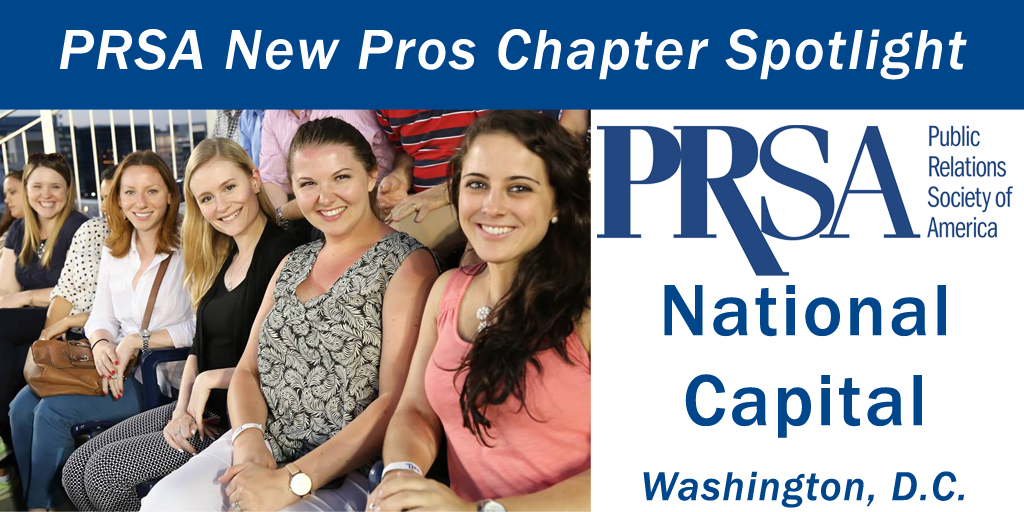
New Pros Chapter Spotlight: National Capital Chapter

New Pros Week is right around the corner and what better way to get everyone excited about it than featuring PRSA’s National Capital Chapter’s lively New Pros group. This month, The Edge sat down with PRSA NCC’s New Professionals Committee Chairs Katelynn Wiggins and Kelsey Pospisil.

New-Pros-Chapter-Spotlight_NCC

The Edge: Tell us about the National Capital Chapter’s New Pros Committee is organized?

National Capital Chapter: We have a core group of really active committee members. They help secure locations for networking happy hours, panelists for professional development events, and help with logistics and registration during events. It is helpful to have involved committee members because with everyone’s busy schedule, typically two people are able to help us with each event.

TE: What kind of programming have you put together for New Pros?

NCC: Most of our activities are networking happy hours at local bars and restaurants. We also offer a few annual events. Headshots & Happy Hour offers attendees an opportunity to get a professional headshot taken while they mingle with other new pros. Professional development events provide information specific to the new professional audience on topics affecting their careers such as personal branding, resume building and presentation skills. The annual baseball networking event is a big hit with chapter members at all stages in their careers. It gives attendees to network in a more relaxed environment and enjoy a game with their fellow chapter members.

TE: How does your group fit into the bigger picture of the chapter?

NCC: The New Professionals group works with many other groups in the chapter. We frequently partner with the Membership committee to offer networking happy hours. We also partner with the University Relations committee to help transition students from PRSSA to PRSA.

TE: What resources do you provide for New Pros?

NCC: The chapter provides new professionals with a mentor-match service operated by our Mentoring committee. We also share job openings with committee members. We encourage more seasoned members to come to New Pros events if they are looking to hire entry or mid-career professionals.

TE: How can New Pros benefit from being involved with their local chapter’s New Pros group?

NCC: The PRSA-NCC New Professionals group is a great place to meet other people in the same stage of their career. It is nice to network in a relaxed environment to exchange ideas and learn from other new professionals. Members have told us they found out about open jobs at our events, and we know of many that have turned into being hired. We facilitate opportunities for people to form, maintain or grow relationships. If you’re eager to connect with other people, we’re just giving you an outlet, and helping you grow professionally at the same time.

Your local New Professionals group is a great way to get to know other people who are going through the same challenges, excitement and career growth you are. As a new professional in the world of PR there is a lot you can learn from connecting and building relationships with other like-minded people.

TE: How do you engage and recruit New Pros?

NCC: Near the beginning of each year the chapter hosts a Membership Rally. We have a table where members can sign up to join the committee. We also have information about joining the committee at all of our events.

TE: What advice do you have for New Pros for using PRSA to their best advantage?

NCC: Definitely make time to attend networking events offered by your chapter. It is the best spot to meet other people in the field. You may even make a contact that could help you find a new job down the line. It’s also a great place to find firms to contract for your company.

TE: What is the best way for New Pros to get involved in the PR community?

NCC: Attend your local chapter events and make an effort to introduce yourself and get to know as many people there as possible. Another way to get involved is through Twitter chats hosted by the National New Professional section. We always say that you’re going to get out of PRSA what you put in. The people and resources are almost infinite, but it’s up to you to take advantage of them.

If you’re in the D.C. area and would like more information on getting involved with the National Capital Chapter’s New Pros group, email Kelsey and Katelynn.

How My Mentors Helped Me Decide to Make a Career Change

Editor’s Note: This post is part of our ongoing #MemberMonday series. Each week, we will share content focused on our New Pros members and how PRSA benefits them. Follow us on Twitter at @PRSANewPros and share your stories using #MemberMonday.

Deciding whether or not to leave your first job isn’t easy. There are a lot of questions to consider. Is it the company you don’t like or is it the industry? Is it the agency world or your particular agency? Have you done all you can to grow and love your job? Do you want to relocate and, if so, can you afford it?

Deciding whether or not to

Fortunately, mentors and other resources can help. As I debated whether to leave the agency world, here are a few lessons I learned from my mentors.

Build a network before you need one

When I started considering a career change, I decided to consult my mentors. Fortunately, I’d been building up a network for the past couple years, so it was easy to think of people to reach out to.

Here are the three types of mentors I consulted:

  1. Seasoned professionals. These are the well-connected, executive-level people who can relate best to the hiring managers who will be looking at your resume.
  2. Young professionals. Mentors who were where you are just a few years ago can relate to what you’re going through and offer timely advice.
  3. Mentees. I’ve found my mentees are so wise that they end up mentoring me in the process.

Don’t have mentors yet? PRSA Mentor Match is a great tool PRSA members can use to connect with seasoned professionals. I developed a corporate mentor who was very helpful in my decision.

Stop worrying about appearing like a job hopper

I, like most Millennials, was worried my résumé would look bad if I left my first job before the two-year mark. But then a mentor told me that’s a myth. Sure, some PR people may think you look like a job hopper, but it all comes down to the story you tell.

As long as you have a good story for why you jumped and if you are truly concerned with finding the right long-term fit, it shouldn’t matter if you leave your first job earlier than expected.

The key is to make sure you are making this change for the right reasons and that you’ve done all you can to be happy in your first job. Before leaving, outline the path you’d like your career to take. Will your current job help you get there? Have you done everything you can to carve the path you want? Have real conversations about your goals with your supervisor before deciding to leave.

Make a decision you can live with

Two people recently told me, “Your career is too short to be unhappy with your job. Why stay if you aren’t happy?” It seems so simple, but it can be hard to come to terms with. Just remember, there’s a difference between having a bad week and having a bad job.

Everyone will have opinions about your career path. But no matter what they tell you, you’re the only one who will be with your employer for 40-plus hours a week. You’re the one whose career is on the line.

Sure, some people will still tell you that you have to stick it out for a year or two. But in the end, it’s your decision. Make the one that feels right.

AAEAAQAAAAAAAAl1AAAAJGM5NWQyMTZkLWFlZTAtNDU1OS05NDZiLTgxYTU2ZDNjZGJmNgHeather Harder is the programming co-chair for PRSA New Professionals and a former national president of PRSSA. Follow her on Twitter at @HeathHarder.

5 Tips to Generate Engagement in Your Chapter’s New Pros Committee

There are plenty of things you could be doing right now besides reading this blog. Working out, binge watching House of Cards, or going to a happy hour with friends. Those are things new professionals in your local PRSA chapter could also be doing. Wouldn’t you rather have them attend PR events you host?

What can we do to make our events as valuable as possible in our efforts to create positive, professional engagement? Make no mistake, we are the future faces of PR in our communities – it’s important to build relationships with each other now and grow professionally. Engaging our local new pros is a great way to facilitate that. PRSA-NCC, the Washington, D.C. chapter, has a few tips for growing attendance at your new pros events:

1) Secure sponsors. Your members are a valuable audience. We encourage you to take advantage of that. Many companies are eager to strategically partner on events where their audience will be in attendance. We recently hosted our second annual “Headshots and Happy Hour” at Microsoft’s Innovation and Policy Center in D.C. Microsoft sponsored the space, as well as our food and beverage. The space came equipped with touch screens of Bing Maps, interactive displays and the latest Microsoft technology. Also, if you have a photographer in your chapter, approach him or her about taking the headshots at a reduced rate. Headshots are normally very expensive, so this is a great way for new pros to update their LinkedIn profile photos to be more professional. And, they can mingle with some new people at the same time.

2) Host events in the evening. It’s difficult for many new professionals to get away from the office during the day. Our networking happy hours typically run from 5:30 to 7:30 p.m. That way, people who get off work early won’t have too much time to kill before the event and people who get off a little later know they can still make most of it.

3) Take advantage of your city. We host a Washington Nationals baseball game networking event each year. Tickets are inexpensive and it gives people a chance to mingle in a more informal, relaxed setting. It’s often quite expensive to rent pre-game networking space from the ballpark, so just pick a designated location where your group can meet to network before the game starts.

4) Be strategic about venues. A lot of restaurants are more than willing to be accommodating. They may offer free, designated space for your group to mingle. They often have happy hour prices on drinks and appetizers, and even more inexpensive platter options. For professional development events, ask around in the chapter for whose office might have a space large enough to host your group. Maybe they’d even be willing to sponsor appetizers and beverages so you can keep the registration cost low for members.

5) Offer professional development events for a variety of audiences. Our most popular professional development event focused on personal branding—obviously a topic that appeals to new professionals looking to position themselves for career growth. It’s also appealing to more seasoned PR professionals looking to either hire for their organizations or move on to other positions. Offering topics that bring professionals from many levels together is a great way to facilitate networking among professionals representing different career stages.

Thank you for skipping House of Cards to read this blog. What strategies have worked well for engaging new pros in your chapter? We’d love to hear and share them!

KWiggins Headshot


Katelynn Wiggins is co-chair of the PRSA-NCC New Professionals committee and assistant director of staff initiatives at the American Psychological Association.


KPospisil Headshot


Kelsey Pospisil is co-chair of the PRSA-NCC New Professionals committee and client engagement & media relations manager at News Generation, Inc.

Book Review: Mastering Micromedia

I’ll admit – when I picked up Mastering the New Media Landscape, I was a little skeptical. I’m generally skeptical of any book or article that claims to help its readers master anything. We know that Malcolm Gladwell’s 10,000 hour rule isn’t exactly accurate, but can you really master a skill in 200 pages or less?

mastering-the-new-media-landscapeThe answer is almost unequivocally no, but with a caveat in this case. Mastering the New Media Landscape’s subtitle “Embrace the Micromedia Mindset” is a more accurate description than its actual title. Authors Barbara Cave Hendricks and Rusty Shelton outline the key principles, define the necessary terms (earned, rented and owned media, anyone?), and relate new media ideas to their traditional counterparts.

By setting the book up this way, Hendricks and Shelton give readers the tools needed to build an effective strategy for leveraging every bit of traditional and new media out there to communicate effectively with your audiences.

Mastering isn’t an end-all, be-all guide for mastering the tools at your disposal, but rather a guide to help you craft your own plan for understanding the opportunities available and conquering internet publishing, the heart of what “micromedia” really is.

The information presented is helpful for managing a corporate or organization’s brand or creating a personal brand, new pros or seasoned practitioners. Two of the best chapters – “Earned, Rented and Owned Media” and “Online Brand Audit” – gave the information and steps I found most useful.

After defining what earned, rented and owned media are, the authors explained something I had never thought of: it is most important for you to have information on media you own and for at least one piece of owned media to show up on the first page of search results. I had always thought that it was just most important for items like my LinkedIn profile, blogs I had authored and things like that to show up before any other less professional items, but that’s not entirely the case. Since those things tend to live either on a social media site (LinkedIn) or on someone else’s site (a blog post), I have no control over how they show up or even if they show up. Those pages could be taken down or edited at any point and there would be nothing I could do about it. If I didn’t keep copies or host my work on my own site that I controlled, it could all be lost forever with no warning.

“Online Brand Audit” piggybacked off of that theme and broke down where and what to look for when assessing and managing your brand. Doing a brand audit can seem daunting, just because of the sheer amount of sources and content you might have to sift through. Making sure that you’re properly represented online. Performing a personal brand audit is particularly important for new professionals while job searching. Employers rely on social media and online information just as much as resumes, portfolios and interviews when filling a position.

In addition to these two chapters, Hendricks and Shelton offer a lot of great information on how to make the most of all of the new media tools out there to use. There are plenty of tips and ideas for types of content, statistics on which users are on each of the social media networks and getting the most out of each network, strategy and piece of content. Most chapters also offer a “Stories from the Front” section in which the authors share an Q&A with a professional on the topic covered in the preceding chapter. All in all, this book won’t make you a master of media by the time you finish, but it is a worthwhile read for anyone looking for a guide to conquering today’s media landscape.

Robyn Rudish-Laning (1)Robyn Rudish-Laning is a member of South Carolina’s PRSA chapter and is communications coordinator for the South Carolina Council on Competitiveness. Robyn is also a member of the New Professionals executive committee. She is a graduate of Duquesne University and is currently located in Columbia, SC. You can connect with her on LinkedIn or Twitter or read her blog here.