Building Trust in Public Relations

Ethics… it’s just a matter of right and wrong, correct? Yes, but there are layers to being an ethical professional. Remember when PR was deemed the profession of spin? We’ve come a long way since then and in today’s media landscape, where everything is picked apart and scrutinized, we must remain trustworthy.

media-gatekeeperWhen covering ethics in public relations, there is a lot of mention of keeping the line of communication between the public and company, client and/or brand transparent, as well as legal. It’s a no brainer that public opinion is important but we must remember the gatekeeper, the middle man, better known as the media. Building trust between practitioner and the media is just as important because essentially, they are telling the public your story. One of PRSA’s core codes of conduct is the free flow of accurate and truthful information. That means building honest relationships with journalists, even if they become a close friend along the way. As ethical PR practitioners, we must play fair and keep an even working relationship between all members of the media. Yes, we should tailor each message depending on the interest of the publication and beat, but that doesn’t mean sending over confidential, inside information to a journalist just because you two are friends.

Being ethical doesn’t just mean avoiding bad situations. It is proactively doing what’s right, giving clear, correct, and complete information to the media while building meaningful relationships. Here are three essential rules to build trust between the media and the public:

  1. Do what you say you are going to do

As a PR professional, it is our primary job to communicate and disseminate information to the public. We are a resource and must be complete, accurate and timely at all times. Don’t be that PR person to hit up a journalist months before or after a issue is being printed with “new news” on the topic. They don’t care, you’ve missed your chance, and you’ve broken a tad bit of trust by wasting their time. We must remember that day to day, we work with a variety of people, companies, and industries that may not work in the same manner. Keep a trustworthy relationship with all stakeholders by meeting deadlines, responding to emails and phone calls, and fulfilling the duty of being a resource.

2. Focus on the relationship not the transaction

Trust comes with respect. If your primary connection with a person is based on press coverage, it is less likely they will come to you when they need a quote from an industry leader. How would you feel if a journalist clearly makes it known they primarily work with you because your company offers cool freebies or perks, you’d feel a little used. Don’t continuously send press releases and pitches without any other dialogue. Set time aside to really get to know the journalist and what they like, beyond their beat. Sometimes, working relationships are forced but to build solid relationships with the media remain open, transparent, and friendly.  

3. Remember the Golden Rule

The Golden Rule simply states, “Do unto others as you would like them to do to you.” How would you feel if you were on deadline and someone didn’t give you critical information needed? What would you think if you gave a journalist cool information on a new campaign, and they left out the hook that made the story interesting? Ethical public relations can be much simpler if we keep the Golden Rule in the back of our minds. Treat your client, the media, and the public with respect by practicing public relations with the highest ethical principles.


i-zthGPGn-XL-230x300Jasmine L. Kent, a member of PRSA-LA, is a fan of all things food and beverage, pop culture, and media. Combining all three passions, Jasmine builds community through engaging online marketing and dynamic events as an integrated communications professional in Los Angeles, CA. Keep up with her on Twitter and Instagram at @LoveJasPR or visit LoveJasPR.com.


Join PRSA New Pros at PRSA ICON

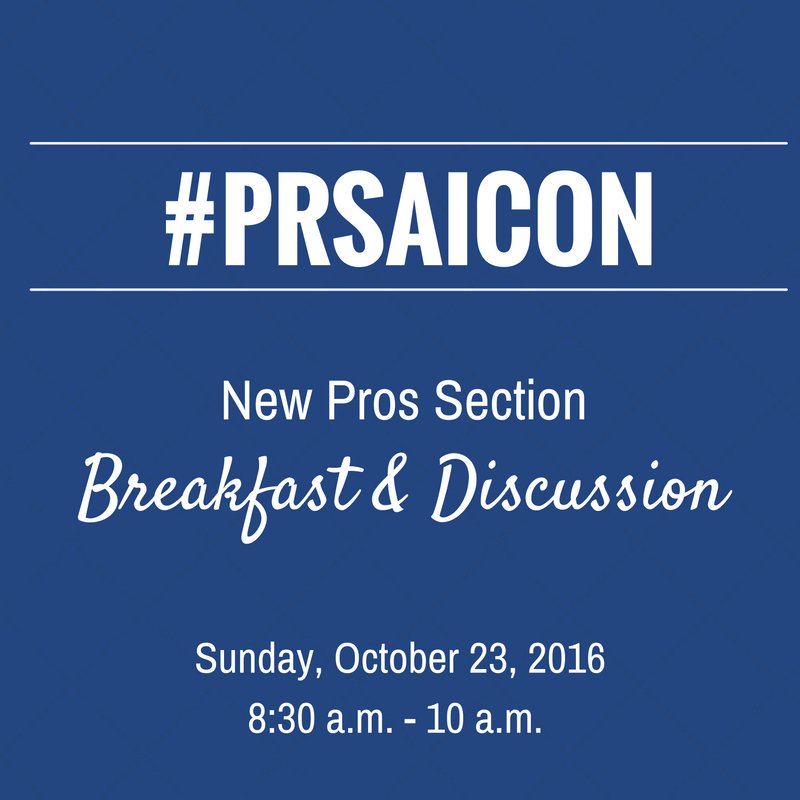
The PRSA New Professionals Section is very excited to announce our networking session during the upcoming PRSA International Conference in Indianapolis from Oct. 23-25!

PRSA New Pros will host a networking breakfast and discussion on Oct. 23 featuring:

  • Updates from the New Pros Section leaders
  • Information on how you can get more involved
  • A guest speaker from the PRSA Board
  • 30-minute networking and Q&A session to meet new pros from around the country

npprsaicon

We would love our members’ input on what you would like included during the networking time. Please comment below with any ideas around what would be most beneficial to you during the networking session. Feel free to also pre-submit questions you would like to ask during the Q&A portion, which will include discussion with other New Pros to help solve challenges you’ve faced professionally. You may also submit ideas and questions via email to Jess Noonan, Heather Harder and/or Ruthann Campbell or tweet us @PRSANewPros.

Please RSVP for the breakfast here.

We look forward to seeing you at #PRSAICON!

 —The New Pros Committee Chairs

Turning Your Internship Into A Full-Time Job

On the first day of my internship, I was handed a laptop, emailed a contract, and shown to my desk. That’s all. No new-hire orientation, no manual; the rest was up to me.

That was nearly three years ago. The trajectory of my internship relied entirely on my own ambition, and quite frankly, my desire to land a job. From my 8-month “audition” I found that there are three basic practices that interns should adopt in order to land a full-time offer.

Follow the Leader

It won’t be difficult to identify the individuals that you admire at your internship. Do some calendar stalking and you will find the leaders—their calendars will be packed with meetings since colleagues crave their input. Ask to join those meetings, as many as they will allow you to attend, and then, stop, sit, and listen. Really listen to the dialogue taking place inside the room, absorb what’s working, and make note of what isn’t.

As an intern, this practice almost felt like cheating. I had regular exposure to the most brilliant minds of the business.

Be a Duck

On the heels of one of our largest, most stressful, customer events of the year, my boss at the time, pulled me aside to share some advice that will stick with me for the rest of my professional career. “Today is going to be hectic,” she said. “Something will go wrong and it will be overwhelming, but all the while, you need to be a duck. Paddle furiously beneath the water and work through the chaos, but maintain cool composure up top where people can see you.”

Every day of your internship is a test of your ability to handle stress and problem-solve. Don’t let them see you sweat. Be a duck, and paddle like crazy. This is an indicator of how you will handle added responsibility as a full-time employee.

elizabethBe Better than Coffee, but Don’t be Above Coffee

Without question, your attitude will be one of the deciding factors of your future employment. In the investment banking world, it’s called the “punch test.” You’re working long hours, you’re stuck alongside the person in the other cubicle—is that person someone you want to be in the trenches with? Or will you fantasize about punching him after 2 months?   

In the tech world, there are common tasks that test your willingness to get your hands dirty. It’s  a “coffee run” or a seemingly never ending source of data that needs to be inputted into a spreadsheet. It’s something that every intern will and should have to experience. Don’t groan, don’t eyeroll, and for godsake, don’t mess up.

Be willing to do any job, but elevate yourself to the point where you’re trusted to do any job. What’s been stereotyped as a demeaning “intern task” is an exercise in teamwork and, depending on the complexity of the order, attention to detail. Be the person who gets coffee AND thrives in your role.       

In that same vein, I would be remiss to not call out to the employers who are reading this: there is a wealth of opportunity for you to learn from your intern and for your intern to learn from you. I was incredibly fortunate to intern with a company that recognized the value of giving interns an opportunity to earn their stripes and take on meaty projects. Interns don’t have to just be coffee runners and spreadsheet fillers, if you nurture their hunger and talent, you’re able to get a great sense of the type of full-time employee that will be. Hiring and onboarding an intern who has a deep knowledge of the company and a proven willingness to learn, saves you both time and money. And that’s just good business.

SamanthaSubarSamantha Subar is a Global PR Manager at Spredfast. She appreciates good sushi and data stories. Preferably combined, if possible. Connect with her on Twitter and LinkedIn.


Diversity in PR: A Millennial Perspective

As the PR industry continues to evolve, so should the practices being used to attract, retain and develop talent. After all, the PR students learning in classrooms today are the future leaders of our industry tomorrow.

Today, millennial PR professionals are considering more than just great benefits and a lucrative salary when it comes to starting a career in the PR industry. Millennials are looking for PR organizations that foster inclusion, uphold diversity and create a sense of belonging for all employees.

The need for diversity in PR is more prevalent than ever among the generation of millennial PR professionals because diversity and inclusion are more than just buzzwords or boxes to check, Millennials believe they are essential to business success.

Millennials are looking for PR organizations that foster inclusion, uphold diversity and create a sense of belonging for all employees.

For PR employers to maintain diversity in their organizations, engage millennial PR professionals and drive the industry forward, they should consider the following:

  • Create a mentorship program for entry-level Millennial PR professionals to engage with mid-senior level PR professionals and build relationships with them. Yes, everyone does not want to mentor (nor do they have to), but not offering a mentorship program in general sometimes prevents those who want to mentor from taking action. Some employees will rise to the occasion and others will wait for their employer to act. Now is the time for PR employers to act and make strides toward increasing diversity in the industry.
  • Develop a review system for millennial PR professionals to rate their PR organizations and provide honest input on the organization’s diversity and inclusion efforts. This will help bridge the gap between what PR employers believe is working and what Millennial PR professionals believe needs to improve. Employee feedback is essential for employers to improve their diversity and inclusion efforts overtime.
    • Nearly eight in 10 (79%) PR employers see their efforts to retain a diverse workforce as being successful.
    • Yet only two-thirds (67%) of young professionals agree with employees on their retention programs.
  • Foster an open-office culture where millennial PR professionals believe their voices will be heard, acknowledged and valued from management.
    • One-third of young professionals say the industry is not effectual at retaining a diverse workforce, compared with one-fifth of employers.
    • All results from a PRSA Foundation survey, which was in the field from October, 2014, to February, 2015. See the full survey here.
  • Demonstrate diversity and inclusion in all efforts. From the top-down, display a company culture where millennial PR professionals believe PR employers are authentic in their efforts and not viewing diversity as another “box to check.” Emulate the culture you want your employees to project and treat everyone with respect.
  • Present career opportunities and advancements to all employees. Do not assume some millennial PR professionals won’t “be a fit” or do not “meet the mold,” you’re looking to cast. Take time to get to know their passions, interests and career goals. Give all employees the opportunity to shine and don’t be a barrier to their success. Empower your employees to do their best.

What else would you add? Tweet us at #NPPRSA with the hashtag, #DiversityInPR and share the ways you believe PR employers can improve their diversity efforts in the PR industry.

SBrownHeadshotSabrina Browne is Client Executive at Burson-Marsteller in New York City. She prides herself on being a champion for the advancement of women and diversity in the PR industry. She is a member of PRSA New Pros and PRSA New Jersey, as well as a Scholarship Committee Member for the PRSA Foundation. Follow her on Twitter for all things PR and connect with her on LinkedIn here.


Resources:
Appelbaum, L., & Walton, F. (2015, September). An examination of factors affecting the success of under-represented groups in the public relations profession. Retrieved from http://www.prsafoundation.org/wp-content/uploads/2015/10/CCNY-Diversity-Study-FINAL.pdf
Dishman, L. (2015, May 18). Millennials Have A Different Definition Of Diversity And Inclusion. Retrieved from http://www.fastcompany.com/3046358/the-new-rules-of-work/millennials-have-a-different-definition-of-diversity-and-inclusion

New Pros Week Q&A with Pat Ford of Burson-Marsteller

Editor’s note: as part of PRSA New Professionals week, The Edge sat down with Pat Ford, Vice Chair, Burson-Marsteller for inspiration and advice.

How did you get started in PR? 

I got my start with a small public affairs firm in Washington, DC, for which I had already been doing freelance writing assignments as a side job when I was still a newspaper reporter.  I didn’t know much about PR then – and in those days (early 1980) – I didn’t ever see the kinds of amazing resources we have today for students and young professionals, such as PRSSA and the PRSA New Professionals program.  Once I joined the profession, I loved it and my enthusiasm has only grown stronger over the past 36 years!

What was your biggest challenge when you were a new professional?

The first priority was to learn all I could about how to be an effective communications professional.  Because I worked in a small firm and simply didn’t know about PRSA or other organizations from which I could have received training and met with role models/mentors, I really had to drive that process myself.  

I immersed myself in anything I could read about PR, and gained a lot from several books on PR.  One that sticks in my mind even today is a work by Edward Bernays, one of the most important pioneers in the PR profession, called Crystallizing Public Opinion.  It was written in 1923 but still resonated in the 1980s and is still worth a read today.  The other key priority was to find and enlist the help of great mentors.  I’m so grateful as I think back now about a number of individuals who invested time in my professional development and generously shared the benefits for their vast experience and insight on PR, on public policy, which was the focus of my early days in this business, and of journalism, so I could learn far beyond the limited experience I had.  

I’ll never forget those mentors and I feel a sincere responsibility to honor their selfless dedication to me and other young professionals.  That’s why I am committed to make that same kind of investment in emerging talent today – and every day of my professional life.  

What makes a new professional stand out and advance in the PR industry/to senior leaders?

Your professional persona is, in essence, your brand.  So how do we grow brand strength?  The most important factors in growing any brand are differentiation and relevance: if someone has made it through our screening process, we expect they will have had good grades in school and be smart; we assume a certain standard of writing ability; we expect they will strive to complete a task when they get an assignment; we expect they are or should be voracious consumers of news and media content from the wide range of channels available to all of us today.  Those are table stakes – everyone has to be able to demonstrate those core skills.  

What differentiates you as a young professional are the ways in which you go beyond the expected to the exceptional.  You do this by learning all you can about how business works and how your company’s (and client companies’) business works.  You do it by being proactive and looking for ways to do even the most routine task in an exceptional way, including through flawless execution.  You do it by continually enhancing and improving your writing ability and adapting it to each specific business situation.  And you do it by asking smart questions that show a keen insightful thought process.  And you do it by demonstrating passion for the mission – don’t just say you are passionate or dedicated; show it!

How can new professionals find a mentor?

If you ask them, most will come!  

To paraphrase a lyric from one of the best songs in the musical Hamilton: “Look around, look around, at how lucky we are to be alive (in PR) right now!”

  • Look around in your own office – not just your bosses, but colleagues at every level.
  • Look around in other professional settings like the PRSA, or the Plank Center for Leadership, or The LAGRANT Foundation.
  • Look around and seek out people who seem exceptional at some aspects of the business (or, if you’re lucky, all aspects of the business).  I can’t think of one who ever declined to be helpful.  Some are better than others, but all or most really want to help.  These are priceless opportunities for young professionals, but you need to make them happen.

As a whole, what areas do young professionals come in with the least amount of experience or understanding and how can they make up that ground?

Business acumen and exceptional writing ability.  I can’t emphasize these points enough. I wish I could connect with every future PR professional while they are still in their early college years and convince them to build more business and economics courses into their course loads.  They should also be reading the top business books/publications/sites to build a strong working knowledge of business trends.  It will give you an immense advantage.

Even in our new social media world that is heavily driven by video and 140-character messages, you gain a huge, differentiated advantage if you are an exceptionally talented writer.  Like any special skill, that requires a passion for excellence, a rigorous devotion to honing your skills, and practice, practice, practice.  

What is your top piece of advice for new professionals?

You have NOT reached your destination: this is the beginning of a journey that will have its biggest opportunities and benefits down the road.  These early years of your career are incredibly important for establishing a strong foundation for that journey, so think of them that way: soak up as much knowledge and experience; keep asking the right questions; look for ways to differentiate your personal brand; constantly broaden your horizons with the profession and in business generally.

FordPatrick Ford is Burson-Marsteller’s vice chairman and chief client officer. Over 27 years at B-M, he has held numerous positions including North American CEO and Asia-Pacific Chairman. Pat is a trustee of three leading PR organizations: the Institute for Public Relations; The LAGRANT Foundation; and the Plank Center for Leadership in Public Relations. He was recognized in 2014 with the Plank Center’s prestigious Milestones in Mentoring Legacy Award. Follow Pat on Twitter @fordpat.