Four Ways to Stand Out (In a Good Way) at Your First Job

From navigating the lunch scene to navigating office politics, a first job can be tricky. You want to find just the right balance of doing your job well without seeming like a suck up. I’m no expert, but I do want to share a few tips I’ve found to be helpful as I navigate my first real job:

Have an opinion

This piece of wisdom floated my way from a mentor who’s worked in communications for over 30 years. Just because you’re the new guy or gal doesn’t mean you have to be quiet. There’s a time for speaking and a time for silence. While it’s extremely important to embody a sponge sometimes — taking in all the newness and expertise around you — recognize that you were hired for a reason. Your insights, thoughts and opinions are company assets, so don’t let them go to waste by being unspoken.

Get to know your coworkers as people

You’re likely spending 40 plus hours in the office each week, sitting next to the same people every day.  Take the time to find out what your coworkers’ lives are like when they’re off the clock. What do they love? What do they hate? What’s their favorite way to goof off or relax? By asking these questions and more, you’ll have a better understanding of who your colleagues are — not just as fellow workers, but as fellow humans. I think you’ll find that this has a catalyst effect when it comes to building trust and empathy. Plus, it’s never a bad idea to gain a little extra social capital by remembering someone’s birthday or wishing them well before they leave for vacation.

Keep a work/life balance

Plenty of people throughout your career will tell you to “say yes to everything.” In my opinion, it’s not the wisest way you can live and here’s why: If you keep saying yes to everything, you’re going to find it harder to flex your crucial muscle of discernment. Instead, you’ll find yourself automatically accepting job assignments and social invitations that are going to wear you out with no substantial gain. To function at your best, you have to create space to recharge and connect. Don’t believe me? Check out this handy PR Daily infographic that explains even more benefits of keeping your weekends free from work.

Do the right thing

At Lockheed Martin, “Do what’s right” is one of our three ethical mottos. (I’m fortunate that it’s also a life motto for me, too.) Lots of times it may be easier to purposefully overlook a small error or choose to end a task before going the extra mile. Hey, nobody’s even going to notice, right? Wrong. The trouble with that thinking is that it doesn’t matter if nobody notices. If you’re not doing the right thing and making choices out of integrity, then you’re not only cheating the company, but also yourself and your coworkers. Instead of “advancing the profession,” you are choosing to take the whole ship down with you.

What advice has been helpful to you at your first job? Or what advice do you wish you would have been given to you?

lauradaronatsy_headshotLaura Daronatsy is the Immediate Past President of PRSSA and currently works as a Communications LDP Associate at Lockheed Martin. She graduated from Biola University with a public relations major and biblical and theological studies minor. Connect with Laura on Twitter @lauradaronatsy.

Three Tips to Take the Jitters Out of Networking

People who work in PR are known for being social butterflies who can drum up a lively conversation with just about anyone. But I’ll be the first to admit that, yes, I work in PR, and yes, I still get a little anxious right before I walk into a networking event. It can be intimidating to attend a luncheon or conference by yourself. There’s that first long minute filled with nervous energy while you look for a friendly face, and then everything melts away after you start your first conversation. And by the end, you’re glad you went. This quote from Kristin Newman’s memoir perfectly sums it up:

“I was a shy little girl and an only child, so on vacations I was usually playing alone, too afraid to go up to the happy groups of kids and introduce myself. Finally, on one vacation, my mom asked me which I’d rather have: a vacation with no friends, or one scary moment. So I gathered up all of my courage, and swam over to the kids, and there was one scary moment… and then I had friends for the first time on vacation. After that, one scary moment became something I was always willing to have in exchange for the possible payoff. I became a girl who knew how to take a deep breath, suck it up, and walk into any room by herself.”

One scary moment is almost always worth the trade-off. Here are three tips to get you through that one scary moment and become an expert networker.

1. Geek out together

The good thing about attending PRSA networking events is that you automatically have at least one thing in common with everyone else there: you work in PR (or aspire to work in PR). So bring up industry news that your regular social circle doesn’t get nearly as excited about, like Snapchat’s new glasses or the latest brand in crisis. In addition to industry news, it’s helpful to be up on the latest global and national happenings, always, but especially before a networking event. My go-to resource is theSkimm, which presents the news in a quick, easily digestible format. It’s ripe with conversation starters.

2. Go beyond small talk

Based on the idea that we’re not defined by our job titles (although I would argue a career in PR results in a serious work/life blend), I recently stumbled upon this great list of questions to ask people instead of “What do you do?” from Fast Company. Some of my favorite questions are:

  • Do you have any side hustles or passion projects?
  • Are you working on any exciting projects right now?
  • What’s your favorite emoji?
  • What was the highlight of your week/weekend?
  • What’s the most interesting thing you’ve learned recently?

These are guaranteed to spark conversations that won’t fizzle out after the first minute.

3. Volunteer

If you’re new to an organization or city, the fastest way to make connections is to raise your hand and volunteer. For example, in PRSA you can join a number of committees, from new professionals to membership to communications. Choose a volunteer opportunity based on your strengths, whether that’s planning events, running the check-in table, or helping with promotion on social media. When you get involved, it allows you to build deeper relationships with members. Plus, you’ll know a few friendly faces when you go to the next event.

What are your tips for becoming an expert networker?

c_ryan_648


Caitlin Rebecca Ryan is a PR writer for Eric Mower + Associates in Charlotte, NC, with a passion for live music, snail mail, and novels. Connect with her on Twitter, Instagram, and her blog.

What Every New Pro Should Know: As Shared by Edelman Immersion Program Employees and Graduates

Editor/Guest post note: The Edelman Immersion Program is a highly competitive program where participants spend 18 months rotating across different Edelman departments to learn the business and determine long-term career goals. 

Are you a new PR pro looking to succeed in this fast-paced and ever-changing environment? Graduates and current participants of the Edelman Immersion Program have gathered their wisdom to share with PRSA New Pros. Take a look at what members from all three of the company’s Immersion classes had to share from their unique experiences.   

edelman

Herschel Kissinger, Class of 2015 – Currently in Program

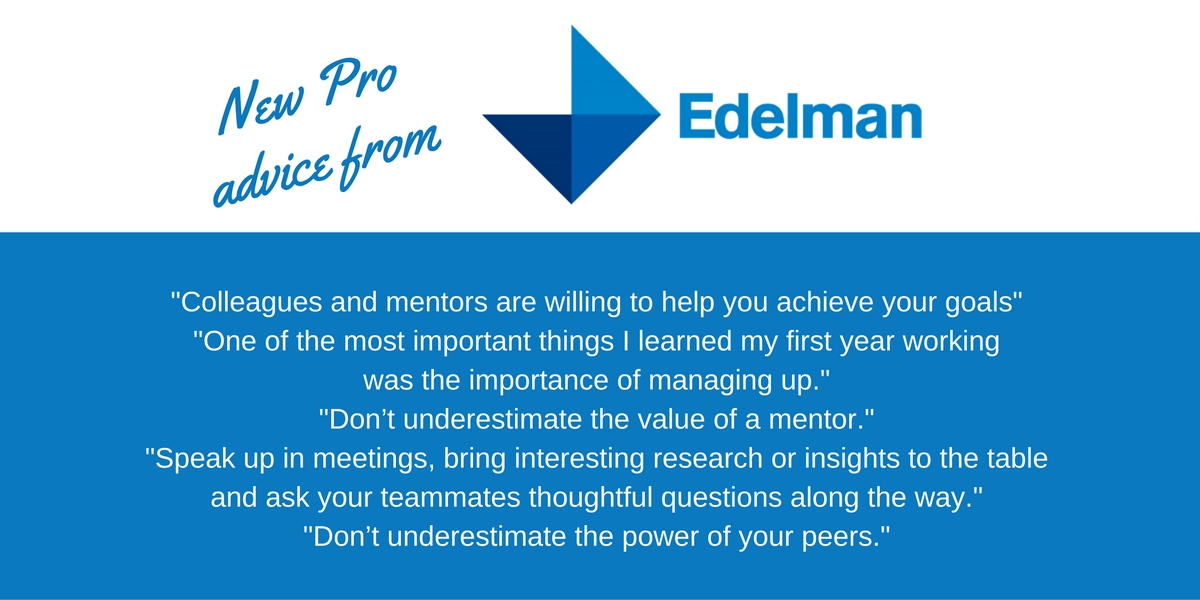
A piece of advice that I often need to remind myself of: nobody is a mind reader. Colleagues and mentors are willing to help you achieve your goals—if they know what those goals actually are. Don’t be afraid to start those conversations yourself.

From working across five different practices at Edelman, I’ve learned that we have an expert or specialist for nearly everything. If you’re starting a new project in an unfamiliar space, the good first question to ask is “Have any of my colleagues done this before?” Often a 15-minute conversation with a subject matter expert gets you a lot more information than an hour of Googling

Molly Shaheen, Class of 2015 – Currently in Program

Allow yourself to think of your role as you thought of college. In a communications agency, your clients and projects are your curriculum and each is an opportunity to gain knowledge on new things.

During your career, you’re going to have those core accounts that you always work on, much like the core classes for your degree. If you navigate things right, you’ll have room to take a couple electives down the line. Keep your eyes open and raise your hand for projects that pique your interest and are outside of your day-to-day role.

Don’t forget what your professors preached – participation! Speak up in meetings, bring interesting research or insights to the table and ask your teammates thoughtful questions along the way. It will help make you stand out.

Lissa Pavluk, Class of 2013

Don’t underestimate the value of a mentor. Find someone a few levels above you who is willing to help you navigate complex situations, give sage advice based on their own experiences and help you understand how to best grow your career. Your HR department should be able to help you facilitate this if you have trouble identifying someone on your own. The best part? You may end up with not only a mentor, but a good friend!

Jenna Wollemann, Class of 2011

One of the most important things I learned my first year working was the importance of managing up (or simply put, making the lives of your managers easier). Entry level employees are expected to be one step ahead, paying close attention to project timelines and various tasks for the team. When I joined Edelman, I quickly learned that you sometimes have to over-communicate with managers and team leaders so they know what the status of your projects are and when they can expect various deliverables. Over-communicating and managing up can be tough at first, but managers have no way of knowing what’s going on unless you tell them.

Additionally, be resourceful and don’t be afraid to ask questions! These traits go a long way. It’s always better to raise your hand to your manager before diving into a task if you’re unsure about something. Also, don’t underestimate the power of your peers. Other colleagues at your level can be fantastic resources if you have questions or ideas, considering it’s likely they have encountered similar experiences or issues.

Interested in applying for Edelman’s Immersion Program? More information can be found here.

Ask New Pros: Your questions answered

As we’ve written in the past, mentorship comes in all shapes and sizes. The beauty of it all is that everyone has something to offer–even the new pros! We’re taking questions from PRSSA members who are looking ahead to the great transition from being a student to entering the working world. Each month, look for our answers to students’ pressing questions. If you want to contribute as a virtual mentor to PRSSA by answering some questions in the #AskNewPros series, send Alyssa an email.

Do you have a burning question for PRSA New Pros? Ask us!

Copy of August

Paperwork.

“Setting up benefits, insurance, etc.”
— Ruthann Campbell, Programming co-chair

Realizing that work/life balance really is an art.

“In comparison to an internship or a semester at school being full-time has no specific end date, so you have to make a conscious effort to find your own work/life balance while giving your career all you can.”
— Jess Noonan, New Pros chair

“I thought I was prepared for everything – a new environment, new city, real job, you name it. Turns out the one thing I wasn’t prepared for was how to handle time management for a good work-life balance. I know it seems like this is such an easy thing to manage, but any YoPro will tell you that this is one thing you need to prepare for in the real-world. Time management and over-communication are extremely important traits to learn quickly. it’ll get you ahead of the rest of the interns/entry level folks if you’re an over-communicator and have a handle on your time!”
— Andrea Easley, Membership co-chair

“Making time for things I’m interested in outside of work. Everyone always talks about how important work-life balance is, but no one really explains that it’s more about making time for the things you care about. In college, it’s easy to make time for going to the gym, hanging out with friends, reading that book you’ve been wanting to finish, getting involved with an activity or organization, whatever because there are clear blocks for everything. You go to class from this time to that time, you go to your internship or to work, you study and everything fits. After college, it’s just as easy to plop on the couch after work because you’re mentally drained and fall down the Netflix rabbit hole instead of doing those things that you tell yourself you’ll get around to. It’s important to make time for things you like, even when you’re tired & busy. If you care enough about something, you’ll find the time to do it.”
— Robyn Rudish-Laning, Membership co-chair

How tired I’d feel! The adjustment to early mornings was hard. If you feel like you’re zapped every day after work, your body will adjust. Get on a good sleep schedule and stay hydrated!
— Heather Harder, Programming co-chair

The expectations of doing your job well all the time. When you’re a professional, even a new one, your supervisor and team look for you start helping them move toward their business objectives soon after you start. “Getting it right” 85 percent of the time as an intern might be great, but when you’re full-time the expectation of a good employee is more like 99 percent.
— Brian Price, Chair-Elect and Section Liaison

The New Pros Bucket List

Whether it’s your first day or your second year on the job, there are several ways to get the most out of your first few years after graduating. Being a new professional is exciting, eye-opening and sometimes a little intimidating. Not sure how to set yourself up for success? We’ve got a few ideas that will make a good start. Welcome to the new professionals bucket list.

1. Find Your Passions and Dig In – This is the perfect time in your career to try everything and discover what you love…and what you don’t. Raise your hand for any opportunity that comes up in the office, even if it seems like something you’d never enjoy. Ask to help the digital guru. Sit in on a brainstorm. Learn a new research software. As you experience all the avenues of our industry, you’ll discover what you’re good at and be able to passionately hone those skills. Plus, you’ll be more of an asset to the company because you’re well-rounded.

2. Sit on a Junior Board – This is something both of us are extremely passionate about – and we think you should be too! Most nonprofits are always in the market for a little pro-bono help, especially when it comes to communications. Find a charity or nonprofit that really resonates with you and see if you can volunteer, or even better, join their junior board. This is a great way to give back to your community and to meet other young professionals. If you’re not sure where to start, some cities have junior board search engines, or you can visit volunteermatch.org to find an organization perfect for you.

3. Find a Mentor – Finding a mentor in your professional life can be intimidating. Remember, acquiring a mentor may not be as daunting as you’re making it! If any of you are fans of Sheryl Sandberg’s book “Lean In,” (and if you’re not, we suggest hitting up Amazon right now), you’ll remember her entire chapter on mentors. She reminds us not to “ask anyone to be your mentor,” but instead, ask people both senior and junior to you for specific advice. This could be as simple as “Can we grab coffee sometime and discuss how I can make my press releases more engaging?” By doing so, you begin fostering an organic mentor/mentee relationship.

4. Become a Mentor – Practice the flip side of No. 3. Both of us were lucky enough to have a plethora of supportive mentors while we were students, and I’m sure you did too. So, you’re a young professional now – it’s time to pay it forward! As we’ve said before, mentoring is so important to the success of your career, but so is being a mentor. You can start by reaching out to your own college or university. Do they have a mentoring program? If not, can you help start one? But, if you’re like us and moved far away from home, you can also reach out to the schools, or PRSSA Chapters, in your area.

5. Try Getting Down and Dirty – Be willing to get down and dirty and pour all your effort into your tasks. Sometimes you’ll be tasked with seemingly monotonous or menial assignments, but they’re actually the backbone of a much larger project. So, raise your hand and get excited! You’ll gain firsthand knowledge of all the small details that go into a successful project or campaign, which will make you a better leader down the road.

6. Grab Coffee with your PR Idol – Is there someone in the industry that you’ve always looked up to, but never approached? What better time than now! Senior-level people in the public relations world are almost always willing to grab coffee with a curious up and coming professional. Whether your idol is in your city or not, there is no time better than when you’re a new professional. If they are not in your city, try scheduling a time with them while you’re on vacation or a work trip. Or do the old-fashioned thing and set up a call! You will learn so much in those thirty minutes, and who knows, maybe your PR idol will turn into your PR mentor!

7. Expand Your Experience – Try a different sector of PR! This is a great way to discover what you’re passionate about and where you can learn the most. You’ll also be more qualified for serving clients from diverse backgrounds. Additionally, try working in different practice areas, even if it’s in the same office. Think you love the consumer practice? Volunteer to help with healthcare or crisis communication needs. You never know where you are most equipped!

8. Join a Speciality Networking Group – While PRSA is a great way to learn about our field, your personal education, and professional development, shouldn’t stop there. Like PR, most industries have networking groups specific to their concentration. Do you work in-house at a technology company? Join a professional tech organization. Are you in a corporate responsibility sector of a PR firm? Join a CSR networking event. These groups are a great way to dive deeper into your projects. Then you won’t only be the go-to person when it comes to communications, but you’ll also be all-knowing of your industry!

9. Attend a PRSA Event – Making the transition from college, and PRSSA, to the workforce, and PRSA, can be very intimidating at first. But, you have to take the plunge! The best way to network with other PR Young Professionals is to attend a PRSA event. Find a friend at work and ask them to attend with you. PRSA will not only make you smarter when it comes to industry trends, but it will also give you a strong network of people just like you.

10. Get Out of Your Comfort Zone – Perhaps most importantly, decide from the beginning of your career that you’re committed to growing professionally and personally. Do what scares you, whether that means moving to a new city or asking someone to lunch. You’ll never grow until you expand your viewpoint and embrace new perspectives. There isn’t just one right path in our industry, which makes the opportunities endless and the future exciting! Choose to seek those opportunities and discover what you love.

You’re only a new professional until the newness wears off. This is your chance to be the rookie, make mistakes and impress your co-workers with your fresh insight. Adding these 10 items to your bucket list (and probably a few more) will set a pattern for continued success and development throughout your career. So get going — your career is waiting.


Lindsey Young headshotLindsey Young is a May graduate of The University of Alabama, finishing her term as UA PRSSA president. During her time in PRSSA, she participated in two Bateman Case Study Competitions, attended seven nationwide PRSSA related conferences and hosted a regional conference. Along with PRSSA, she worked for her student-run firm, Capstone Agency, as a media relations specialist for The Plank Center for Leadership in Public Relations. Lindsey is currently working in Chicago as the New Business Development intern for Burson Marsteller’s U.S. team.
You can usually find her looking for the best place to cheer on the Crimson Tide or catching up on Saturday Night Live. Connect with her on LinkedIn or Twitter!


taylor-shelnuttTaylor Shelnutt graduated from The University of Alabama in May 2016 with a Bachelor of Arts in Communication and Information Sciences (Public Relations) and a Bachelor of Arts in Spanish. She served as the firm director of the PRSSA nationally affiliated student-run integrated communications firm, Capstone Agency, and worked directly with The Plank Center for Leadership in Public Relations. Taylor spent the past two months as a Summer Fellow at Ketchum Chicago and has loved learning the ins and outs of agency life! Connect with her on LinkedIn or Twitter!