5 Tips to Make Business Travel a Breeze

Unfortunately, traveling for business isn’t as easy as packing up your car or shoving your carry-on items in the overhead space. To make the agony of travel a little more bearable and keep you from looking like the new kid in the airport, here are five tips to travel like a pro:

tips for a business trip1. Research your travel destination before you board the plane –Typically, you’re going to have down time on business trips so it’s a good idea to look up popular bars, restaurants and coffee shops in the city. And, if traveling with a client who isn’t familiar with the area, it’s a good idea to get a feel of the land ahead of time. That way, when the down time comes, you can suggest things to do and get to know your client a little better in the process

2. Pack the important stuff in your carry-on – A co-worker shared a horror story with me once that went a little something like this: “I flew to Germany for a meeting with a global company’s executive team and made it there without my luggage.” Be sure you have the essentials with you at all times – a business suit, contacts, medicine, glasses, basic toiletries, jump drive with your presentation and chargers  should all find room in your carry-on to avoid headaches and frantic shopping trips around an unknown city.

3. Know how travel expenses will be handled –Talk to your office travel coordinator, finance department or supervisor before you leave about how to handle expenses acquired during your time away from the office.  Some offices choose a per diem, while others require employees to keep track of their receipts and fill out an expense report upon returning. Clearing up any confusion about how to handle finances before you leave will make sure your company and your pocketbook are left surprise-free. Also, don’t forget cash. You’ll need it to tip the folks that make your life easier, like doormen, bellhops and maids.

4. Confirm all the details of the trip before you leave – Make sure everything is in check prior to leaving the office – including your flight, hotel and car rental – and be sure to bring the confirmation emails with you so you have it if any issues arise. If you have to ship product or additional materials to your destination ahead of time, it is best practice to call the location ahead of time and give them a heads up as to exactly what and when your things will be arriving.

5. Download travel apps – If you’re flying, there’s a good chance your airline has an app that lets you check your flight status, change your flight time and check-in online. Plus, car service apps, like Uber, make sure you get from Point A to Point B on-time, without worrying about trying to hail down a cab or navigate through an unfamiliar city. If your destination is within driving distance, apps like Waze can give you inside information on traffic patterns, slowdowns and construction areas. Also, the likes of Yelp and UrbanSpoon give you quick access to nearby restaurants and cafes.

Most of all, don’t forget to have fun. Take the opportunity to reconnect with old friends, develop a more personal relationship with coworkers and connect with your clients. After all, there’s no better place to learn than on the road.

Kelsey SpellmanKelsey Spellman (@kelseyspellman) is a social influence manager at The Adcom Group, a full-service communications agency in Cleveland, Ohio. Kelsey works with a variety of B2C and B2B clients, specializing in media and blogger relations and experiential marketing. Kelsey graduated from Ohio University in 2011 with a degree in public relations and blogs over at starfishsnacks.wordpress.com.

Solo PR Life Isn’t Easy

open-4-bizDid that headline catch your attention? Good. If there is one thing that I appreciate in friends, colleagues, and experts, is honesty. Don’t sugar coat anything; tell me how hard something is going to be so I’m prepared.

This isn’t meant to scare you if you are looking to become a solo public relations professional. It is meant as an honest post to show that being your own boss can be great, but can also be very rough.

Being a solo PR pro is a ton of sweat and incredibly hard work. Don’t be fooled into thinking that you’ll have clients knocking down your door when you are solo. Just like working for an agency, you need to focus and put in long hours at times. At the end of the day, you’ll be wiped.

Feeling overwhelmed? Don’t be. While I’m being honest, there are strategies get you on the road to success in your solo career. Organization and balance are two of the more important things to have as a professional, solo or otherwise. You may have one, but not the other. It doesn’t happen in a day or month. It takes time. Since I became a solo PR pro, I’ve learned that balance is integral to your home and work success. Here is how I’m doing it.

1.      Create a comfortable work environment. We’ve all seen that Facebook post or Twitter pic of a messy desk. There’s no way you can be productive with your desk cluttered with papers, yesterday’s snack and the over abundance of photos of your dog. Take a moment to set up a desk that will allow productivity and inspiration. You want to feel as good as possible to work. I have my inbox, inspirational quotes and a notepad on mine.

2.      Start your week out by setting goals. At the beginning of each week, put your clients and the tasks you have for each. Then, look at the tasks that are “must do’s.” This will not only help keep you focused, but on point as well. No more of the “I have nothing to do!”

3.      Work is work, home is home. You do need that separation, especially when you are a solo pro. While I enjoy working on some projects after the kids go to bed, your mind needs to reboot. Don’t push the brain too much. Set a time to shut it down for the day and make a note where you need to pick up. You aren’t a robot, so take a break.

Also, don’t be afraid to ask questions. I’ve taken advice from many solo PR pros and asked questions about what to expect and how to handle my own business. This helped me in more ways than I can count. Don’t be afraid to hear “NO!” You’ll get hung up on or told a business isn’t interested. It’s not because you aren’t good at what you do. It is all about timing (and money). Sometimes it’s just not a fit. Lastly, You have to want it… badly. If you don’t like your job and think that being on your own will solve everything, you are going about it all wrong. Running my own business and the challenges that go along with it invigorates me. BUT, there’s been plenty of frustration and bumps. If you just go halfway, you are halfway to failing.

Ultimately, your chances at success are greater if you know the truth. I’m still learning… and don’t want to stop doing so. My current and future clients will be better for it. So will you.


Jason MollicaJason Mollica
 (@JasMollica) is the president of JRMComm, a public relations and social media marketing consultancy. He combines knowledge of the broadcast news industry, traditional public relations expertise and today’s new and innovative social media tools. Mollica operates his own blog and has guest blogged on several others, including the respected Ad Age-ranked PR Breakfast Club, Ragan.com and PRSSA’s Progressions.

February Twitter Chat Highlights: Real-Time Marketing

We’d like to thank everyone who participated in the February #NPPRSA Twitter chat by discussing the opportunities and challenges of real-time marketing. This month we discussed ways that brands can be authentic when engaging in real time and also addressed some the of risks that can come with real-time marketing.

Real-Time Marketing Twitter Chat Highlights

Specifically, we’d like to thank our two special guests for February: Adam Naide and Ken Burbary. Adam Naide is the Executive Director of Marketing for Social Media at Cox Communications, where he leads overall strategy for the company’s social media presences including fan engagement, customer acquisition & retention, social commerce and Social TV. Ken Burbary is the Chief Digital Officer at Lowe Campbell-Ewald. Ken has over 20 years of marketing experience with a focus on digital for Fortune 500+ brands.

Join us again on March 6 for our next #NPPRSA Twitter chat and stay up-to-date with PRSA New Professionals on Facebook, Twitter, LinkedIn or Google+.

Review highlights of the chat below. What did you learn from the February chat? Should brands attempt real-time marketing? Is it worth the risks? How can brands authentically engage with consumers?


Amy BishopAmy Bishop works in digital PR and marketing for DigitalRelevance, a content distribution and promotion agency. She is also Social Media Co-Chair for the PRSA New Professionals Section.  Read her insights on customer experience and social business on her Marketing Strategy blog. Connect with Amy through Twitter, Pinterest or Google+.

5 Advantages of Working in Tech PR

I studied public relations at the University of Southern California with the expressed intention of someday heading up communications for a major studio. But after graduating in the height of the Great Recession, entertainment jobs were few and far between, and a former manager 5 advantages of working in tech PRrecommended I tried technology. Pursuing a role in this industry is the best decision I’ve made in my adult life.

Here are the top five things you should know if you’re interested in the dynamic world of technology communications.

1. Embrace the challenge

At first glance, any PR practitioner, regardless of level, may balk at the idea of taking on a tech client. Chances are, you chose this profession because subjects such as science and math weren’t your strongest suits. But that really doesn’t matter.

Just because you don’t have an engineering background doesn’t mean you can’t communicate with engineers, scientists, CTOs or programmers. In fact, it’s often your role to “translate” their jargon into terms mere mortals can understand. And that’s quite rewarding!

2. Zeitgeist

It’s no question that this is the golden age of this industry. Startup founders are the new rock stars, tech executives grace the cover of fashion magazines.

People will look back at this era and wax nostalgic about the beginnings – and ends – of technology companies, trends and the characters that move them. Get in on the movement.

3. Being young is an advantage

Especially in startups, executives tend to be young and demand a team that will be able to go toe-to-toe with them on the latest trends. If you’re a new PR pro, you’re likely to be an early adopter of the latest gadgets or the cutting edge of social media.  It’s easier to find your role on teams.

Deep tech, or the enterprise, is undergoing a renaissance as well. And I promise you that some of the most rewarding work can be connected to highly complicated, back-end services and structures.

4. The industry is growing with you

Many of the burgeoning products and trends are facing coming-of-age, just like you: mobile devices, Internet privacy, 3D printing, console gaming – these are product lines reckoning with growth, change and regulation. How much more exciting can it get?

5. Tech affords a diverse crowd that will keep you on your toes

The cast of characters that are involved in technology are some of the most interesting, intellectually stimulating, unpredictable people I’ve ever worked with. They’re mad scientists, relentless humanitarians, have doctorates in medieval studies. They’re immigrants that have overcome amazing obstacles and eventually create billion-dollar companies.

The people that power technology PR have more facets than I can shake a semiconductor at. And that’s a beautiful thing.

Have you chosen or considered a career in technology PR? How has your PR experienced crossed paths with the technology world?


Clare Sayas (@claresayas) is a senior account executive in Edelman’s Silicon Valley office, where she works on a broad range of tech clients, including Adobe, SnapLogic and Evolv. She is also one of the proud community managers for @EdelmanSV

Company Culture: Finding the Right Fit

As a friend told me about some reservations that she’d been having at her new workplace, comparing the competitive nature of her colleagues to “The Hunger Games,” I couldn’t blame her for reconsidering her decision to accept the position.

My friend’s revelation got me thinking about the job search process and how we as young professionals often become so focused on how we’re the right fit for the employer that we forget to consider if the company culture is right for us.

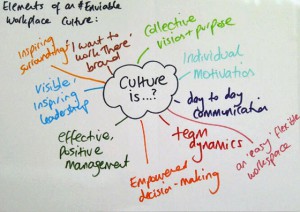
While most of us have heard the term “company culture,” I’d argue that it’s still one of those ambiguous phrases that can be difficult to describe. In a 2013 New York Times article, Josh Patrick of Stage 2 Planning Partners defined office culture as “what you value, what is important for you and your company.”

When considering what we value most in a job, among the first things that come to mind are typically salary and benefits. While undoubtedly important, money isn’t everything and our generation has come to equally value the workplace itself; sometimes even sacrificing a lower salary for a more suitable culture.

Young professionals work hard (before playing hard) and, according to Geoffrey James of Inc., seek to be rewarded accordingly when it comes to perks and promotions. We don’t want to be seen as kids, instead value our voices being heard, opportunities for professional growth and fair treatment by senior-level employees and older colleagues. Although we thrive in a team setting, we expect others to pull their weight and to be able to work independently rather than being constantly micromanaged.

Perhaps most importantly, we desire a personal life. While long hours are often to be expected, we appreciate having realistic goals set for us as well as ample time to complete our work so we can hit the gym at the end of the workday before getting home to watch The Bachelor or some Monday Night Football.

But how do we ensure that we’ll arrive at this comfort level? Finding the right fit begins by determining what you value in the workplace and then asking the necessary questions during the job search and interview process.

Job seekers are encouraged to conduct informational interviews with individuals at a prospective employer in order to not only learn about potential openings, but to get a better feel for its company culture as well. Utilize personal connections to get in touch with individuals that also work there and ask for their honest opinions. Be proactive; there’s nothing wrong with cold contacting folks whose information you find on company websites and LinkedIn.

When you find yourself in the interview itself, have a number of questions prepared to ask different people at various levels of the company. Make an effort to talk with both veteran employees and new hires. In terms of the questions themselves, be sure to ask these potential colleagues about their favorite aspects of the company culture, any complaints they may have and how often staff meetings are held. For one resource, Scott Ginsberg of TheLadders.com poses seven insightful questions you should ask during the interview.

Moreover, keep in mind that unlike skills, the right fit cannot be learned. What criteria are most important to you and how does your company culture match up?


Zach Burrus is currently a public relations professional in Richmond, Va., with experience in both political and sports communication. He graduated from the University of Missouri and the University of Notre Dame and holds degrees in political science, journalism and strategic communication. Mr. Burrus is an active member of PRSA National, PRSA Richmond and the PRSA New Professionals Section. He can be reached at zachburrus@gmail.com.