Three Things You Need To Know About Diversity

Editor’s Note: The following post is part of the ongoing “What does diversity mean to you?” series on The Edge. This series provides insights into diversity and inclusion topics of value to new professionals. To help us champion diversity in PR and to write for the series, email our diversity liaison Henry Cervera Nique.

In a few months, I will have lived in Silicon Valley for a year. Although this tech hub is home to numerous startups and some of the most innovative minds, that doesn’t mean that it doesn’t have its fair share of problems. For years, companies across the nation – both big and small – are at a loss when it comes to hiring and retaining diverse talent. Don’t believe me? Just read this article, this article, this article and countless others. They do a good job at explaining the issue.

Whether you live here in the valley like I do, or out in the Midwest, here are three things you need to know about the diversity conversation:

1. Diversity is about more than just race

When individuals think of diversity, you may be quick to think white, black, native American and Hispanic/Latino and other race groups. Although our physical makeup is a part of what makes us unique, it is not the only thing that makes us diverse. In fact, Merriam Webster defines diversity as, “the condition of having or being composed of differing elements.”

Key takeaway: Look for opportunities to surround yourselves with others who may be different than you are. They may be a different race, from a different country, or are a part of different political party than you. Even though they may not share the same views, you will become better versed in a wide variety of topics, and may even make a friend or two in the process.
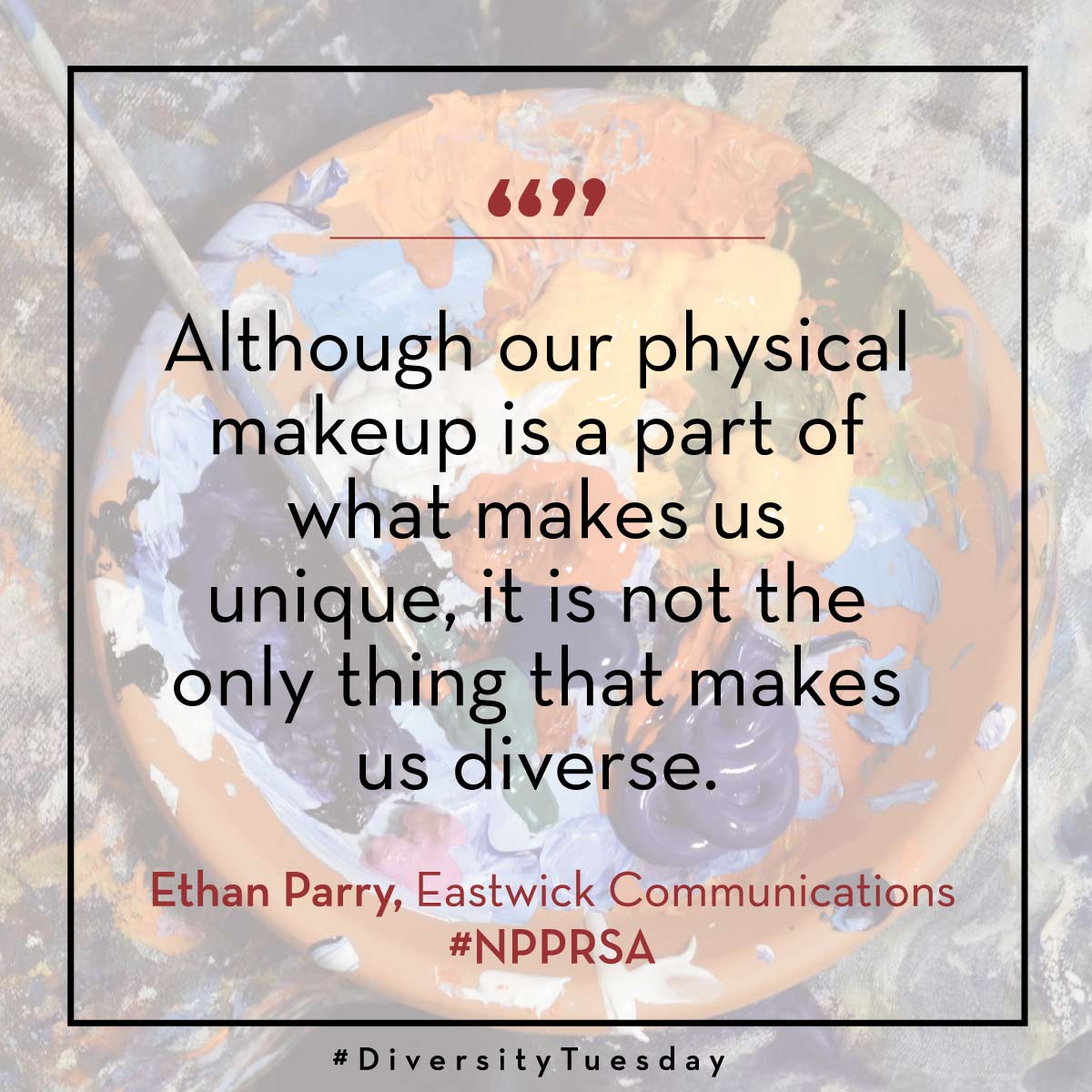
diversity-ethan-parry

2. Diversity will continue to sit at the C-suite table

Although by no means a new trend, chief diversity officer and other similar titles are appearing more on senior leadership benches. Within the first few months of the year even, we have already seen Pinterest welcome Candice Morgan as head of diversity and Twitter name Jeffrey Siminoff as vice president of diversity and inclusion.

Key takeaway: If your company is making diversity a priority, it would be in your best interest to make it as a priority as well. Know your company’s goals and initiatives as they pertain to diversity. You may not be directly involved in the hiring of talent, but make an effort to befriend as many colleagues as you can. Who knows? You may someday be their manager.

3. Want to stand out? Learn more about other cultures.

For two years, I served a volunteer mission for my church in Barcelona, Spain. As soon as I stepped foot on Spanish ground, I knew the experiences that I would have would leave a lasting impact on my life. They did. I have also been very fortunate to visit the University of San Martin de Porres in Lima, Peru before finishing my term as PRSSA National vice president of public relations last year. I had the opportunity to give several different presentations on topics such as personal branding, my top ten tips for new PR professionals and of course, why they should join PRSA.

Key takeway: Do you need to travel in order to learn about another culture? No. Does it help? Yes, but it is not the be all end all. Paula Caligiuri, professor of international business and strategy at Northeastern University, said, “Culturally agile professionals are not necessarily those with the greatest number of frequent fly miles or passport stamps. Developing culturally agility is more of an active process requiring learning in a novel context with opportunities to practice new culturally appropriate behaviors, make some mistakes, receive feedback and question one’s own assumptions.”

Diversity isn’t just an issue here in Silicon Valley. I encourage all to take the time to understand what diversity truly means, notice how companies are making it a priority and make the effort to be more culturally minded.

Ethan Parry is an account coordinator at Eastwick Communications. He served as the 2014–2015 PRSSA National vice president of public relations. He is a member of the PRSA Silicon Valley Chapter and PRSA National New Professionals Section. He currently serves as the public relations chair for the Social Media Club San Francisco Chapter. Connect with Ethan on Twitter, through his LinkedIn page or by emailing him.
Pros and Cons of the “Always On” PR Culture

Although public relations is exciting and engaging, it ranks as one of the most stressful professions. This unfortunate ranking may be due to the idea (or reality) that public relations is a fast-paced industry where professionals have to be ready to manage a crisis at any hour, with lots to know and learn at all times. To be frank, we’re always on — but is the “always on” culture necessarily a bad thing?

The answer varies. An eager new professional may love being immersed in their work, thinking that the commitment and long hours is what it takes to climb the corporate ladder. From an executive’s point of view, they may deem the long hours inhibiting from personal activities like spending time with loved ones or taking care of their health.

There’s the saying, “When you love what you do, it’ll never feel like work.” Most aspects of public relations are exciting for those who truly love it. When there is passion for the work, it is natural to always be on — in many sectors of public relations, key events happen after “office hours.” Passionate professionals genuinely want to keep up with the latest trends and build relationships with influencers and journalists who cover niche subject matters.

On the opposite end of the spectrum, always being on means there is no clear distinction between work and play. Because public relations professionals often choose to work in a niche industry they enjoy, things that were pleasurable before starting a career can now be incorporated into work projects and as a hook when pitching journalists. But at the end of the day, where is the balance?

For those who find the always on culture to be taxing, there is a solution for more work/life balance. Professionals can limit their working hours to a set amount of hours per week, including the time spent returning emails, working on press releases, and managing budgets. During designated free time, turn on your out of office, do an activity that will help clear your head, attend community events, and spend time with those who mean most to you.

Are there any other work/life balance tips that you practice in the “always on” public relations industry?

i-zthGPGn-XL-230x300 Jasmine L. Kent, a member of PRSA-LA, is a fan of all things food and beverage, pop culture, and media. Combining all three passions, Jasmine builds community through engaging online marketing and dynamic events as a communications professional in Los Angeles, CA. Keep up with her on Twitter at @LoveJasPR or visit LoveJasPR.com. 

3 Questions to Ask Yourself Before Accepting a Job Offer

The internet is full of great advice about how to find a job – where to look, how to approach a hiring manager, what to say in a perfect cover letter – but I’ve noticed that advice on how to identify the right job for you isn’t as abundant.

When you graduate from college, the goal is to find a job in your chosen field with decent compensation, benefits, and an enjoyable work environment. New PR pros often go the agency route to get their foot in the door and soak up as much experience as humanly possible.

After that first job or two, choosing a job gets a bit more sophisticated – at that point you’re at a critical turning point in your career that shapes your professional future. I’m currently happily employed in my second job, after happy employment at my first job, and have been lucky to land two fulfilling opportunities. With that said, I know the questions I would ask myself before accepting my next opportunity would be entirely different than those I asked in the past. Here are three things I would ask myself the third time around.

1. How does this role fit into my long-term vision for my career and life?

At a certain point, the ultimate goal of a job isn’t about getting you to the next job – it’s about getting you closer to your ultimate vision. A job should support your long-term professional AND personal development. It shouldn’t be shortsighted. Does this job offer the work-life balance you will need to fulfill personal goals? What about flexibility and the compensation or benefits needed to save for retirement or buy a house? Time off to support a side hustle? This is the time to understand what is most important to you, and find a job that supports you in that quest.

2. Do my values align with the values of management and my peers?

So important. The more your values and goals align with those of your team, the more motivated job-offer_lauren-legeryou will be to progress together. Carefully notice those who speak with you throughout the interview process. What kinds of questions are they asking? How do they treat you? What’s their body language? All of these things can provide insight into their values and work style. If you don’t feel like it’s a fit, it’s probably not, and you’ll likely run into roadblocks in the job as a result. Go with your gut impression of people and be sure to consider how it will affect your day to day at work. If you don’t consider values in the job search, you may find yourself working with people who are not likeminded, facing an uphill battle every day at work – not fun!



3. Is there an opportunity to contribute something big and make a real impact on the company?

If you’re like me, you quickly get bored doing your actual job as described in your job description. At this point, I’m looking for positions that give me flexibility to explore different areas of marketing, communication and business. This is something I didn’t realize I needed or liked, until I started at my current company. Although I was hired as a PR account executive, I started to become interested in social media and inbound marketing. I talked to our president and CEO about inbound, and she got super excited about it – so excited that she asked me to run with it, so we could offer it to our clients. I also ended up taking over social media work from our then manager of digital services. It turns out she was trying to move into a business development position, and was psyched that someone on our team had the passion and skill to take over for her.

Lesson learned – share your passions and just speak up and ask! Now my role is multifaceted, which can be hectic, but I wouldn’t trade it. I’ve learned so much in the past year, and more than anything, learned something about myself – I need to be constantly learning and challenging myself, and working hard to make a big impact on whatever company I’m a part of.

Managing your own career is a long-term process, but by asking yourself the right questions at the right stages of your career journey, you can ensure you’re setting yourself up for professional success and happiness at work.

lauren-leger

As digital account executive at The Power Group, Lauren creates custom digital strategies, crafts tailored social media content, and manages social media accounts on behalf of clients. She also leads Power’s inbound marketing efforts, and is certified by HubSpot Academy in Inbound Methodology. Lauren’s expertise is in B2B and technology. She started at Power in the fall of 2014 as an account executive, and manages select PR accounts. (Connect with Lauren on LinkedIn and Twitter)

The Do’s and Don’ts for Making 2016 YOUR Year

I believe 2016 is going to be a big year. You know what I mean, how some years take much more space in your memory than others when you look back. It’s an overwhelming inkling, like the way you feel a sticky summer breeze and can just know it’s going to rain. Yes, 2016 is going to be a big year. It’s an election year for starters, but I think it’s something in our collective energy that’s buzzing for change. So as we take our early steps into 2016, here are some tips to be more intentional and make sure our efforts go toward making this new year bigger and better than those that came before it.

TAKES

  1. Drink more coffee.

Kidding! Though new health standards say you can have up to five cups a day now. Which is great news for those of us who need a little java courage to tackle early morning segments. So, to good health!

1.5 Don’t check your email/social media pages until an hour after you wake up.

Email, Facebook statuses, news headlines all can have a major affect on your mood, which can alter the way you frame your day. Let yourself have a media-free hour and put the reigns back in your hands. Whether you chose to blast a pump-up morning mix or eat breakfast with your original thoughts. Use the time to touch base with your kick-ass self and start each day with your best foot forward.

  1. Write things down.

This is not just to make your 3rd grade cursive teacher feel validated. Studies show that handwriting notes facilitates memory, cognitive function and also helps with your creative process. (Click here or here for proof.) Maybe it has something to do with how writing in ink relinquishes your ability to backspace, making it a more permanent declaration. Whatever the reason, if handwriting my to-do list could ensure I don’t accidentally skip a thing, I’ll hand-sign myself up for that.

  1. Don’t be afraid of a phone call.

Speaking of going old-school… Humor me. Tap your phone and click on your recent calls; how many outgoing calls did you make besides those to your mother? It’s widely agreed that things like sentiment, sarcasm and even the contents of conversations get shortchanged through text, and yet 90% of the time when presented with both options, we chose the less efficient. Don’t be afraid to dial. An hour-long texting conversation can be communicated more personably over a ten-minute phone call. I mean this for both our personal and professional lives. PR is all about relations. It’s hard to have relations with a digital ghost.

  1. Put effort into “doing you.”   

The worst thing you can do – at any point in your life, not only at the start of the year – is allow yourself to feel comfortable coasting on autopilot. I understand life tends to throw a lot at us and sometimes all you have time for are “survival tactics:” sleep, work, eat, work, Netflix. And that’s fine. We’re at a unique stage in our lives where the effort we put in now can and will shape the course of our careers. But I think we need to stay mindful in making sure we don’t forget to build a life as well. We all have interests besides work that make us tick, and if you can’t remember what those are, go discover them! Be it painting, running, photography, cooking, traveling, guitar etc. Dedicate time for it and don’t lose touch of that part of you. It’ll likely be what sparks your next big idea into a full flame.

The new year can either be seen as another month, no better nor worse than that before it (besides the lack of holiday sweets delivered at your door), or as a wonderful opportunity; to evaluate what we’ve done well, what we maybe didn’t do so well at and set goals (not resolutions) to gradually build on for the months to come. I challenge you to look at 2016 as a blank canvas of opportunity. Choose one thing you’d like to accomplish, professionally or personally, and add a brushstroke each day. It’s going to be a “big year” after all, so don’t be afraid to choose bold colors.

gtzQK8HpMegan O’Neal graduated from UCLA in 2011 with a Bachelor of Arts in Communication Studies, emphasizing in mass communications. She is currently the PR & Social Media Manager at Marketing Design Group and volunteers with the National Multiple Sclerosis Society, freelancing for the public relations department. Connect with her on Twitter @megannenicole.

Start, Stop, Continue: Developing Strategies for Success as a New Pro

start-stop-continue

We’re two weeks into 2016, and PR pros are undoubtedly busy tackling the new year’s new campaigns and deadlines. Despite long to-do lists, the year’s beginning is also the perfect time for young public relations practitioners to assess their current performance and make a plan for professional development over the coming months.

The ”start, stop, continue” model offers an excellent blueprint for teams and individuals looking to identify strengths, weaknesses and areas for growth. Consider a few places where new pros can apply these principles in the new year:

START getting serious about social media

Young PR pros aren’t shy to boast their social media savvy, but is your knowledge beneficial in a business setting? Touting a strong Twitter following or high Klout score is unlikely to impress employers unless you can demonstrate the industry relevance of your influence.

Begin the new year by taking action to prove your social capabilities. Learn the ins and outs of pitching via social networks. Proactively engage with a key contact in your industry or tweet a journalist to let them know you enjoyed reading a recent piece they wrote. In short, be sure you’re taking steps to leverage Twitter and other social platforms as powerful professional networking tools.

STOP pointing out problems without a solution in mind

Offering feedback to company leadership can be one of the smartest career moves in the life of a young pro – or one of the worst. New professionals are able to offer fresh perspectives and bring to light issues that others have missed, but these efforts can backfire. Calling out the faults in your workplace without offering a potential solution will quickly earn you a reputation for complaining, a toxic trait in the eyes of managers.

In 2016, stop pointing out problems without having an alternative to offer. Even if your feedback isn’t implemented, the desire to improve your team or organization will be recognized. Instead of being seen as a critic, you’ll earn a reputation as an innovator and an advocate for your company’s continued success.

CONTINUE making strategic connections

In an era defined by always-on communications networks and a rapidly changing media landscape, PR pros who know how to build productive relationships will continue to prove their worth and find success.

Emails, calls and social media messages vying for journalists’ attention make it difficult for them to give every correspondence their full attention, but resourceful public relations professionals canstop-start-continue_square become an integral part of their network. However, this requires putting your immediate self-interest aside.

When you find a new journalist in your industry during the new year, introduce yourself and offer to meet for a few minutes (without pitching your client or company’s latest development in the next paragraph.) Take time to listen, ask questions and learn what they look for in a pitch. Then – and only then – offer opportunities for collaboration that may be a good fit.

When a journalist knows you respect their time and understand what they’re looking for, they’ll be receptive (even enthusiastic!) the next time they see your name in their inbox.

Of course, these are just a few things I’d like to start, stop, and continue this year. The list is far from complete, and this model can be applied widely to improve professional performance. What will your “start, stop, continue” list look like this year? I’d love to hear your thoughts.

Derek

Derek Byrne is a New York-based public relations professional at Development Counsellors International and a 2015 graduate of Baylor University. Get in touch with Derek via LinkedIn or on Twitter (@Derek_Byrne).