Applying Psychology to PR

illus_2heads-mediaPsychology is a broad major that applies to many of the industries, but for some reason people only associate becoming a psychologist or psychiatrist as appropriate career paths for psychology majors.  Most don’t even consider the possibility of working in the public relations industry, and some might insinuate that since you didn’t major in communication or journalism you are somehow incapable of working in the communications field.  The reality is, psychology makes up majority of the theories behind public relations, social media, and marketing, becoming very much entwined within the industry itself.  Why wouldn’t it?  The study of human behavior is directly involved whether you are planning a campaign for behavior change, trying to manage a company’s image after a crisis, or persuading consumers toward a new idea.

You might be a new grad who majored in a social science, but now you’re interested in public relations.  Or maybe you’re a young professional and after spending a few years in a different industry want to switch career paths.  You are probably wondering, “How do my skills fit into the world of public relations?”  Fear not, coming from a psychology and science background provides many transferrable skills that will help you succeed and can make you an attractive candidate to employers. Psychology actually equips you with many of the desirable traits for the public relations and marketing industry, especially with the new focus on social media in today’s society.

Research – Psychology and other sciences that are research-intensive, require you to be skilled at researching and analyzing information and data.  You have experience not only with conducting primary and secondary research, but also in knowing how to critically evaluate the data and draw appropriate conclusions.  Sure, there is an abundance of information available but you have to know how to evaluate the findings and whether it actually provides support for your objectives.  There are a number of findings that support certain claims, but they will not help your client’s communications campaign if it’s based off of faulty logic or inadequate study design.

Writing – Psychology courses will not provide you with much experience drafting press releases or practicing AP style, but you certainly gain sufficient experience with writing.  Whether it’s by writing research papers, article critiques, or lab reports, you certainly leave college having acquired numerous hours perfecting your writing ability.  Now, it’s just applying your writing talent into a new format.

Social Psychology – Persuasion, behavior change, group behavior, and attitude formation are main concepts covered in social psychology, but they are also the basic concepts for planning a public relations campaign.  Understanding the background of your key publics and why they hold their opinions, beliefs, and attitudes, is the first step in your plan.  Knowledge of the principles behind attitude formation and group behavior is essential when planning and deciding what strategies and tactics will relate and be the most successful for your campaign’s messages and goals.

Social Media:  Knowledge and understanding of how people’s behavior is affected through the use of online environments is extremely useful when planning social media campaigns.  It’s not just about understanding how to use the technology, but deciding how to use these social networks to enhance your brand and increase interaction with your followers.  What factors of the online environment change the way people interact, behave, and make decisions?  Understanding these differences will help your company or brand when engaging followers.  Interpreting how the different channels (Facebook vs. Twitter) affect behavior also becomes beneficial.  Certain messages or tactics will have better reception and response on one channel versus the other for the simple fact of how people interact with it.  It might seem like common sense but behavior can become much more complex and unpredictable through the online environment.

Recent grads, what were some of your favorite psychology courses in college?  Current professionals, how do you find psychology applied in your job today?

LShank headshotLauren Shank does freelance public relations and marketing, specializing in social media.  She graduated from Virginia Tech with a Bachelor of Science in Psychology and is a member of PRSA – National Capital Chapter.  Connect with her on Twitter (@LaurenEShank).

Book Review: ‘Spin Sucks’ by Gini Dietrich

This post is part of The Edge monthly series of book reviews on books relevant to new PR professionals.

The wise Ricky Bobby once told us: “If you’re not first, you’re last.”

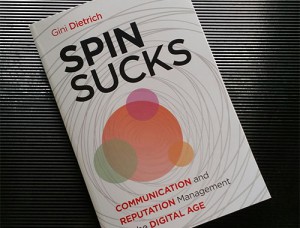
spin_sucks-500x380Well, after reading “Spin Sucks,” it’s obvious that Hollywood’s favorite NASCAR driver has never met industry thought leader Gini Dietrich. In “Spin Sucks,” Gini examines the evolving communications world, and shares actionable insights to help PR pros of all ages adapt to the changing industry both successfully and ethically.

Unlike Ricky, Gini says a quality communications plan is a marathon, not a sprint. If you’re cutting corners, vying for first – not best – even a full dish of fancy sauce can’t help you succeed.

But, follow “Spin Sucks’” fancy-sauce recipe for success, and you’ll get positive feedback from reporters, customers and, most importantly, company leadership.

Prepare your paid, earned, owned and shared media.

Curious how the four PR silos can work in tandem? In “Spin Sucks,” Gini explains how DirecTV used each avenue to execute its successful “Football on Your Phone” campaign.

“They used paid (because it cost them to produce it), owned media (it’s embedded both on their website and YouTube channel), and shared media [through social sharing] for this campaign, and earned media was the result,” she writes.

Add a cupful of content marketing.

Sure, it’s a buzz term now, but in a few years content marketing will be a successful PR pro’s bread and butter.

Think about it. You own this content. It has your brand’s messaging and voice with no third-party filter. And, as Gini notes, once you distribute content through social and email networks, you’ll conveniently (and strategically) bring the audience back to your website.

Not sure where to start? Gini has you covered. She suggests:

–       Subscribing to SmartBrief and Talkwalker Alerts for industry news,

–       Reading blog comments to get story ideas from readers’ questions, and

–       Looking through your sent emails to uncover recurring topics you’ve discussed with customers. (This tip from Andy Crestodina.)

Sprinkle in some SEO.

When it comes to content marketing, if you build it, they probably won’t come. But, if you build then optimize it, they’ll slowly start to find you.

As new PR pros, you’re likely seeing SEO quickly becoming a necessary skill. Here’s how Gini suggests getting in the SEO know:

–       Keep blog posts between 500 – 700 words with five or six keyword mentions,

–       Your keyword or phrase should be in the post URL (here’s how to change it), and

–       Always use an image and copy your headline into the “alt text” section.

Mix in your media relations.

Yes, SEO is an important skill for new professionals, but don’t forget the PR pro’s mainstay: media relations.

As Gini notes, the best media relations starts with storytelling, relationship building, patience and time. She also suggests:

–       Reading the outlets and reporters you’re contacting before drafting the pitch, then tailoring it to their niche.

–       Commenting intelligently on your target reporter’s articles to build your credibility as a source.

–       Writing short emails. For some reporters, you may even consider a handwritten note to break through the clutter.

Technically speaking, Ricky Bobby could be right. If you’re not first, you could end up last. But, as “Spin Sucks” illustrates, speed doesn’t always equal the best batch of fancy sauce.

Conversely, if you train for the marathon – not sprint – your company’s content will be read, news will be reported and goals will be met.

I’ve only skimmed the surface of the PR lessons offered in “Spin Sucks.” Whether you’re a new or seasoned pro, I’d highly recommend this book.

Have you read “Spin Sucks”? What industry insights did you glean from it?


Stephanie Vermillion headshotStephanie Vermillion is a senior account executive at Wordsworth Communications, a public relations agency in Cincinnati. She is on the PRSA Cincinnati Leadership Team and is part of the PRSA Cincinnati New Pros Committee. Connect with Stephanie on LinkedIn and Twitter (@SMVermillion).

 

Four Ways to Keep Your PR Skills Sharp Outside of Work

In our day-to-day lives and work days, it can sometimes be hard to keep some of our lesser-used skills up to date and sharp. We fall into routines and some things we learned years ago become fuzzy.

Here are a few ways to keep those skills sharp, even when you’ve finished your work for the day.

07fe6551. Work pro bono

There are many companies, especially nonprofits, that may not be able to afford to hire someone in-house or from an agency to provide professional public relations for them, although they may desperately need it. Find organizations that you would like to help and offer your skills and expertise without charge. You’ll expand your creativity and formulate plans for a cause or organization you want to stand behind, and help those people to further their programs and events.

2. Create great content in support of products and services you personally enjoy

When I find a product or service that I love, I want to shout it from the rooftops. Using your public relations expertise to promote and strengthen the brand of products and services that you personally use and would vouch for is a great way to sharpen your writing, social media, and interpersonal skills. Use your influence and honest thoughts to spread the word to people who can use them.

3. Network

Talk to and help out other public relations professionals. One of my favorite things about attending a meetup with other like-minded PR professionals is discussing what works and what doesn’t for particular situations, and sharing what you’ve learned through your personal work and education that can help someone else. Discussing these topics helps to refresh methods and skills that you may not have a chance to draw upon often.

4. Stay up to date

Public relations practices and methods are constantly changing, at a faster rate all the time. Play with and experiment with new technology, tools, and methods, explore and find out what works best for your brand and clients. Be proactive, and continue learning new technology, new content strategies, and what your clients want at the pace that it happens.

These are just a few of the ways to continue to hone your skills outside of the workplace. What tips do you have on staying sharp?


Screen Shot 2014-07-31 at 12.03.32 PMSamantha Owens is a writer, hobbyist photographer, and grammar enthusiast based in Napa Valley, CA. She writes her own blog, contributes at a literary fiction book blog, and freelance writing work. Find out more about her at about.me/seowens or follow her on Twitter at @sowensphoto.

The Artistry of Creating What’s Never Been Done Before – Part 2

Continued from the previous post:

Nicole Dobrzynski, ‎Global Football Brand Manager at Nike

“I find my creative inspiration when I am least expecting it. I find that if I sit too long at my desk and try to force an idea, it is hard to land on something compelling. It sounds cliché coming from someone who works at Nike, but inspiration usually finds me when I am out being active – playing soccer on the weekends, taking a yoga class on a Tuesday night, etc. Maybe this habit has been formed from years of playing soccer, but it always seems to happen for me. When my mind is not forced to think about something, random thoughts tend to come in that are different from a concentrated thought.

I also recently read an article that stated that the best creative thinking happens at night. The theory is that your mind is the most tired at this point, which allows the brain to bypass normal logic and think in new and interesting ways. Whether this is completely factual or not, I like to think that there is some truth to this thought. This would help explain why I am able to weave together a seasonal concept in the span of a 60 min evening yoga session, when I have been thinking about it for the past eight hours at work with little success of finding clarity.”

Tony Telloni, Managing Director at Golin NYC

“I think the key to any good creator is the skill of observation. There is creativity in just about anything and everything you come across. You have to be willing to look at things a little bit differently and embrace the thinking that comes with it. At Golin, we like to take creative field trips. We’ll go to a museum opening or an art exhibit. We’ll know that an event is happening at Times Square or Grand Central Station, and we’ll make a point of all going down to see it, even if it’s not an event that’s run out of our office. We do that to keep our creative skills sharp and go where we know you’re going to find sources of creativity and inspiration. I think, willingness to share what inspires you with others is another really important factor and lets great ideas grow to even greater ideas.”

Ben Roth, SVP Creative at MKTG Inc.

“I think you have to be an explorer and open up your frame of reference. You have to read things…things that you don’t want to read in order to explore different points of view. I also believe that in our business, you have to ask the obvious questions that most people think – they already have a simple answer to them. Even if you don’t ask them out loud, ask them to yourself, write them down, look them up – and learn.

Many times, people come in my office, and we have long conversations. I’ll bring up one topic, after another topic, and another. Often they ask me: ‘How come you know that kind of stuff?’ It’s easy. Every day, I write down questions I have, I think about them, look them up – and I ‘learn’ them. I am not smarter than anyone else but I created a ritual for myself that if I don’t have an answer, I’m not satisfied – I look it up and I write it down. The same goes for words. If you come across a word and don’t know its meaning, write it down and look it up. When I started my career and just came out of school, I had little notebooks full of words I didn’t know, full of things I’ve learned. It’s about creating that routine for yourself.”

Inspiration is powerful; on that we can agree. Not surprisingly, there isn’t a simple recipe to it. First and foremost, it’s about finding a balance that works for you; discovering what and who inspires you. It’s about exploring the world, being receptive and sharing your creative journey with others. Beyond that, understanding creative blocks as part of the experience and seeing every moment, encounter and place as an opportunity to learn, opens new doors toward creating the unseen.

HelmaVonZadowHelma von Zadow works with the Brand and Integrated Marketing team at Major League Soccer and is a member of the PRSA New York Chapter.  She served on the 2013-2014 PRSSA National Committee as vice president of professional development. Connect with her on LinkedIn or Twitter.

The Artistry of Creating What’s Never Been Done Before – Part 1

Before the previous World Cup, Nike asked its go-to creative agency, Wieden+Kennedy, to create ‘something that’s never been seen before and never been done before.’ No pressure, right? What sounds like an overwhelming statement at first, has now become the industry norm. 

Creativity and innovation are not only critical in the public relations and marketing profession – they are vital to generating ideas that can differentiate a brand or an organization from a million others.

TheAmericanGenius_AGBeat

But what is the key to continuous inspiration – is there even one? Is it as simple as reading magazines, researching industry trends and talking to as many people as you can? Or is it about being awake, taking things in and experiencing life?

I consider myself a creator and love my profession, yet, sequentially having to come up with new concepts, innovative solutions and BIG ideas ads pressure. I do love the challenge but at the same time, it’s worth exploring how one finds continuous inspiration after having been in the industry for a few or even many years.

On my journey to endless imagination and artistry, I asked five leaders in the industry to share some of the secrets that keep their creative juices flowing:

David Bruce, Senior Director of Brand and Integrated Marketing at Major League Soccer

“I believe pretty firmly that inspiration is everywhere; it could come it the biggest or the smallest form. To me, the most crucial factor in being inspired is not closing yourself off to anything – not coming to judgments. A lot of my energy comes from the city I live in and the sources of inspiration it offers. Living in a city such as New York, gives you this rich tapestry – this energy – gives you this vibrancy. To me, that doesn’t necessarily mean having to go to a show, seeing an art gallery. It’s just walking around the streets having my music on, listening to a podcast and observing things around me. You see street graffiti and kids acting in a cult-like way. Here, they are all part of a small collective and express themselves a certain way, whether it’s through music, with art or how they dress. Every part of the city has its own style and sensibility. Chinatown is different from the Lower East Side, Midtown or East Village. That energy you get from experiencing those various communities and how different they are offers endless inspiration. It gives me direction.

I also enjoy experiencing cuisines from different cultures, seeing how a restaurant creates an experience from start to end: How you enter, how they greet you, what the waiters and waitresses are wearing, looking at the different types of menus, how everything is staged, what music is playing in the background, how you leave – all that, for me, is fascinating. You also see it in hotels, or when getting on and off an airline; it’s the small and unexpected things, the attention that people pay toward certain elements of an experience. I try to remember those things and create a memory log of things that I can regurgitate when I need to.”

Janet Froelich, Former Creative Director of the New York Times Magazine and Real Simple

“I think that a lot of what you do when you problem solve in an area that you’ve worked in for a very long time, is you feed off of it. It’s like a language that you learn so well, that you can use it without thinking about it any longer. You can structure new ideas by examining the nature of the problem. That also means, working off and with other people. I strongly believe that creativity is often collaborative. No matter which field you go into, you will work with other people. Today, I was reading an article in the paper, about how different Paul McCartney and John Lennon were. John Lennon was more of a wild spirit and undisciplined in his approach whereas Paul McCartney was very structured. They played off each other, sometimes battling it out, but often coming up with a much better solution than either of them would have had alone. So, some of it is about collaboration, learning to work with other people, developing a strong team, and understanding the nature of a problem solving in your specific discipline. The more you solve those problems often, the better you get.”

Check back on Monday for part two featuring Nicole Dobrzynski ‎(Global Football Brand Manager at Nike), Tony Telloni (Managing Director at Golin NYC) and Ben Roth (SVP Creative at MKTG Inc).


HelmaVonZadowHelma von Zadow works with the Brand and Integrated Marketing team at Major League Soccer and is a member of the PRSA New York Chapter.  She served on the 2013-2014 PRSSA National Committee as vice president of professional development. Connect with her on LinkedIn or Twitter.