Five Reasons to Attend a Conference as a New Professional

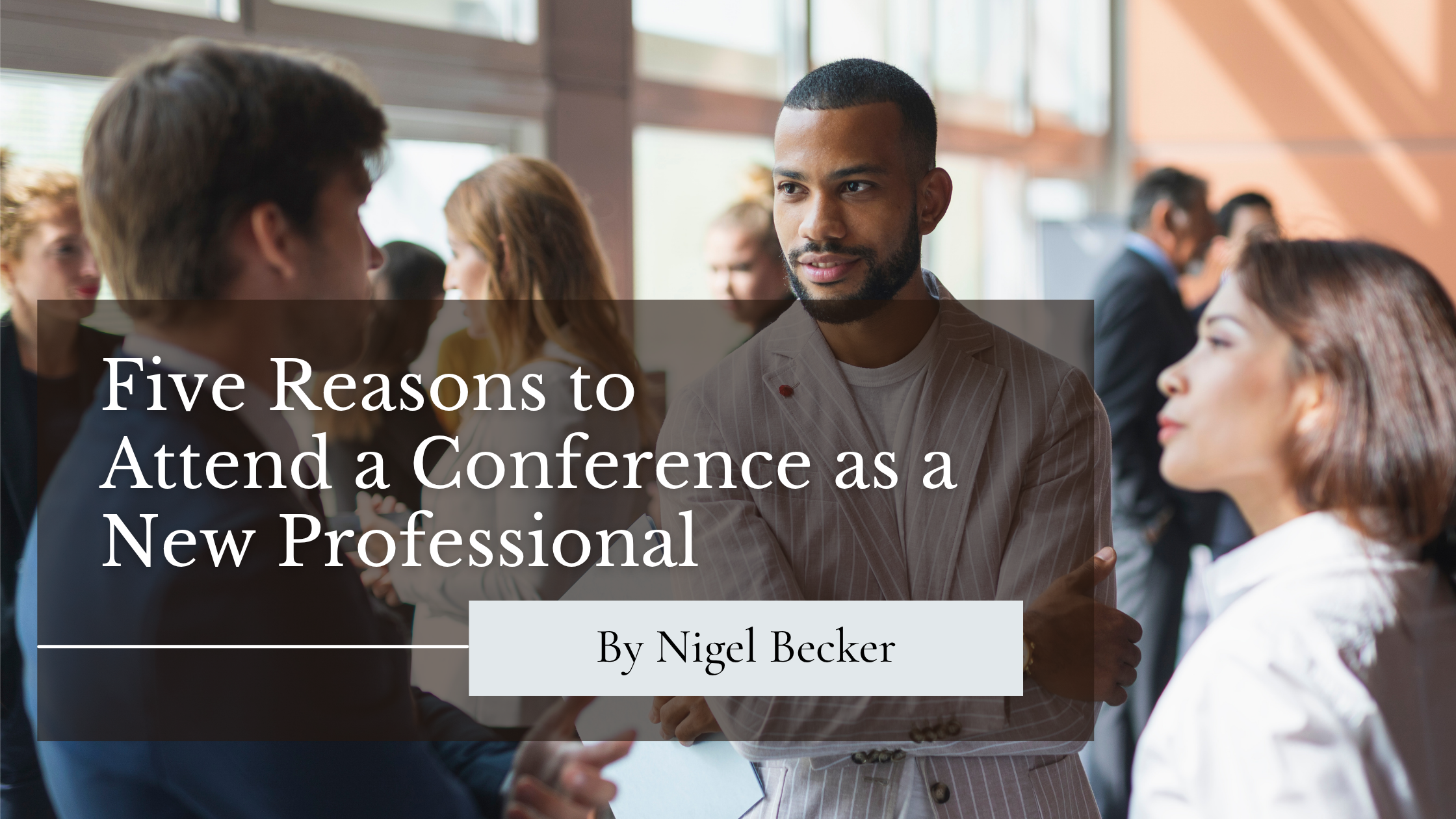
A group of young professionals speaking to one another in a conference hall

PRSA’s annual conference, ICON 2026, is taking place October 18-20 in Orlando, Florida. Over the coming weeks, the PRSA New Professionals Section will be posting a series of blog entries aimed at educating our members about the importance of attending events like these–even and especially as a new professional.

By Nigel Becker

As new professionals, we’re always looking for ways to expand our skill set, access new opportunities and meet fellow professionals who can become connections, mentors, and above all, friends.

Attending a conference is a great way to do that. 

I recently attended PRSA’s 2026 Public Affairs and Government Summit, and it was one of the highlights of my professional career so far. 

PRSA offers a huge selection of conferences every year, from the marquee ICON to those hosted by the numerous professional sections. Many local and regional PRSA chapters and sections also host their own conferences.

If you’re wondering how you might be able to benefit from a conference, I’m here to break down five specific ways that going to one can open doors and help you level up your career. 

1. Expand Your Network

Professional conferences bring together hundreds of industry representatives, vendors, and partners all together under one roof. These attendees come from diverse backgrounds and experience levels. They may be able to help you get a job, share tips to make you better at your role, or provide an extra set of eyes and ears to bounce ideas off on future projects. 

You can also connect with mentors at these events. Approaching someone to say “I’m really interested in your work and would love to learn more” can stand out in ways an email or LinkedIn message simply can’t.

And if a fellow conference-goer is looking for work and seems talented, you may even be able to connect them with your own organization. 

2. Learn from Pros Who Are Further Along in Their Own Journey

As a new professional, you may worry that you’ll be the youngest or least experienced person at a conference. That might not be the case; attendees from all stages of their careers attend conferences! 

Even if you are the least experienced person in the room, that’s often a benefit. It can mean you have the highest likelihood to learn something impactful, and where better to learn than a room full of people who have been in the industry for years or decades longer than you? Many are eager to share what they know, especially with a new professional who’s taking the time to learn.

3. Gather Fresh Ideas from Other Organizations

Every organization is unique. They have their own audience, their own stakeholders, and their own internal team with its own skills and opportunities for growth. 

But even organizations that seem different on the surface can learn something from each other. If you work for a PR firm, you can still learn from a media relations manager, a public utility organization, or a government spokesperson. Effective communication is still effective communication, regardless of how different our audiences look. 

4. Get Hands-On Experience

Many conferences host activities like crisis simulations and brainstorming sessions where you can work with other professionals to solve problems and put best practices into action. 

During the PRSA Public Affairs and Government Summit, I experienced an afternoon-long crisis simulation that made my head spin in the best possible way–and it taught me more about crisis communications than any book or how-to video ever could. 

5. Find New Passions

If you say “I had no idea that was a job!” coming out of a conference, you won’t be the first!

You might meet a conference-goer with a job title you didn’t know was possible or discover a new way to put your media relations background into action. 

Treat the conference floor as a discovery zone, and you’ll often be rewarded for the adventure. 

What Now?

Whether your goal is networking, learning, or finding new career directions, there’s likely a conference for that. 

PRSA maintains a list of upcoming conferences, and if you’re a PRSA member, you’ll likely qualify for discounted tickets. Other local, state, and national organizations host conferences too, so be sure to ask colleagues and mentors for recommendations. 

As for tickets and travel costs, ask your employer about professional development funds. Many organizations offer stipends or reimbursement for professional development expenses. Find out if they can help pay for conference tickets, travel, and/or membership in professional organizations like PRSA. 

And above all, keep looking out for professional development opportunities. As a PRSA member, you have access to a tremendous number of resources–many free or discounted. The time you invest in your growth now can have a real impact on your career down the road. 

Reflections on My Experience

During my three days at the 2026 Public Affairs and Government Summit, I participated in the mock crisis communication simulation mentioned above (complete with a mock press conference), explored case studies at organizations ranging from a regional sewer district to a public health department to a state department of corrections, and met government and public affairs officials from all stages of their careers who were beyond generous in sharing their time, insights, and encouragement. 

Heading home, I felt so inspired–with fresh ideas to bring back to my team and pros to stay in touch with as I continue to navigate my professional journey. 

If you’d like to know more about my experience and want help understanding how a conference can help you as a new professional, feel free to message me on LinkedIn.

I’d like to thank the Public Affairs and Government section for putting on a wonderful event. If my experience is any indication, you won’t regret exploring conferences as a new pro either. 

About the Author

Nigel Becker is an account executive at Slide Nine, a communications, public relations and digital marketing agency based in Columbus, Ohio. Since 2025, he has served as the Social Media Co-Chair of PRSA New Professionals, overseeing the section’s Instagram and Facebook. He also chairs PRSA Central Ohio’s Student & New Professional Engagement committee.
Using Employee Narrative to Defend Corporate Reputation: Southwest Airline’s Flight 1380 Crisis Case Study

The COVID-19 pandemic has brought to light more than ever the need for public relation practitioners to have the proper skills in crisis communication management. While this has always been known to experienced practitioners, it makes the case for those new to the industry to see if they need more knowledge and training in this area.

One of the ways to gain more knowledge is looking back at the past and learning from these case studies.

As a part of Ball State’s online master’s in public relations curriculum, students are required to take leadership courses — one being dedicated to case studies. The work completed by our students not only builds their critical analysis skills of how professionals handle public relations issues in global, digital and ethical contexts, but also provides an opportunity for recognition.

Two of my graduate students won third place in the 2020 Page Student Case Study Competition for their case study, “’Nothing to Hide.’ That’s Southwest. Navigating Crises Fast and Well With Human Stories in the Era of Misinformation.”

The case study took a deep dive into Southwest’s response to Flight 1380’s mid-air emergency, where the aircraft’s left engine exploded shortly after takeoff, causing the plane to plummet toward the ground. Shrapnel from the explosion broke through a passenger’s window, creating a vacuum that sucked her body halfway out of the plane before other passengers could pull her back inside to administer CPR. The crew managed an emergency landing, but the incident left one passenger dead and eight others with non-critical injuries.

Already known for its mission of “Transfarency,” Southwest maintained their core principle of transparency throughout the entirety of the crisis. During and in the immediate aftermath of this crisis, the airline remained transparent with its public, regularly communicating updates regarding the situation via press releases, Tweets, press conferences, sympathy letters, videos, inspection updates, compensation packages and blog posts.

After the incident, crew members and passengers of Flight 1380 were featured on various media outlets as a part of a media tour. Through the stories shared by crew and passengers, a narrative of faith and trust developed in Southwest’s messaging. These reputation tactics are only a few examples of what helped the airline recover from the crisis and gain back the public’s trust.

Studying how corporations and organizations respond to the public during times of crisis can provide a way to diversify your skills and critical thinking in your current and future public relations career. Employers are always seeking candidates with these sets of skills. If you think you may need more education or experience to help further your career, consider pursuing your master’s degree.

Ball State’s master’s in public relations is entirely online, so you can continue working while earning your degree. What you learn in our courses can be applied to your career the very next day.

Interested? Apply today. Applications for the 2021 Spring semester are due January 5, 2021. Use the code PRMA2020 before December 31, 2020 to waive the $60 application fee.


Dr. YoungAh Lee is an associate professor and Graduate Studies Director in the Department of Journalism. Her approach to public relations emphasizes the role of reputation, believing that businesses succeed best when they align their communication and business goals.

To learn more about Dr. Lee and Ball State University, visit the university’s Department of Journalism.

LinkedIn: Dr. YoungAh Lee


“Getting Involved in PRSA” from a New Pro

Getting fully involved in PRSA may seem like a scary thing – joining a new organization, let alone trying to be active in it isn’t always easy. If you’re anything like me, you may not feel like you should interject because you’re a new young professional and don’t feel like you have enough experience to be involved with practitioners of 15+ years. I am here to tell you that PRSA at the local, district, and national level are ready to welcome you with open arms! They are always looking for young professionals to be involved, because young professionals are the future of the profession and the organization.

If you’re interested in starting to do more than just attend meetings or follow PRSA social media channels, here’s how you can start!


Local Level

The first and probably most impactful way to get involved is to start with your local chapter. As a member of the Oklahoma City chapter and committee chair, my involvement got started when I moved to Oklahoma City in 2017. After attending a couple meetings, I decided I wanted to help serve the chapter. If you already have a connection with someone on the board, reach out to them and ask if there is somewhere you can serve. If you don’t know anyone (like I did), contact the chapter president. They’ll know exactly where the chapter needs the most help and will be willing to get you connected with the right people. Also, don’t forget to attend as many meetings/events as possible so you become a recognizable figure in your area!


District Level

Every PRSA chapter belongs to a district. Here in OKC, we belong to the Southwest District. When we’re able to attend in-person events again, keep an eye out for or ask your chapter leadership about district conferences. Most of the districts hold them annually, and it’s a great way to meet PR professionals in your area and get connected with all sorts of people. Because of my attendance at the last few Southwest District conferences, I am currently serving as the Treasurer of the Southwest District and am presenting at ICON with one of the connections I made!


National Level

There are many ways you can serve at the national level. Although it’s usually best to have some experience serving at lower levels, it never hurts to reach out to someone at the national level. For example, we are always looking for people to write for this newsletter and write for our blog. You may even want to submit something to Strategies & Tactics (PRSA’s national publication). If you’re interested in serving on the National New Pros Committee (I am the 2020 Membership Chair), reach out to one of us! We’ll be happy to point you in the right direction. Eventually you may even have the opportunity to serve on the National Executive Board.

As you can see, there are many ways to be involved in PRSA. It all starts with just asking! I highly suggest you attend as many meetings, conferences, and events as possible; especially ICON. If you’re not sure you can afford membership or conferences, check with your local chapter or district about scholarships. Also, ask your employer about paying for your membership – I promise you it’s a great investment and offers a multitude of professional development opportunities. The worst anyone can say is ‘no’ and you’ll never know until you ask!

How do you plan to get involved? Comment below or connect on LinkedIn to share your thoughts.

Landis Tindell

Landis Tindell is currently the Communications Coordinator for the Oklahoma State Regents for Higher Education in Oklahoma City, OK. He serves as the Professional Development Day committee chair for PRSA-OKC, the treasurer for the PRSA Southwest District, and as the Membership Chair for the National New Pros Committee.

Landis holds a Bachelor in Public Relations from Harding University and is pursuing a Masters Degree in Strategic Communication from Texas Tech University. Landis was named a 2019 PRNEWS 30 Under 30 Rising Star and the 2018 Young Professional of the Year by PRSA-OKC.

LinkedIn: Landis Tindell

“Development, Reflection and Union” from a New Pro

In these uncertain times, we should support each other. This current situation we find ourselves faced with has forced us to change our way of thinking. While for some of us this change was big, it was not so for others. Even so, it may yet affect your future. I personally believe there are three main factors that are essential to consider if it does: development, reflection and union.

In this post, I will analyze each of these separately so that you may call upon them as we all navigate the unique challenges our new normal creates.

  1. Development

Using the time that we previously did not have, or simply could not use efficiently, is currently possible as interactions turn virtual and work becomes remote. Being able to learn new things through online courses, webinars, reading or really any type of education is something very beneficial with the additional time you may suddenly have on your hands.

As a Public Relations professional, your career may concern many high-stress, quickly changing and even competitive elements. We should take advantage of every learning tool we can to develop our skills during these times of quiet to make a difference in our field when things inevitably speed back up.

  1. Reflection

Regardless of how we use our time, there is something we’ve been given in this situation: a pause.

This pause can be long or short depending on the situation. In my opinion, this is the ideal time to reflect. Try to perceive those things that maybe you didn’t see before.

As you reflect, it’s inevitable that one of those thoughts will be about your health. Indeed, health is the most important thing; it’s essential. In regards to this, I believe that we — as communicators — should use our talents to help represent the essential things in life, rather than the superficial. That we should go beyond what people expect from us, and rise above the typical.

More than anything, reflect on the priorities in your own life. Consider what really matters.

  1. Union

Thirdly, there must be union. Teamwork. Collaboration.

Is it easy? No. And yet teamwork is what solves most of our problems. Consider your own relationships, especially during this particular crisis. You’ve probably had to become very flexible, and maybe pitch — or listen to — more unconventional ideas while trying to navigate the unprecedented restraints we all find ourselves under.

In my opinion, your attitude is the best solution. And by the time this whole crisis is over, it’ll continue to be. Because in the end, an inclusive behavior toward others is always the best solution.

To conclude, I believe that we should remember that self-development, a little reflection on life and some good old fashioned teamwork are three essential aspects to consider — today, and in the future.

Do you agree? Comment below or connect on LinkedIn to share your thoughts.

Facundo Luque is a Young PR Professional from PRSA Argentina on the Communications Sub-Committee in the PRSA Diversity & Inclusion National Committee. He is currently working in an Argentinean public relations agency.

LinkedIn: Facundo Luque

New Pros Chapter Spotlight: PRSA Colorado

PRSA Chapter: Colorado
Location: Greater Denver Area
Chair(s): Dani Row and Bailey Gannett

Tell us about your New Pros group:
We’re a dedicated group of new professionals (a mix of young pros, professionals in the midst of career change, and those looking to stay sharp on PR trends). Our group gets together about once a month for happy hours, panels, professional development workshops, and more to help cultivate our PR skills and provide a network where we can all come together to collaborate.

How many members do you have?
We have around 100 in our email list, but around 30 active members.

What kind of programming have you put together for New Pros?
Monthly (or bimonthly) happy hours; events vary from casual networking happy hours after work to more refined events with local industry experts/professionals; twice a year we host larger events to help professionals (both PR and non-PR are encouraged to attend) where we offer an added incentive like a new headshot for LinkedIn, resume critiques, or mock interviews.

How does your group fit into the bigger picture of the chapter?
We work closely with our chapter’s communications committee to promote our events and to encourage our membership team to attend events to talk about the benefits of becoming a PRSA member.  Our group also acts a pipeline to funnel in those who have expressed interest in PRSA but have not yet committed fully to joining the organization. The New pros events are a friendly, top of funnel type of event that encourage participation from all who have even a remote interest in learning more. We often help with converting PRSSA students over to PRSA members. We also work with the Finance team on budgets (when applicable) and work with a liaison, someone who serves on the Board and can serve as the NP representative at monthly Board meetings. Oftentimes, we rely on PRSA Board members or seasoned members to help with larger events to serve as resume critics or mock interviewers.

What resources do you provide for New Pros?
Expert advice from respected members of the PR community and tips on all things PR (social media, media relations, community relations, crisis communications). Members of the NP group who are regulars get the added benefit of becoming friends with other members and using the time to network with other members for job opportunities or relationship-building

What do some of your members see as the benefit of being a part of the bigger New Pros group?
Our members utilize the New Pros group to gain industry insight on trends and knowledge, collaborate with both young and seasoned professionals, and develop professional skills necessary to propel forward in their careers.

How do you engage and recruit New Pros?
We often engage and recruit new professionals through our PRSA Colorado social media channels, through our personal social media channels, during regular PRSA chapter events and through active recruitment with local universities and their respective PRSSA chapters.

What advice do you have for New Pros for using PRSA to their best advantage?
Get involved! Joining a committee or even serving on the Board or as a chair allows you to build your network of industry professionals—you never know when this will come in handy.

Find what interests you. Not every group is the right fit for every member. Go to a few different group events and see what feels right. Once you’ve found one (or more) you like you can dedicate your time to getting more involved.

Many times, members get discounts for events outside of the NP like luncheons. Being a member certainly has its perks—and a financial gain is certainly a big one.

Contact Us!

Dani Row and Bailey Gannett are co-chairs of PRSA Colorado’s New Professional Section.

Dani Row
Dani graduated with a bachelor’s degree in public relations from Kansas State University in 2012. She is currently a public relations manager with Velocity Global, LLC, based in Denver, Colorado.
Email: danirow@velocityglobal.com

https://www.linkedin.com/in/danirow/

Bailey Gannett
Bailey graduated with a bachelor’s degree in strategic communication from the University of Colorado Boulder in 2018. She is currently a communications specialist with Cherwell Software, based in Denver, Colorado.

Email: bailey.gannett@cherwell.com

https://www.linkedin.com/in/baileygannett/