
Intro To Series… Healthcare PR by Heather Sliwinski

If I were a betting woman, I’d say my experience as a new professional in the healthcare industry is similar to other New Pros’ positions out there. The skills we use are generally the same—they are just applied in a different way.

The daily life of a New Pro is quite different than that of a student, or even an intern. The transition can be challenging. Working for a small, growing drug testing laboratory, I was given a great deal of responsibility early on that spanned all areas of communications. One minute I was designing our two quarterly newsletters and the next I was producing and hosting an educational video series for the Web. From day one, I was pushing past my limits and gaining responsibilities to which no company had ever entrusted me as an unpaid intern. I was dabbling in design, communications, event planning and management. If I had to sum up my biggest responsibilities into a brief job description, it would look something like this:

Design: I create and edit all promotional materials, including brochures, direct mailings and quarterly newsletters, for current and potential clients.

Exhibit coordination: I manage our attendance at over 30 conference exhibitions, working with conference sponsors and third-party vendors, as well as representing the company at a number of conferences myself.

Team leader: I coordinate larger marketing projects with third-party firms that have included the overhaul of our website, identity package and overall brand image.

Writing and editing: I write and edit copy for promotional materials, the website and our two quarterly newsletters.

What’s more important than a list of my duties, I think, is an overview of the skills expected from me on a daily basis:

Self-starter: The training wheels are off now. Gone are the days of endless small tasks at an internship or syllabi from professors. In my position, I am expected take a lead role and tackle projects before they are assigned to me, as well as bring new ideas to the table. Make suggestions, take risks, make mistakes and try again. A positive energy and willingness to participate and learn outweigh any ideas that don’t pan out.

Flexibility, multi-tasker: As I stated earlier, my position covers all areas of marketing and beyond. In the current economy, not only does a New Pro have to be flexible on what area of PR or advertising they want to work in, but they have to be willing to change direction at a moment’s notice. Companies want someone who can work well under pressure and don’t get frazzled when their typical routine (if you even have one) is disrupted. I don’t know how many times a week a printer will break down or a colleague needs a promotional piece by tomorrow, and I have to drop what I’m working on and tend to the urgent matter. It’s all part of the fun in PR.

Fast learner: To be honest, my undergrad self never would have guessed that I’d be working for a drug testing laboratory after graduation. I’ve never been that big of a science buff. USDTL didn’t expect me to know the ins and outs of the industry before they hired me, but they did expect me to be open-minded and capable at picking up knowledge quickly. Today, I am able to communicate to current and potential clients our wide range of services and the science behind them. Being a fast learner goes hand-in-hand with being a self-starter. When I come up with new projects for the marketing department, that often results in me diving head first into software I’ve never seen or a social media outlet I’ve never used. To achieve our goals in a timely fashion, I have to pick those up sooner rather than later. And, with the world of PR and technology changing at a rapid pace, there is always a new PR tactic with which to familiarize myself. I frequently attend workshops and seminars, including those provided by PRSA, to continue my professional education.

So, the only question left is, how does working in the healthcare industry differ from other areas of PR?

I can truly say that working in healthcare has been more rewarding than any other position I’ve held. What I do on a daily basis directly affects the health and lives of others. If selling just one more drug test aided in the treatment of one newborn, it’s all worthwhile, isn’t it? Healthcare may be tied with the unknown right now, but the uncertainty has opened up opportunities for great impact. Working for a lab may not be as glamorous as a “Mad Men” agency setting or working PR for an entertainment giant, but your clients and colleagues are passionate about what they do, and I consider that a privilege for any professional in the work force today.

Heather Sliwinski is the marketing communications manager at United States Drug Testing Laboratories, a forensic laboratory providing alcohol and drug testing services to hospitals, government agencies, social services and drug treatment programs. Before joining the USDTL team, Sliwinski graduated from University of Wisconsin-Madison in 2008 with a Bachelor of Arts in Journalism and Mass Communications and a Certificate in Business. She has held positions with a nonprofit, a Fortune 100 company, and her university. Sliwinski is a member of PRSA National and Chicago Chapter, as well as the New Professionals and Health Academy Sections. Feel free to connect with her at Sliwinski@uwalumni.com or find her on LinkedIn at http://www.linkedin.com/in/heathersliwinski
professional development… Here’s What’s for Us at PRSA International Conference by Janet Krenn

Two words: development and networking. This is what we as New Pros stand to gain by participating in International Conference this October 16-19 in Washington D.C. And if you register by next Friday (August 27) you can get this at the saver rate, i.e. $200 less.

(Now, I’ll be honest with you, you might find this to be too expensive to pay out of pocket, but other New Pros have attended conference in the past by asking their boss to foot the bill. If you’re interested in telling others how you convinced your boss to send you to IC or you have questions for those that did, join the discussion on our eGroup page.)

OK,  so you’re going to International Conference. Now what? In addition to the other cool sessions, the New Pros Section is sponsoring a session and two networking events.

  • New Professionals Section Workshop
    “Myth or Reality: ‘Agency Experience Preferred'”
    Tuesday, Oct. 19, 8–9:15 a.m.

    What are employers really asking for when they require “agency experience”? Is an agency position truly the best public relations experience? Learn about the pros and cons of agency and non-agency experience from Sarah Siewert, account executive, KemperLesnik; Heather R. Huhman, founder and president, Come Recommended; and Lara Kretler, vice president and social media lead, Fahlgren Mortine Public Relations. Receive advice on how to choose the path that best suits your skills, and learn how to make your own experiences marketable to all employers.

  • New Professionals, Technology and IPA Sections Networking Dinner
    Monday, Oct. 18, 6:30–9 p.m., Lauriol Plaza
    Graceful architecture and sophisticated service set a stylish tone for some of the best Tex-Mex in Washington, D.C. Lauriol Plaza offers good conversation, a strong margarita and the finest offerings from the mesquite-fired grill to IPA, Technology Section and New Professionals Section members.
  • Sections Soirée
    Monday, Oct. 18, 9–11:30 p.m.

    Stop by the Sections Soirée to network with colleagues from all 16 Professional Interest Sections, and share tips about the latest industry trends. Also, don’t miss a chance to win some great prizes.

If you can make it, International Conference is a great way to learn more about the profession and start networking with seasoned pros in your and other industries. Hope you can make it!

JANET A. KRENN is your 2010 Chair of the New pros of PRSA.

  • New Professionals Section Workshop
    “Myth or Reality: ‘Agency Experience Preferred'”
    Tuesday, Oct. 19, 8–9:15 a.m.

    What are employers really asking for when they require “agency experience”? Is an agency position truly the best public relations experience? Learn about the pros and cons of agency and non-agency experience from Sarah Siewert, account executive, KemperLesnik; Heather R. Huhman, founder and president, Come Recommended; and Lara Kretler, vice president and social media lead, Fahlgren Mortine Public Relations. Receive advice on how to choose the path that best suits your skills, and learn how to make your own experiences marketable to all employers.

  • New Professionals, Technology and IPA Sections Networking Dinner
    Monday, Oct. 18, 6:30–9 p.m., Lauriol Plaza
    Graceful architecture and sophisticated service set a stylish tone for some of the best Tex-Mex in Washington, D.C. Lauriol Plaza offers good conversation, a strong margarita and the finest offerings from the mesquite-fired grill to IPA, Technology Section and New Professionals Section members.
  • Sections Soirée
    Monday, Oct. 18, 9–11:30 p.m.

    Stop by the Sections Soirée to network with colleagues from all 16 Professional Interest Sections, and share tips about the latest industry trends. Also, don’t miss a chance to win some great prizes.


New Pros Summer Book Club – “Crush It” and Personal Branding

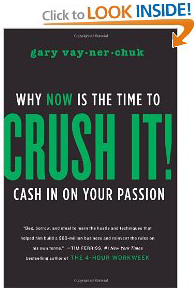
In “Crush It! Why now is the time to cash in on your passion”, Gary Vaynerchuk sets up an ambitious 12-item to-do list to accomplish within less than 200 pages. Last week, we talked about “What real hustle looks like”, but this week I want to talk about a different theme: Personal Branding.

Branding

Personal branding is a topic of interest to New Pros especially as we try to gather the quality and quantity of experience that will help us achieve our career goals. But, as Vaynerchuk indicates, personal branding is not just appearances and image.

Vaynerchuk argues “personal branding”=”content generation”, and he recommends blogging as the means towards personal branding. In our brave new world of microblogging and mini-messaging, the idea that long-form blogs hold the key toward establishing you and your personal brand seems nearly old school. After all, weren’t blogs so 2003?

Now let’s tie this back to last week’s post on Time. Vaynerchuk says to expect working your butt off both at work and at home for years before you start to see the payoff. At this point, you could reasonably assume that you’ll blog strong for about a year, but that the technology will change and you’ll need to pioneer a new medium.

What do you think?

How would you define personal branding?

Do you agree that Vaynerchuk’s arguing that content generation is the means toward achieving a personal brand?

Do you attribute your personal branding progress to blogging?

New Pros Summer Book Club – “Crush It!”

You voted, and we responded! For the last selection of our summer book club, we’re talking about “Crush It! Why now is the time to cash in on your passion” by Gary Vaynerchuk.

Vaynerchuk’s claim to fame lies in the fact that he used social media and the internet to turn his family’s <$10 million liquor store into a $50 million business in 8 years, and  he did it all during those years immediately after college.

If you’ve ever seen Vaynerchuk speak (he’s been speaking at countless events as well as TED), you know the guy has a deep, well-expressed passion. That passion explodes through “Crush It!”, making the book an entertaining, motivating, and quick read.

In the book, Vaynerchuk sets us up with a game plan toward embracing our passion and developing a business through the use of social media and the Internet. There’s a lot to like about this book, but in our two blog posts, I’m going to talk about the two themes that really struck me. This post, we’ll talk about Time, and next week, we’ll talk about Branding.

Time

How much time do you think you need to spend on building your business before you can monetize?

Vaynerchuk makes no attempt to hide his opinion: You need 40 hours each week and several years.

If you have a full-time job already, get ready for long nights in front of the computer. Because Vaynerchuk lives by three rules (1) love your family, (2) work superhard, (3) live your passion, he factors in family time into your after work schedule and suggests crushing it from 7pm to 2am every evening, with slightly altered hours if you have kids. “…assuming you’re doing this right, you’re going to be bleeding out of your eyeballs,” he writes, or rather dictates as he confides later in the book.

I like to sleep, and hearing this time commitment had me more than a bit apprehensive, but Vaynerchuk assures me:

“You’re not going to be stressed or tired. You’re going to be relaxed and invigorated… The passion and love for what you do will enable you to work the hours necessary to succeed.”

Well, Vaynerchuk’s enthusiasm had me all amped up at near-midnight on a Tuesday, and I thought, “What the heck! I’ll try it out tonight.” The next day, after 4 hours of sleep, relaxed and invigorated I was not. Although I am still laying the groundwork to crush it, I’m skeptical of how well I can meet this, or even a slightly abbreviated, time commitment.

What do you think?

If you’ve read the book, are you inspired to take on this time challenge? What are your apprehensions?

Are you crushing it now? Tell us what you’re crushing and drop any pointers you may have!

Intro to Series… Corporate Consumer PR by Kelly Misevich

In Corporate Consumer PR we may not work on client projects in the way PR agencies do, but we have no shortage of work to do for our customers, consumers, employees, stakeholders and other function areas within our organizations. A typical day can range from working on media relations, developing internal employee communications, fostering brand awareness through community events, issues management, and promoting corporate philanthropic programs.

As a corporate consumer PR professional, branding is key. We connect our brand with customers and consumers through strategic and creative media relations, community relations, and brand awareness programs. We also ensure that employees are engaged as brand ambassadors through the use of internal communications such as newsletters, intranet sites, and company-wide magazines. Teamwork, flexibility and enthusiasm for the brand you represent are extremely important in this industry.

Challenges in Corporate Consumer PR

Some of the challenges of the corporate consumer PR industry arise when dealing with the following areas:

  • Issues management: monitoring and researching political, economic and social environments for any potential threats to a brand
  • Crisis communications: developing clear messaging during an emergency, while ensuring timely delivery of information
  • Reputation management: ensuring trust, credibility and responsibility around a brand

Non-PR Activities to Consider

If you are considering a career in the corporate consumer sector of PR you might want to consider exploring some college courses that offer insight into other function areas within an organization, while giving you the opportunity to sharpen your communication skills. I’d recommend taking introductory courses in

  • business law
  • operations management
  • finance
  • human resources.

Kelly Misevich is a Public Affairs and Communications professional for the Midwest region of Coca-Cola Enterprises. Her four years of experience include internal communications, community relations, event planning, government relations, issues management and media relations. Kelly attended Georgia State University earning a B.B.A in Managerial Sciences.