Maximize Your Career Potential by Managing Up

Picture this: you’ve just started a new job, but your new manager isn’t as hands-on as previous supervisors or professors. Instead, you get 30-minutes of one-on-one time with them every other week and—before you can even learn how to use the printer—they expect you to show results. Yikes! Other managers may report into someone that is too hands-on—an entirely different challenge. Whatever your situation may be, learning how to work with your direct supervisor can make or break the early days of your career. The right manager can be your mentor, guide and biggest cheerleader, and it all comes down to how you manage up.

Changing Workplace Dynamics and the Keys to Managing Up
According to the Pew Research Center, Millennials (ages 21 to 38) have overtaken Baby Boomers in the workforce. Did you cringe at the word “millennials”? It’s Ok. I hate that word, too. Younger generations get a bad rep – we are often pegged as needy, entitled, narcissistic, unfocused, lazy – the list goes on. What’s interesting is that we see ourselves as motivated and purpose-driven, trying to make a difference in the world.

Simon Sinek’s video about Millennials in the workforce highlights a key point that unlocks a lot of our problem here: Millennials tend to have difficulty developing meaningful relationships—especially in the workplace. They also tend to be impatient about getting to where they’re going.

The reality, as stated by Sinek, is that the key to managing up is found at the intersection of patience and relationship development.

We’ve all heard the saying, “People leave managers, not companies.” According to Gallup CEO Jim Clifton, “The single biggest decision you make in your job—bigger than all the rest—is who you name manager. When you name the wrong person manager, nothing fixes that bad decision. Not compensation, not benefits—nothing.” (Source: Inc.)

But what makes a good manager? In my experience, the best managers are available when you need them, capable of sharing quality feedback, and able to recognize the strengths and weaknesses in others. While it’s easy to demand those of others,  best way to bring these characteristics out in your manager is to portray them yourselves.

Millennial psychology aside, there are some clear ways to “hack” managing up—no matter which kind of manager you have.

The Power of Quick Wins
If you’ve worked at an agency, you’ll be familiar with this concept. This is the first rule of onboarding a new account—deliver quick wins. However you define a “win,” immediately delivering on your promises and showing success can go a long way in getting the right attention from your manager.

This doesn’t only work for new relationships. In fact, this works after every performance review, weekly one-on-one meeting and more. Remind them of why they hired you and remind them that it was a good decision.

How to Ask for Feedback
How many times have you felt criticized or unappreciated at work? In those situations, I would say it’s probably because you were lacking quality feedback. There are hundreds of articles and books about giving and receiving feedback for a reason—it’s the key to every good relationship.

When giving feedback, first make sure they’re open to it. Ideally you would have already established a relationship with your manager so you can go to them with your questions and concerns. If you have a weekly 1:1 with your boss, then it’s easy—that’s your chance to talk about things that are/aren’t working.

If not, then you need to ask. It’s easiest to do that in the context of your work with them. When they come to you with a new project ask if you can discuss your concerns one-on-one. Some helpful phrases to try out:

  • “Would it be helpful to have another perspective?”
  • “Now that I’ve gotten my head around this assignment, can I talk to you about how things are going?
  • “Do you have a minute to discuss ____? I need more clarity from you on [my role, my responsibility, how we are approaching the assignment].

The key with this is to be specific and don’t get personal. If you start making generalizations or start attacking them as an individual, you could put them on the defensive, and lose your chance to be effective.

It’s worth noting that some relationships will not allow for feedback. In those situations, it’s usually a senior executive so empower yourself to do your best to see things from their perspective.

Receiving feedback is simple—all you need to do is ask:

  • “Do you mind providing feedback on this project? I’m interested in getting your thoughts so I can learn and make adjustments next time.”
  • “Did this meet your expectations?”
  • “Am I getting closer to your vision for this project? If not, where should I focus?”

Feedback should be honest (not brutal, but direct) and real-time. If you only get feedback once per year, then you only have one chance per year to improve. If you get generic responses to your questions, follow up: “Tell me more about that.”

How to Discover “Unwritten Rules”
I’m a fan of discovering “unwritten rules” by befriending the gatekeepers—like the receptionist or your boss’s assistant. You should also work to get to know the people that have been at the company longer than you—they will be a tremendous asset to you as you get to know the “way” of a company’s culture. They can also share tips for working with certain individuals (like your manager).

Unwritten doesn’t usually mean secret, so also don’t be afraid to ask. You’re probably not the first person to do so.

Why Personalities Matter in the Workplace
In Meyers-Briggs, I’m an ENTJ. That means I’m extroverted, intuitive, a thinker and judging (i.e., logical and decisive). The better you understand yourself, the better you can help others to understand you. And for someone to truly manage me, they need to understand me—it works the other way, too.

Understanding how your manager processes information is something I’m still learning—my manager internally processes information and needs more time to think before coming back to me with feedback. I, on the other hand, externally process everything—meaning I like to talk it out with you right then and there until we come to a resolution.

Get to know your manager and be curious about how they think. Learn to anticipate their questions based on their priorities. Understand that everyone is different, and it would be unreasonable to assume otherwise.

What it Means to Set Expectations
Understanding what your manager wants from you—and vice versa—comes down to how you communicate expectations. Be clear about what’s expected up front so there are no surprises (or disappointments) down the road. How do you do that? Have a process. First, ask questions and repeat what you’re hearing. Then, put it in writing (e.g., in an email) and get them to agree to it.

Communications for Communicators
Practice what you preach. Sometimes we can be so client-focused that we forget to utilize our own best practices. Try creating your own formal strategy, just as you would with any client, for how you communicate with your manager. Pre-empt their asks by being proactive. If your manager ever has to come to you and ask you for a status report, you’re too late in getting it to them.

Learn to anticipate the questions of your manager: what are they being held accountable for? That’s what they’re going to ask you about. Find a way to let them know the status of what you’re working on so they don’t have to come looking for you.

In closing, managing up is a challenge because managing people is hard. Be patient with yourself and with your manager. Everyone is on a journey and learning at their own pace.

And the key to any management relationship—up or down—is not management, but the relationship. Take your boss out for coffee and get to know her. That relationship will be the key to your success.

Scott ThornburgAbout the Author
Scott W. Thornburg, APR, is an accredited marketing communications leader with nearly a decade of global agency and in-house experience. Passionate about his work, he is known for thoughtful management of complex issues, careful attention to detail and high-impact leadership. Scott has been a strategic communications adviser for top global brands like Oracle, ExxonMobil, Dell, Cirque du Soleil, Hard Rock, Nasdaq, lynda.com (acquired by LinkedIn) and more. He now works as a senior public relations manager for Sojern, a travel marketing and advertising technology company. He’s a graduate of The University of Southern Mississippi (2010), with a degree in journalism, and an emphasis in public relations. Scott is a member of the Public Relations Society of America (PRSA) and serves on the organization’s national board.

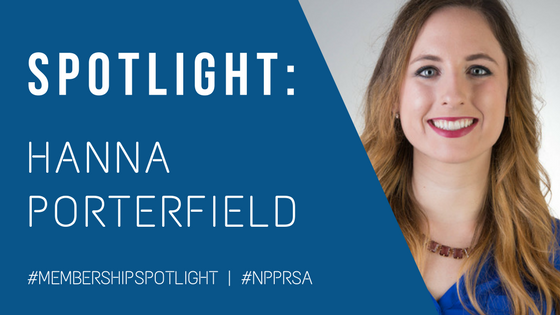
Member Spotlight: Hanna Porterfield

Name: Hanna Porterfield
Position/Company:
Senior Account Executive at Development Counsellors International
Location: New York, NY
Education: B.S. in Advertising and Specialization in Public Relations, Michigan State University
Social Media Handle: @citygirlhanna

How and when did you first become interested in PR and communications?
It’s funny, I was always reading and writing growing up, but never thought of it as a career because I didn’t necessarily want to be author. I began college as a mathematics major, with a goal to be an actuary. While that didn’t work out, loving numbers still comes in handy for calculating results and ROI of work. After changing my major I looked into advertising and marketing. Public relations was a specialization at the time, and the more I learned, the more it became for me. Internships and PRSSA involvement solidified my career choice.

How did you find internships/jobs?
Well, for internships I looked at my college job website and internship websites that I can’t even remember the name of (and they’ve probably since changed and been updated!). The question I think people actually want answered as a new professional is how to find a full-time position that will launch their career. For this, it takes time; looking for a job can be a full-time job, with late nights sending resumes, cover letters and follow-up notes all while you’re in school or working. I suggest setting up job alerts so that you can get potential positions emailed to you and all of your time isn’t spent going down a rabbit hole searching. LinkedIn and PRSA are good for this. Also think outside the box – literally every type of business needs PR.

I found my first (and current) job by putting my all into it. This means you’re going to have to make sacrifices. For me, that meant setting up 10 interviews during my senior year spring break and paying my way to New York City. When asked in an interview why I wasn’t on the beach, I said I could go to the beach the rest of my life, but I wanted a career in NYC. It paid off and I had two job offers before graduation.

What was the biggest challenge you’ve ever faced in your career? How did you overcome it?
One that comes to mind is when my first boss quit about a year and a half after I’d been at my company. It seemed like the end of the world to have a manager I liked and respected leaving so soon. In the end, it was for the better. Having a team member leave–while probably increasing workload–will ultimately give you an opportunity to step up to the plate and grow. For me, that resulted in my first promotion and an even more supportive manager than I previously had.

What has been the most valuable thing you have learned through classes or experience?
The most valuable things I’ve learned for my career have been though experience, not school, without hesitation. While college classes provide a good foundation, you cannot learn without doing. I cant stress enough the value of internships and your first jobs. When asked to present to public relations classes at my alma mater, I always share case studies of projects I’ve worked on, and try to apply to the topics in their textbooks.

What has been the best piece of advice you have received?
The best piece of advice I’ve received is simply to work hard. My dad instilled the word ‘industrious’ in our family, and that’s really motivated me to work hard no matter what I’m doing, in my career or otherwise.

Do you have any advice for PR pros early in their career?
Keep learning. It’s amazing how much can change in the PR industry just within a couple of years being in it. Read industry news and blogs, and keep any certifications you might have up to date. Bring up professional development budget in your annual salary reviews.

What do you think is the best benefit of PRSA and the New Pros section?
Having a network of PR professionals across the country who are going through similar things as you in their career. From Twitter and LinkedIn to MyPRSA, there’s no shortage of ways to get in touch with other members. While mentors are an important part of your career trajectory, being able to bounce ideas off people who are in a similar role to you, but at a different company, is helpful. Plus, make the connections now and run the world together later!

Is there anything you wish you would have known before becoming a new professional?
Outside of the actual office setting and your first career, I wish I would’ve known to keep balance and that it’s okay to say no to things. I have been extremely involved with lots of organizations during college and since graduating, but am just now learning how to balance priorities and make time for myself. You need time to rejuvenate to thrive. Put your all into organizations and side projects you’re passionate about, but don’t spread yourself too thin. For me, serving PRSA is one of those priorities.

Name one little-known thing about yourself.
I won my hometown’s Punt Pass and Kick in 6th grade for females and went on to the regional competition.

Hanna Porterfield is Chair of PRSA’s New Pros Section and a senior account executive at Development Counsellors International in New York. She is a graduate of Michigan State University. Connect with her on Twitter @citygirlhanna.

Porterfield,Hanna_headshot2017

If you are interested in being featured, or interested in nominating someone to be featured as a part of our #MemberSpotlight blog series, please complete the following form. Or reach out to us via email at prsanewpro@gmail.com.

Managing Up: What Does That Even Mean?

Stat: 85% of millennial managers worldwide have moved into management in the past five years (Ernst & Young).

Coming from a new professional classified as a millennial, and who recently moved into a management position last year, this is a terrifying daunting statistic.

Making the transition from an early-staged new professional to a mid-level new professional can happen before you even realize. Nonetheless, you still must be prepared as you make this transition to set yourself up for success (and ensure minimal stress-induced sugar binges).

What could this new transition include . . .

Overseeing staff? Say what?

Giving hard feedback instead of only receiving it? You’ve crossed the line, Greg!

Managing up? What does that even mean?

These are all questions we have to face as we produce solid work and move up the professional ladder, whether we’re ready or not. Let’s focus on the last of those three facets of mid-level new professionalism: managing up.

I was fortunate enough to deliver a presentation at 2017’s PRSA International Conference with two of my fellow colleagues (“colleagues” is what you say when you’ve transitioned into mid-level new professionalism, by the way) from the PRSA New Professionals Executive Committee. The topic in which we delivered captivating content to our session attendees? You guessed itmanaging up.

I’ll let you look over the presentation on your own time HERE (there are some pretty interesting stats and tips in there), but I want to pull out two main points:

  1. Managing up, the act of managing upwards to your superiors, is not something that’s often taught outside of real-world experience (and even that’s if you’re lucky).
  2. When done well, managing up takes foresight, strong two-way communication and a grounded perspective.

“But Greg, you say it’s only taught in the real world? I’m in dire need of this skill; where can I learn more?!”

Well, I just happen to know of the perfect event to recommend and it’s coming up next Wed., Jan. 24 from 3 – 4 p.m. EST in the form of a virtual teleseminar!

This session, PRSA New Pros’ first of the year and entitled Maximize Your Career Potential by Learning to Manage Up, will be presented by Scott W. Thornburg, APR.

This session is a crash course on managing up and you’ll end being armed with tangible takeaways! I met Scott last October and I’m so excited to hear what advice he’ll be offering attendees. Needless to say, I’ll be showing up with my Do Not Disturb active on my phone and the door shut to my office (no distractions, you know, as a mid-level new professional you’re now being pulled in 200 different directions both upward and downward).

>> REGISTER FOR THE TELESEMINAR HERE <<

So register, buckle up and get ready for a worthwhile learning experience to rock your mid-week next Wednesday.

With that kind of hype, how could you not register?

jan-24_teleseminar

greg-rokisky

Greg works full-time as the Marketing Manager for the Michigan Association of School Boards, as well as a freelance creative services consultant. With several years of strategic communications experience, he specializes in digital and creative marketing and public relations. His experience spans agency, corporate and nonprofit arenas. He serves as the social media co-chair for both the New Professional and Association/Nonprofit PRSA sections. When he’s procrastinating not working he enjoys pretending he’s Twitter famous @GregRokisky and checking off items on his never-ending Goodreads shelves.

Answering The Tough Questions

Weighing the ethics of any situation may seem like something better left to those with more experience under their belts than we New Pros. Questions of ethics are the tough questions.

But being an ethical professional isn’t magically bestowed on PR pros once they have a certain amount of experience. That would be nice, right?

As PR professionals, the closest thing we have to an ethics fairy godmother is PRSA’s Board of Ethics and Professional Standards, or BEPS. BEPS is responsible for developing PRSA’s Code of Ethics and counseling professionals through ethical dilemmas and practices.

Since an ethical professional can’t be born overnight, New Pros has teamed up with BEPS to answer any and all ethics-related questions to celebrate Ethics Month. Throughout the month of September, we’ll be collecting questions from New Pros via this form. BEPS will answer each question and we’ll share the answers in a blog post and across our social media between Sept. 25 and Sept. 30.

Have a question, but prefer to remain anonymous? No worries! Just select that option on the form before you submit your question.

ethics-banner

That’s a wrap!

Thank you for joining us for New Pros Week 2017!

Each year, PRSA’s New Professionals Section puts together a weeklong celebration of PR’s new, aspiring and up-and-coming professionals. Working together with PRSSA and PRSA, we organize conversations and programming that highlight the great things new pros bring to the profession.

This year, we decided to take it a step further and focus not only on our successes and newness, but to explore the opportunities out there for us to grow and learn as we progress through our careers. We worked to build conversations around what we need to know and what we can to to set ourselves up for career-long growth, how we can find and utilize a mentor relationship to grow as PR professionals, what we can do to give back and cultivate future PR talent, and the importance of building and maintaining our networks. In addition to conversations, we created handouts and guides to help members find their own path to success.

If you missed any of last week’s New Pros Week events, don’t worry – we’ve got you covered!

Celebrating New Pros doesn’t have to be limited to just one week of the year!

If your organization or PRSA chapter is interested in engaging New Pros and creating programming for them, here are a few of our tips.

  • Host a special viewing of a PRSA webinar for new professionals
  • Sponsor a Networking Mixer or Happy Hour at a popular local restaurant or bar
  • Coordinate a job fair or career connection event for new professionals
  • Host at an event or workshop at a local company or agency
  • Create a mentor program
  • Host a happy hour or meetup around one of our upcoming programs