
Intro to Government PR by Doug Matthews

I’ll be honest. I never made a formal decision to get into government communications. Would you believe that I was actually a forensic science major for my first two years of school? Yep. I wanted to be CSI before David Caruso inexplicably made it seem cool. Now, how David Caruso and “cool” found their way into the same sentence is a subject for another time. Suffice it to say, I’m a bit of a nerd at heart.

It was a combination of life experience, timely opportunities and great mentors that guided me to where I am today, and I couldn’t be happier with the result. So here’s my first bit of advice: create your own opportunities, but don’t get so focused that you fail to see the new, unexpected ones that present themselves along the way.

I joke that I was “infected” with the public service mindset. I blame my parents. My father was a career law enforcement officer and police chief, and my mother was an emergency room nurse. The first “marketing” I ever did professionally was working at the city pool, getting families to show up for “Dive-In Movies”…in between fits of whistle-blowing and telling kids to “walk, not run” on the pool deck.

So, after an epiphany while sitting in Applied Calculus II (another interesting, albeit off-topic story), I left class and changed my major to advertising and public relations. I secured my first internship as a sophomore doing marketing and events for the county recreation department. (Another aside here: get as much job experience as you can before you graduate–it’s the single best thing you can do to differentiate yourself from the thousands of other job-hunting graduates entering the work force.)

I continued that work until graduation, with a short stint in between studying in London and interning with Fleishman-Hillard. It was during this venture into corporate public relations that I had my second epiphany. The assignments were interesting enough, and the people were great, but I had trouble finding satisfaction with the work I was doing. For me, there was a satisfaction and fulfillment that I got from serving the public that I didn’t get when serving a client or a private industry.

That’s something I love most about this career: the absence of a traditional “target market.” Sure, you’ll always have specific audiences for specific programs, but government service is a great equalizer. After all, everyone needs their garbage picked up, right? And every one of you expects the lights and sirens to arrive when you call 911.

There’s also unbelievable variety in what our team does. I mentioned garbage collection and public safety, but we also do engineering. We do public health. We manage parks. We build roads. The work we do truly touches the lives of everyone who lives here in Austin and I get to be a part of that. We help people understand, appreciate and connect with the products and services they have invested in as taxpayers. We help make good government.

In my role, I get to be both the PR pro and the media pro. We run an in-house agency, with teams spanning media relations, Web development, employee communications, project management, community engagement, marketing, events and interactive media. We have our own television station and graphic design shop. The opportunities for learning and development are limited only by your desire and willingness to expand your horizons. The work environment is what you make of it: there is more space to try new things and take risks than you might think!

We do, though, have to talk about the other side of that coin. When you sign up as a public servant, you do so with the understanding that virtually everything you do is public. The work you do belongs to the taxpayers, and they can be a fickle and demanding audience. Likewise, there’s always an undercurrent of politics. Ultimately, my boss (the city manager) works for seven elected officials, so you can’t escape it. You can, though, maintain a distinct line between political and professional communication.

If it sounds interesting, you can start by looking for internships in your local jurisdiction. I learned as much interning with Orange County Parks & Recreation as I did in four years of coursework. Get involved with the International City/County Managers Association or the City/County Communications and Marketing Association. Look into public administration and public affairs courses as a supplement to your normal coursework.

The work might not be for everyone, but for someone with the passion to serve, a love for the art of governing, and the willingness to wear virtually every hat in the haberdashery (or millinery), there’s not a better job on the planet. 


Doug Matthews is an 18-year veteran of local government communications, currently serving as the chief communications director for the City of Austin, Texas. He served similar roles for the Florida cities of Largo and Clearwater before becoming an adopted Texan in 2009. He holds a master’s degree in public administration from the University of South Florida.
PRSA New Professionals Section 2012 Executive Committee

After a year of outstanding growth and participation in the New Professionals Section led by a group of passionate young PR professionals, we would like to welcome the members of the 2012 Executive Committee. Some are veterans of the Section, and some are new faces, but all are enthusiastic and optimistic for the coming year. Big thanks go out to the 2011 committee, and especially immediate past chair Sarah Siewert, for their leadership, commitment and fresh perspective, which positioned New Professionals as PRSA’s biggest Section in 2011. The 2012 Committee will strive to build upon the foundation they have laid out for another successful year.

This year, the Section has a diverse group of individuals from a range of PR specialties, companies and geographic location. Each committee member brings with them a different viewpoint, and as a way to introduce them, we asked–what is your favorite thing about your city?

The thing I love about Dayton (Ohio) is that it provides a combination of “city” life and a quiet, little suburbia town (living in Centerville). Everything that I want/need to do is within a 10-minute driving distance and there’s a nice mixture of nightlife, museums/theaters and great places to eat! It’s also just a short drive to Cincinnati or Columbus if I need a little something extra (like baseball games)!Leah Moon, Section chair

Woolrich, PA – “The best of both worlds” – For those who love the outdoors, I’m right beside the Pine Creek Valley. The views from the peaks and valleys are breathtaking, not to mention the opportunities for kayaking, biking, fishing, camping, etc. How about that city life? I work in Williamsport, PA, which was just recently listed as the 7th fastest growing city in the United States! Trust me, there is a lot of growing space – it’s a very small city. It’s also right across the Susquehanna River from the home of the Little League World Series – we get our few weeks of fame every August!Elizabeth Rhoads, Section chair-elect and programming director

Seattle, Washington: Venture here from May-September and experience why so many Seattleites never move away – the water, mountains and abundance of green are spectacular and make the rest of the year worthwhile. Add in opportunities to work with top-tier technology, healthcare, biotech and aerospace organizations, and it becomes obvious why we’re proud to call Seattle home!-Brendan Hughes, programming co-chair

Philadelphia. We’ve got cheesesteaks, Rocky and, of course, the Liberty Bell. While Philly may have a tough reputation, those who live here know they’ll never trade the lights on Boathouse Row or Citizens Bank Park for any other city. Say what you will about New York or Chicago, but we know it’s always sunny in Philadelphia.–Anna Cramer, social media chair

What I love best about my city is that it’s a big city with a small-town feel.  Charlotte, North Carolina may not be considered a big city to most, but given its popularity,  it has just the right amount of people. It’s not extremely busy, the people are friendly and the community generally cares for each other.–Jamela Wintons, newsletter co-chair

First, let me say that I love the Mitten!  Yes, the Mitten, as in the state of Michigan. The area plays host to great sports teams such as the Detroit Red Wings, Tigers and even the Lions. Music is in its veins, and the art scene is growing. If you’ve not seen a Pure Michigan campaign, you are missing the beauty that is often overlooked when you hear about the city and its surrounding communities. I’ve lived in several communities in the Detroit metro area, and I have an affinity for each one. The best part about the town, regardless of the location, is the people. They are strong and resilient even through tough times.  Without the drive of the people, I don’t believe I would be the person I am today.–Diahnn Henderson, newsletter co-editor

“NEW YORK! Concrete jungle where dreams are made of, there’s nothing you can’t do.”- Alicia Keys. Several musicians have said it best when describing New York as an extraordinary town- if you can make it here, you can make it anywhere. New York City is a wonderful location for a new professional in the PR industry because it offers so many opportunities and experiences that help shape your professional development. From networking to events to top-notch clients and corporations, New York City is a great place to launch a career.Brandi Boatner, mentorship co-chair

Living in Washington, D.C., is a truly an amazing and eye-opening experience. From jogging trails that run by the Lincoln Memorial to spotting the President’s motorcade on a ride to work, it is a city like no other, where residents descend from across the country and the world to make up our nation’s capital. D.C. is great for young professionals to start their careers, whether it be in the nonprofit world, civil service or private sector. Whatever your interests are, there is something for everyone in our little district.Kate Enos, mentorship co-chair

I love that Chicago has so many faces. Besides the fact that there are incredible opportunities for new professionals to learn and grow, Chicago is a great place to live. I really enjoy exploring new neighborhoods, trying out new restaurants and visiting the lakefront running trail. Despite the brutal winter weather (which I’ll often complain about on Twitter), Chicago summers make up for it with street festivals and outdoor concerts.Nick Lucido, PRSSA liason

CHICAGO! Land of deep dish pizza, Lake Michigan and the Cubs: Chicago is a great place for any young professional interested in educating themselves about or working in public relations. Between the many universities offering graduate degrees to the numerous different fields of PR, it’s a city that people can come eager to learn and leave with a bountiful amount of knowledge! I’m happy to call Chicago home!–Alyssa Bronikowski, PRSSA liaison

In what has to be a sign of the times, I don’t have an office. Well, I do, but it doubles as a guest bedroom. When I signed on with a virtual workplace, I had to ask myself where I wanted to set up shop. After thinking about it, I settled on Newburgh, Indiana, about six miles east of Evansville and a solid 90 minutes from the closest “major” city. This place is home for me, but it’s also a fascinating town and area to work from as a virtual worker. The city is big enough to have much of the amenities I would need or like (such as good coffee), but also small enough to feel at home and be familiar with a lot of people. It may not be the biggest or the most glamorous, but it’s home, and that’s the most important to me.–Ben Luttrull, membership co-chair

Washington, D.C.: Though I originally moved from New Hampshire to D.C. to work in PR at a theater, I quickly found that D.C. has many avenues for PR professionals: government affairs, agency work, lobbying, non-profit communication positions and a host of other opportunities. What’s best about D.C. though is that it’s so small! You run into people you know all the time, are able to build a strong network of peers, get to meet accomplished professionals and can go to exciting events on the Hill, at think-tanks, at universities or at other venues. Without a doubt, D.C. has really helped shape my career.–Whitney Gray, membership co-chair

San Francisco: Known for its iconic skyline, steep hills, cable cars, trolleys and the Golden Gate Bridge, San Francisco offers more than just visual appeal: The diversity of its people, variety of restaurants and endless festivals and events make it a cultural hot spot for residents and visitors alike. It’s also the start-up mecca of the world, providing an environment that fosters innovation and entrepreneurship. A fusion of fun and professionalism, it’s no surprise that San Francisco is an ideal city for a new PR pro.Carolina Madrid, diversity chair

The place that I call home is Michigan and I am fortunate to operate around the state, embracing all of which the Great Lakes State has to offer. From catching concerts and sports in Detroit to professional research and alumni support in East Lansing to helping local businesses in Flint, I am proud to be a Michigan resident!–Zaneta Chuniq Inpower, blog co-chair

I’ve had the privilege of living and visiting many cities in recent years, but Chicago will always be the place I call home. The Windy City has more to offer than anyone could experience in a lifetime–from professional sporting events to well-known music festivals and venues, unrivaled food (deep-dish pizza, anyone?) to the best broadway shows. Every day presents something new, all while keeping with treasured traditions. Working in PR in Chicago has opened me up to endless possibilites for fun, networking and growth. Sweet home, Chicago.–Heather Sliwinski, blog co-chair

New Professionals Week: A Hit from Coast to Coast by Elizabeth Rhoads

Young professionals had the opportunity to do everything from mingling at happy hours to getting professional development advice during our first ever New Professionals Week, November 14 through 18. Our #NPweek hashtag took over Twitter for the week, and everyone enjoyed connecting with other new professionals in their area and online.

We are looking forward to New Professionals Week 2012 and are excited to connect with even more Chapters and see what fun, new events will be held!

Special thanks to each of these individuals and their Chapters for all of their efforts in planning and implementing so many successful events in celebration of New Professionals Week:

Rachel Sprung, Boston (@PRSABostonYPN)

Jeana Harrington & Janelle Huelsman, Central Ohio (@PRSAcentralOhio)

Alison Hamer, Chicago (@YPNChicagoPRSA)

Dan Tipton, Delaware (@PRSADE)

Joshua Preister, Detroit (@PRSADetroit)

Emily Geesaman & Anna Cramer, Philadelphia (@PRSAPhilly)

Angi Ramos & Cameron Bays, Puget Sound (@PRSA_yoproCheck out their success!)

Carolina Madrid & Francie King, San Francisco (@prsasanfran)

For more information on New Professionals Week 2012, please contact Elizabeth Rhoads (elizrhoads@gmail.com, @ElizRhoads), programming co-chair.

Intro to International PR: Why Going Global Can (and Should) Be Your Next Career Move by Stephanie Takach

For new public relations professionals looking to get ahead and obtain a unique skill set, getting international career experience is more than a viable option—it’s one that’s becoming a necessity—as organizations increasingly expand outside of the United States. To find out more about what it takes for PR professionals to get experience overseas, I sat down and interviewed Stacie Berdan, an international careers consultant and author of the new eBook GO GLOBAL! Launching an International Career Here or Abroad. Stacie has more than a decade of experience at Burson-Marstellar and later joined Unilever before publishing her first book Get Ahead By Going Abroad.

Stephanie Takach: Why do you think it’s important for PR professionals to experience part (or all) of their career abroad?

Stacie Berdan: Globalization is here and its pervasiveness is destined to expand. There has been a shift in many companies as to where their revenue is being generated–for many it’s in the emerging markets and at increasing percentages. As a consultant or a support function in-house, PR professionals who have a combination of industry skills and international experience can better support their client’s or organization’s global growth.

ST: Are there any unique skill sets that PR young professionals need or should pick up before looking to jump-start their international career?

SB: Acquire as much international experience as possible. Before you graduate, study or intern, join international clubs, practice foreign languages, volunteer or work abroad. Once you’re in the workforce, work on global teams or with global clients to demonstrate that you can work cross-culturally and on virtual teams. If you have foreign language skills, practice. If you have knowledge of or experience with another culture or country, try to get involved in a relevant assignment.

It’s important that young PR professionals build up what I like to call their “toolbox of talents”–working with top-notch professionals at the start of their career. This could be anywhere in the world but requires some thought. Once you have three to four years of experience, you can start branching out and looking for opportunities most anywhere because you will then have multiple offerings: solid PR skills, international mobility and the global skills you’ve acquired.

ST: And what about languages? For PR pros who only speak English fluently, how much of a barrier can that be?

SB: Being bilingual or trilingual is a definite benefit to working in the global marketplace, but it doesn’t have to be a deal breaker. Consider what other skills you have that an organization would benefit from and market them. Exceptional English language skills can prove beneficial in many markets where English is the second or third language to ensure accuracy, but you’ll want to be careful you don’t simply become the editor as opposed to the strategist behind the PR.

ST: What advantages does international PR bring to the table for young professionals? Are there any disadvantages?

SB: International PR provides the opportunity to work at the forefront of the globalization wave, which shows no sign of slowing down. Most internationalists agree that the personal and professional growth is explosive–working abroad for one year usually feels like the equivalent of three in experience. However, the downsides can be the incredibly challenging circumstances you face every day. It’s difficult to live in another country and work cross-culturally every day, in a second language or through interpreters; learning new ways of doing things as well as new regulations, currencies and politics can be draining.

ST: When is the right time in one’s career to go global?

SB: The right time is when you spot the opportunity because there are benefits to going at any stage in a PR professional’s career. If you go early on, you probably have fewer restrictions, yet the flexibility to go anywhere, which many companies appreciate and want, so the opportunities are probably the broadest. If you go mid-career, you’ll have significant talents in your toolbox and can probably step up your game in a smaller or emerging market that needs your professional expertise. This could then transfer to greater responsibility faster to be leveraged in another market or your home market after a few years. If you go as a senior person, you have a great deal of practical knowledge and experience to offer a new market, yet you’ll still need to learn about your new home. It all depends on what you’re looking for, your expectations and your flexibility, which are key in seeking, landing and thriving in an international role.

Is now the right time in your career for you to go global? What challenges or roadblocks have you encountered on your journey to gain international PR experience?

Stephanie Takach is a senior at Drexel University, majoring in communication with a minor in marketing. Takach is also president of Drexel’s Public Relations Student Society of America Chapter and an aspiring PR and marketing professional. Feel free to contact Stephanie on Twitter.

PRSA New Pros Tweetchat – Promoting YOU: PR Tips for Networking, Landing a Job and Moving Up Recap

PRSA New Professionals Section hosted its first Tweetchat last week. Two experts shared advice on the art of self-promotion.

On Tuesday, October 25, PRSA New Professionals Section held it first tweetchat with Meryl Weinsaft Cooper and Jessica Kleiman, the authors of our July Summer Book Club selection, “Be Your Own Best Publicist: How to Use PR Techniques to Get Noticed, Get Hired and Get Rewarded at Work”. #NPchat participants gathered to hear Cooper and Kleiman shared great advice for networking and getting ahead in your PR career.

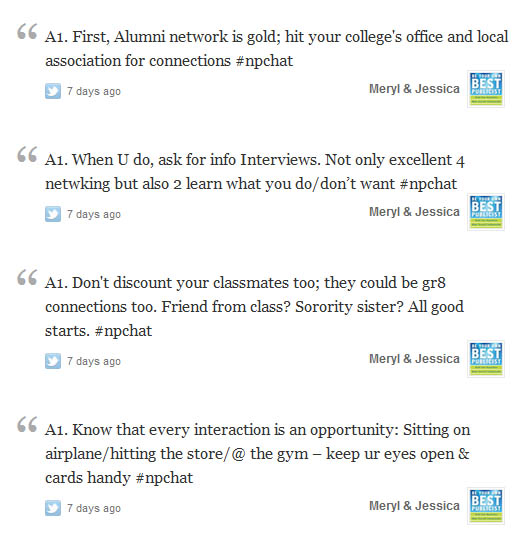
Boy were the tweets moving fast and furiously across our timeline. From the first question to the last, the chat provided valuable advice for recent graduates looking to kick start their career and new pros striving to get to the next level. We kicked the discussion off with best way to network as a new graduate. Here are a few tweets of advice from our authors:

If you weren’t able to stop by our #NPchat or want to access the transcript of the event, click here. The response to this event was positive, and we thank everyone who attended.


If you have topics you’d like to read about on our blog or discuss on a future Tweetchat, comment below, Tweet @PRSANewPros or share on our Facebook and LinkedIn pages. If you really want to get involved, fill out our volunteer interest form and be a part of our 2012 Executive Committee!